impressive gold coin collection.
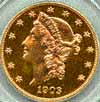 NOTE: Attending coin auctions is exciting. If you’re fortunate, you may also encounter notable collectors with tremendous knowledge. John Dannreuther tells of talking to Harry Bass during one of these auctions and also studying the Bass collection.
 The following is a brief excerpt from an in-depth article previously published by PCGS called “The King of Gold – The Greatest Collection of United States Gold Coins Ever Assembled.”
The remainder of the Bass Collection will be sold by Bowers and Merena in auctions scheduled May 25-26 and November 20-21, 2000.
Harry Bass was a man whose passion was United States gold coins. Starting in 1966, he began assembling a gold coin collection that would eventually include over 6,000 coins. Not only did he collect by date and mintmark, he collected by die variety and die state! Besides being the most complete die variety and die state collection of United States gold coins ever assembled, Harry’s collection is also the finest condition set of all time!
For over 30 years, Harry singled out specimens for his collection, some by private treaty, others through public auction. When he decided he needed a certain coin, his resolve to buy it was immense. Few collectors, other than large cent variety specialists, collected with such passion. Harry was just as interested in a worn 1836 quarter eagle that was a rare variety as a Proof Classic Head quarter eagle. (He bought the run of Proof Classic Head quarter eagles in the 1982 Eliasberg sale – 1834-1837. There was no 1838 in Proof, which I am sure he also would have purchased had it been included in that landmark sale.)
Although Mr. Bass did not assemble a collection as massive as the super collector Virgil Brand, he was just as consumed by the “coin bug.” Mr. Bass left his collection to the Harry Bass Research Foundation, upon his passing in 1998. (This non-profit foundation also provides assistance to the American Numismatic Society.) This collection is an unbelievable legacy to one of the greatest collectors of all time. His seminal work on gold die varieties will propel researchers into the next century. Although he never published his die variety work, his countless hours of study have blazed the way for future numismatists. His notes provide the basis for the identification of most die varieties and numerous die states of United States gold coins.
Harry Bass also had an incredible numismatic library. (This treasure also is part of the Foundation.) He often bought entire collections to obtain one book he desired. His duplicate books and catalogs were sold by noted bibliophile George Fredrick Kolbe, who had to break the 50 plus boxes into four separate sales.
Fellow researcher Doug Winter and I were fortunate to be the first numismatists to view the Foundation’s fantastic collection. In late 1998, I went to Dallas to view the collection. I expected a lot and I was not disappointed. Gold dollars were a short series, 1849 to 1889, so they should easily have been viewed in the six hours we set aside on that nice November day. Wrong! Harry Bass had 635 gold dollars, mostly different die varieties and die states. We were able to view over 500 coins, but a second visit was required just to finish the gold dollars, at which time we also viewed quarter eagles dated from 1796 to 1837.
I did not know Mr. Bass as well as I wished. Most of his coin buying took place in the 1960s and 1970s; however, I do have one Harry Bass story of note. When the Eliasberg gold coins were sold in 1982 by Bowers and Ruddy, the collection was not directly identified as such. It was called The United States Gold Coin Collection. It was not really a secret to most numismatists whose collection was being sold (the collection had been on display several times, including the Philadelphia Mint during the bicentennial celebration in 1976).
I had the good fortune to be seated next to Harry Bass for two days of lot viewing for this event. Mr. Bass brought a great deal of his coin collection to New York City for this auction. He would examine a lot in the auction, then pull out his coin and compare the two. I initially thought he was looking for coins that were upgrades to his examples, but soon realized he was comparing die varities and die states! Although I had not written anything on die varieties at the time, I was interested in them and Harry soon realized this. We spent two days discussing coins, handing them back and forth, and noting specific die information. Among the discoveries made at that sale was the common Proof-only reverse die for the 1846 and 1841 quarter eagles. This was the beginning of my study on common Proof-only reverse dies that was published in the PCGS Market Report.
Mr. Bass always shared information and was, on occasion, a practical joker. We were discussing the 1854 Dahlonega three-dollar issue and I made a comment about how rare the coin is with full denticles. Harry said that he would bring his three-dollar collection the next day and he had one to show me. The next morning I took my seat at viewing and started examining more coins. At some point, Harry said, “Oh, here’s the 1854-D three-dollar coin we discussed.” He handed me a nice Uncirculated coin that had almost no denticles! Not wanting to offend one of the greatest collectors of all time, I smiled and made some small talk about what a nice specimen he had of this elusive date. Harry started laughing and then handed me another coin – the coreect one this time with full denticles, although not in as nice condition. We both laughed and I realized I had seen the humorous side to Harry as well as his choice Uncirculated 1854-D.
Sorry about the digression, but I love to tell that story.
The gold dollars assembled by Mr. Bass are not only the most comprehensive collection ever assembled, they also are the finest condition set known. The collection contains 80 of the 81 major varieties, missing only an example of the ultra rare 1849-C Open Wreath. The average grade is better than 63 and with one coin removed (the 1859-C is low grade), the condition nears 64 quality. As noted previously, there are 635 regular issue gold dollars included. The 1849 Philadelphia issue has three major varieties: the No "L" variety, the Open Wreath variety, and the Closed Wreath variety. The collection contains 44 examples of these three varieties -- all different die varieties or states!
This is a brief excerpt from an in-depth article previously published by PCGS called “The King of Gold – The Greatest Collection of United States Gold Coins Ever Assembled.”
The remainder of the Bass Collection will be sold by Bowers and Merena in auctions scheduled May 25-26 and November 20-21, 2000.
John Dannreuther
is well-known for his numismatic research. He is also the co-author of The United States Gold Coinage Significant Auction Records.
The Bass gold coin collection eventually included over 6,000 coins.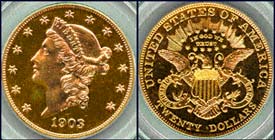


 Copper & Nickel
 Silver Coins
 Gold Coins
 Commemoratives
 Others
 Bullion
 World
World
 Coin Market
 Auctions
 Coin Collecting
 PCGS News