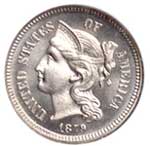
The Proof issues of the Three Cent nickel series are just the opposite of the circulation strikes. Most of the early dates are the rare issues with the late dates quite common. In fact, the most common date in Mint State is the most rare date in Proof! The coins dated 1865 are by far the most difficult date to obtain in Proof. It is not the most rare by condition, but in overall rarity. Its rarity is actually slightly understated as some collections contain Pattern examples of this date. The pattern is easy to confuse with the regular issue, the only noticeable differences being the date placement and ribbon size. The pattern has the date placed near the bust and has over-sized ribbons that overlap the denticles. The regular issue has the date low and normal ribbons. Besides this difficulty, planchet flaws plague many Proofs of this date. Novice collectors often confuse these "chips" for marks, and, although they are viewed negatively by PCGS, unless they are large or in conspicuous areas, they do not "punish" the grade as severely as marks or hairlines. The same is true for lint marks for the entire Proof series. They also are not viewed very negatively unless they are large or in obvious areas. Most Proofs have deeply mirrored fields contrasting with heavily frosted devices. All are found with re-cut dates.
1866 Proof Three Cent nickels are nearly as rare as the 1865. The population data bears this out with 178 graded of the 1865 and 231 graded of the 1866 (June 2001 PCGS Population Report). They are not only similar in rarity, they are similar in appearance. Frosted devices over hard mirrored fields, often pockmarked by planchet flaws. This is a very difficult issue to find in PR-66 or better condition. It is priced near type price in the lower Proof grades, thus it is underrated in all conditions.
Only slightly less rare than the 1865 and 1866 in the lower grades, the coins of 1867 are similar in look to these two issues. It is actually slightly harder to find than the two previous years in grades of PR-66 and higher. There are slightly fewer planchet flaws seen for this year with slightly better quality control for the planchets. As noted, it is very tough to find in PR-66 or better and is considered one of the keys to completing a high grade date set in Proof.
The coins of 1868 in Proof are very similar to the 1867. With only 184 total coins graded (June 2001 PCGS Population Report), it ranks second among the Three Cent nickels in all Proof grades. It is found with deeply mirrored fields and only slightly less frosted devices than the 1865-67 years. Again, this is a very tough Proof issue, especially in the higher grades.
Of the issues of the 1860s, the 1869 coins are the most available in all grades. However, it is one of the tougher dates for the total series. In grades of PR-66 and PR-67, it is of comparable rarity to the 1867 and 1868, although there are several PR-67 examples of this date, while there are currently none graded in that lofty grade for 1867 and 1868. It is similar in overall appearance to the 1868 with good mirrors and medium frost on the devices. The small planchet flaws are not as often seen as with the prior years.
Starting with the year 1870, striations, or die polish, become a commonplace occurrence with Proofs. Many 1870 coins display these fine lines, especially on the reverse. These are often confused with hairlines, but the test for determining the difference is easy with a little practice. When tilted in a good light source, hairlines "move" and usually criss-cross, while die polish lines are "fixed" and mainly run parallel to each other. Finding deep mirror, nicely frosted examples is difficult but not impossible; still, this is one of the keys to finishing a high grade Proof set. There are only 9 examples graded PR-66 and not a single example in PR-67 graded by PCGS by June 2001.
Most 1871 Proof Three Cent nickels have light to heavy die polish. This makes examples with deep mirror fields and frosted devices very difficult to obtain. If one will accept the fine die polish, an acceptable coin can be located. "Pockmarks" on the face (and in the fields on some coins) also make high-grade examples tough to locate. This is another of the tough Proof issues, especially in the higher grades.
The coinage of 1872 is slightly better in most respects than the previous two years or the following two years. Most examples have fairly deep mirror fields and decent frost on the devices. However, there are still very few high-grade examples. Finding PR-66 or better examples is very difficult and it ranks in the top five for the fewest number of PR-66 or better coins (June 2001 PCGS Population Report).
Back to the future, whoops…I mean the past, for this issue. Many, if not most, of the 1873 Closed 3 Proof issue have the fine die polish noted for several of the earlier years. The reverse is especially plagued by this "problem." Since so many of this issue have this phenomenon, collectors and dealers have adjusted. Finding a superb example is quite difficult and this is another of the keys to the date set of Proofs. This issue is tied with 1875 for the least number of PR-66 coins graded by PCGS by June 2001. The 1873 issue has a single PR-67 example graded. As noted under the circulation strikes, Proofs of this year are only found with the Closed 3 date logotype.
The next year, coins of 1874, are slightly more available without the fine die polish, although numerous examples also sport these. High-grade examples are tough with frosted devices and strongly mirrored fields. This is another key to the Three Cent nickel date set of Proofs.
The most heavily polished date of the Proof series, the 1875 coinage is scarce without die polish. Many examples have both obverse and reverse striations. In fact, more coins of this date in Proof have been called Mint State than any other date in the Three Cent nickel series. It is very tough to find nice, although PR-65 coins are available, PR-66 and above examples are extremely rare. In fact, it is tied for first with 1873 for the least number of PR-66 examples (June 2001 PCGS Population Report) and does not have a single PR-67 graded as of that report. A key of keys among the coins one needs for this Proof series.
The Mint seemed to figure out the "problems" in 1876 as most Proofs of this date have good frost on the devices and fairly deep mirror fields. However, it is still difficult to find in high grade, as seen by its overall rank among the other dates - it is the fourth toughest date to find in PR-66 or better.
Although the 1877 Proof is considered one of the keys to the set, it is easily available in the higher grades. The fact that it is a Proof-only issue with a reported mintage of 510 has put tremendous date pressure on the survivors. Most examples are very well struck with frosty devices. The surfaces range from slightly frosty to deeply mirrored and price is the only obstacle to obtaining this very popular date. This is first year that beautifully toned examples are very plentiful. It seems that from this year forward, many Three Cent nickel Proofs were stored in the Mint paper that contained quite a bit of sulfur. This resulted in a gorgeous blue coloring for those coins stored in this way. Noted dealer Art Kagin once told me a story that might shed some light on the number of colorful survivors of the late date Three Cent nickels. In the 1930s, he bought hundreds of three-piece "Proof Sets" that contained an Indian Head cent, a Three Cent nickel, and either a Shield or Liberty Head nickel. These were in their original wrapping and were superbly toned. By the way, he paid a dollar a set and sold them for two dollars a set! As he recalled, it only took him six or seven years to sell the whole group!
As with the 1877, the 1878 coinage is readily available in the higher grades. It is almost identical in strike, reflectivity, and frost. This date can be obtained for only slightly more than common-date price with some searching, and, as such, is underrated, since there were but 2,350 were struck for this Proof-only date.
Starting with 1879, Proofs are consistent in grade, price, strike, reflectivity, and degree of device frosting. This is a very common coin in PR-66 and better and can be obtained for the type price.
As noted under the circulation strike discussion for this date, 1880 Three Cent nickels are common in both Mint State and Proof. However, the designations for each are often confused. One can obtain obvious Proofs without difficulty and high-grade examples are plentiful.
The 1881 Three Cent nickel has the highest mintage among the circulation strikes and the Proofs are among the easiest to find of the post-1877 issues. Frosted devices and hard mirrored fields are available enough and high-grade examples are available for type price. This is the third most common date Three Cent nickel in PR-66.
1882 Proof Three Cent nickels are very available and are often found with the blue color noted under the discussion for the Proofs of 1877. Frost, heavy reflectivity, and virtually no marks or hairlines are the norm. This is an excellent type coin for those collectors who do not collect the entire series, as it is the second most available coin in PR-66 and the most available in PR-67 and PR-68.
The 1883 Proof Three Cent nickel has the highest mintage of the series with 6,609 coins struck. The number of high-grade 1883 Proof examples bears out this fact with PR-66, PR-67, and even PR-68 examples available for type price. Exquisite blue toning is found on many of these and one will have no trouble filling this hole in the set. This is the most available date in PR-66.
With 1884, one only needs to note that the number of Proofs struck is 3,942. The rest of the story is found under the discussion for 1883, except that it is less available in PR-66. Strike, reflectivity, and degree of frosted devices are nearly identical to 1882 and 1883.
The 1885 Proof coinage is nearly a ditto of the 1883 and 1884. However, there are slightly fewer high-grade examples. The other factors are nearly identical except that many Proofs of 1885 exhibit weak denticles, as do the circulation strikes as noted above.
A Proof-only date, 1886 coins should have a greater premium than they do (the fact that it has the second highest mintage of the series - 4,290 - is the culprit for its lack of respect). It is often priced at nearly type price and, as such, is underrated. One should have little difficulty in obtaining this issue and should not have to pay but a pittance above the type price, which makes it a definite bargain at the present time..
Interestingly, the 1887 and 1887/6 Proof issues combined are the toughest Proof issue of the 1880s. The overdate of this year, the 1887/6, probably is about as common as the non-overdate. However, not much of premium is charged for either, although many dealers charge a little more for the sexy-sounding 1887/6. Both coins are found with great surfaces, good frost, and great eye appeal. Both can be obtained for slightly over common type price. The 1887 and the 1887/6 Proof issues occasionally display weakness in the denticles and rim.
The 1888 issue is a common coin in all Proof grades. It is found with frosted devices, strongly mirrored fields, and superb eye appeal. It is only slightly less available than the 1882-1884 group in PR-66 and better - it trades for the type-coin price.
As the last year of issue, the Proof 1889 Three Cent nickel was saved by collectors of the era. Thus, it is found with ease. There is one variety of this Proof that has a die crack, one of the few middle date coins (1840-1917) issued with a die crack in Proof state. This was common on early Proof issues (1817-1839), when the Mint usually pulled circulation dies from production and polished them to produce a few Proofs and sometimes placed the dies right back into circulation strike production.
There you have it. The Three Cent nickel series is one of the most romantic, quaint, and collectible series in the field of United States numismatics. With a little patience, one can assemble a nice set of circulation strikes or a superb set of Proofs. This endeavor can be one of the most satisfying aspects of collecting. Completing a series of obsolete coinage is always a thrill and this series is certainly doable.
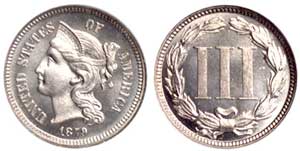
1879 Proof 67 Three Cent Nickel


 Copper & Nickel
 Silver Coins
 Gold Coins
 Commemoratives
 Others
 Bullion
 World
World
 Coin Market
 Auctions
 Coin Collecting
 PCGS News