The slowing economy is being felt from Wall Street to Venice Beach, and the rare coin market is no exception. Even so, coins are performing extremely well in many areas, and excitement is still rampant in the game of "find me the best."
"The impact of the PCGS Set Registry has not slowed one bit," says Rick Tomaska of R&I Coins in Solana Beach, California. "Top quality better dates are still in great demand, and the truly rare dates are stronger than ever."
Can you give us an example? "We recently sold a 1951 half dollar is PCGS PR66DCAM [Proof 66 Deep Cameo] for $16,500. This is up about 10% over a piece we sold earlier in the year. Collectors are confident that this is a true rarity, so they don't mind paying the money to get it. Some of the more common issues (1956, 1962, 1963) are the same price that they were two or three years ago, but the demand for the best is unabated."
How far back does the demand go? "The interest in DCAM coins of top quality goes back to the 19th century coins. These coins have tremendous eye appeal, and it's exciting to find examples that show the Mint's original intent."
"The market is doing well, especially when you consider the threats of recession," says Donald Kagin of Tiburon, California. "Money is definitely tighter, but there's a lot of enthusiasm about buying and collecting coins.
"Pioneer gold is strong, and this is unquestionably because of the interest created by the S. S. Central America coins, bars and related material. The strong publicity these items have received has brought numerous new collectors into the market."
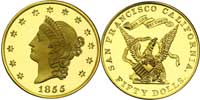
When I attended the ANA Convention in Portland, Oregon, a few years ago one of the most memorable aspects of the trip was viewing the original dies that were used to strike the 1855 Kellogg $50 gold pieces. Not only were the dies not canceled (which is highly unusual), they were also in pristine condition. Those same dies were recently used to make transfer dies for the production of restrikes of the rare Pioneer issue, with the gold planchets made from original Kellogg & Humbert bars that were recovered from the S. S. Central America.
"Transfer dies were made and used because no one wanted anything to happen to the originals," Kagin said.
The coins were produced under the supervision of the California Historical Society in cooperation with the California Marketing Group, headed by Managing Partner Dwight Manley. "We purchased the dies," Manley said, "and they're not on loan to us as has been written elsewhere."
Manley was gracious enough to show a sampling of the pieces that have been produced so far. There were "circulation strikes" and magnificent cameo Proofs.
The minting of the coins has not been completed, but the total mintage of the two formats will not exceed 5,000 coins. "I would estimate that there will be 4,500 Proof coins and 500 uncirculated coins produced," Manley said.
I also spotted two coins that had been rejected for certification by PCGS. What's going to happen to those? "They're going to be melted," Manley said. "Any coin that isn't an absolute Gem will never be offered on the market at any price."
There's lots of controversy swirling around the amazingly popular Buffalo silver dollars. First of all, the Mint is undecided as to whether or not to produce more. The original issue sold out immediately, and there's a tremendous after-market, especially for the PR69DCAM and MS69 pieces. Another 250,000 pieces may (or may not) be struck.
There are also questions about the inconsistency of the finish of the "circulation strike" coins, as some are bright and vibrant and others are dull. A statement directly from the Mint proclaims: "The process was consistent with previous silver (Uncirculated) programs completed by the Denver Mint. No unique treatment was made to the silver blanks or dies. All Denver Mint processes were similar to past programs."
This is an interesting statement following the recent controversy about the different finishes used on Sacagawea dollars and the Mint's disclosure that the Buffalo dollars required "...three strikes to stamp the image for acceptable fill and detail." The circulation strike commemoratives usually receive only one or two strikes, with the three strikes (or multiple strikes) reserved for Proof coinage.
 September 14 and 15, 2001, are the dates for the Bowers and Merena Galleries auction of the Tree Many Feathers collection. This spectacular sale is something that you don't want to miss! To view lots and/or to bid online, click here.



 Copper & Nickel
 Silver Coins
 Gold Coins
 Commemoratives
 Others
 Bullion
 World
World
 Coin Market
 Auctions
 Coin Collecting
 PCGS News