An unexpected discovery was made by PCGS experts as a coin show wound down.
The American Numismatic Association’s Pittsburgh World’s Fair of Money® was winding down early on Saturday afternoon, August 21, 2004, when my mobile phone rang. The first excited words from the caller, PCGS Director of Education Michael Sherman, were an enthusiastic command: "Whatever you’re doing, stop. This is more important."
It certainly was!
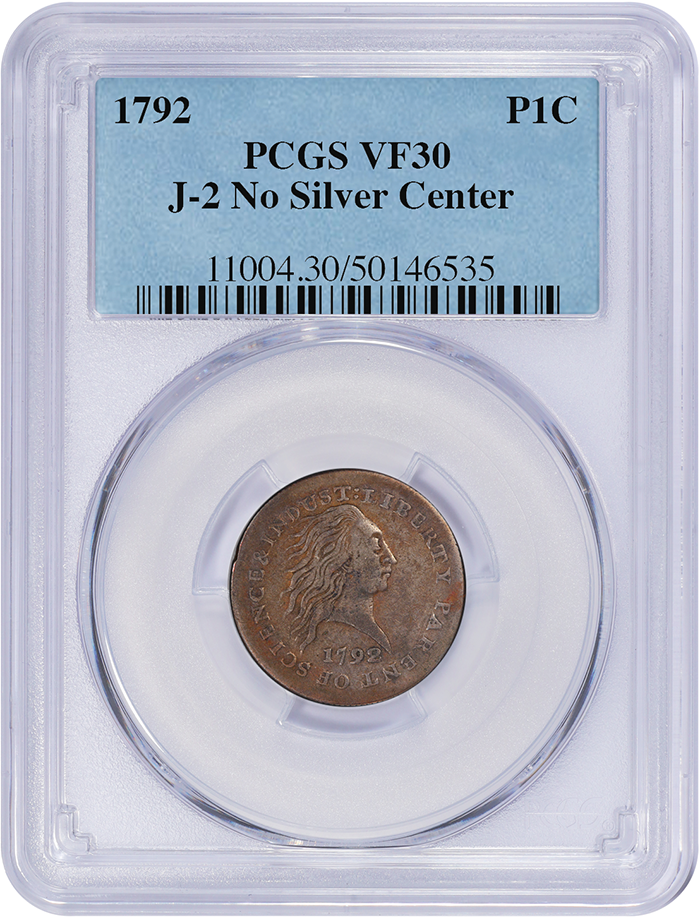
A family from New York State had arrived at the show a short time earlier with a handful of coins that were in the family for at least three generations, all stashed for decades in grandfather’s Prince Albert tobacco can. One of the heirlooms was a previously unknown example of a rare, experimental early American coin, a 1792 No Silver Center large cent (Judd-2). It was authenticated and encapsulated on-site as PCGS VF30 just a few minutes before Sherman’s ecstatic phone call.
This previously unreported coin became only the ninth known example of the historic pattern.
"Judd" refers to Dr. J. Hewitt Judd, author of the reference guide, United States Pattern, Experimental and Trial Pieces. Coins listed in the book are classified by Judd numbers, such as this 1792-dated coin’s designation as J-2.
PCGSCoinFacts.com, the Internet’s most comprehensive source of information about United States coins, points out that 1792 was a busy time in early American numismatics. Congress passed the Mint Act, David Rittenhouse was appointed the first Mint Director, land was purchased and the Mint building was constructed and employees were hired.
Four different one-cent denomination coins were tested in 1792: a large copper piece known today as the Birch Cent, named after its designer Robert Birch; a smaller copper piece with a silver center; a similar design cent in pure copper; and a piece of similar size with the copper and a silver center melted together in what is known as a fusible alloy.
Mint engraver Henry Voight designed both the J-1 Silver Center cent and the J-2 No Silver patterns in 1792. The following year he created designs for the famous 1793 Chain and Wreath large cent varieties.
When owners of the J-2 cent brought it to the PCGS booth at the 2004 ANA Pittsburgh show they explained they remembered how their grandfather kept it in a Prince Albert tobacco can along with about a dozen other old coins. When their grandfather died in 1976, their father placed the tin can and coins in a small safe in the corner of the living room of their usually unlocked home in upstate New York. Since 1989, the coins were kept in a bank vault.
In addition to the on-site PCGS authentication and grading team...
To continue reading this article please visit the digital version for the Current Issue. You will be prompted to input the email address on your PCGS profile. All current PCGS Collectors Club members will have free access to the Rare Coin Market Report. To purchase a single issue or 1-year subscription, please visit the RCMR Homepage.
If you are not a PCGS Collectors Club Member and wish to join please visit our Membership page at www.pcgs.com/join.
Author Bio: Las Vegas-based publicist Donn Pearlman is a former Chicago broadcaster and recipient of the American Numismatic Association 2015 Farran Zerbe Award and the Professional Numismatists Guild 2018 Lifetime Achievement Award.


 Copper & Nickel
 Silver Coins
 Gold Coins
 Commemoratives
 Others
 Bullion
 World
World
 Coin Market
 Auctions
 Coin Collecting
 PCGS News