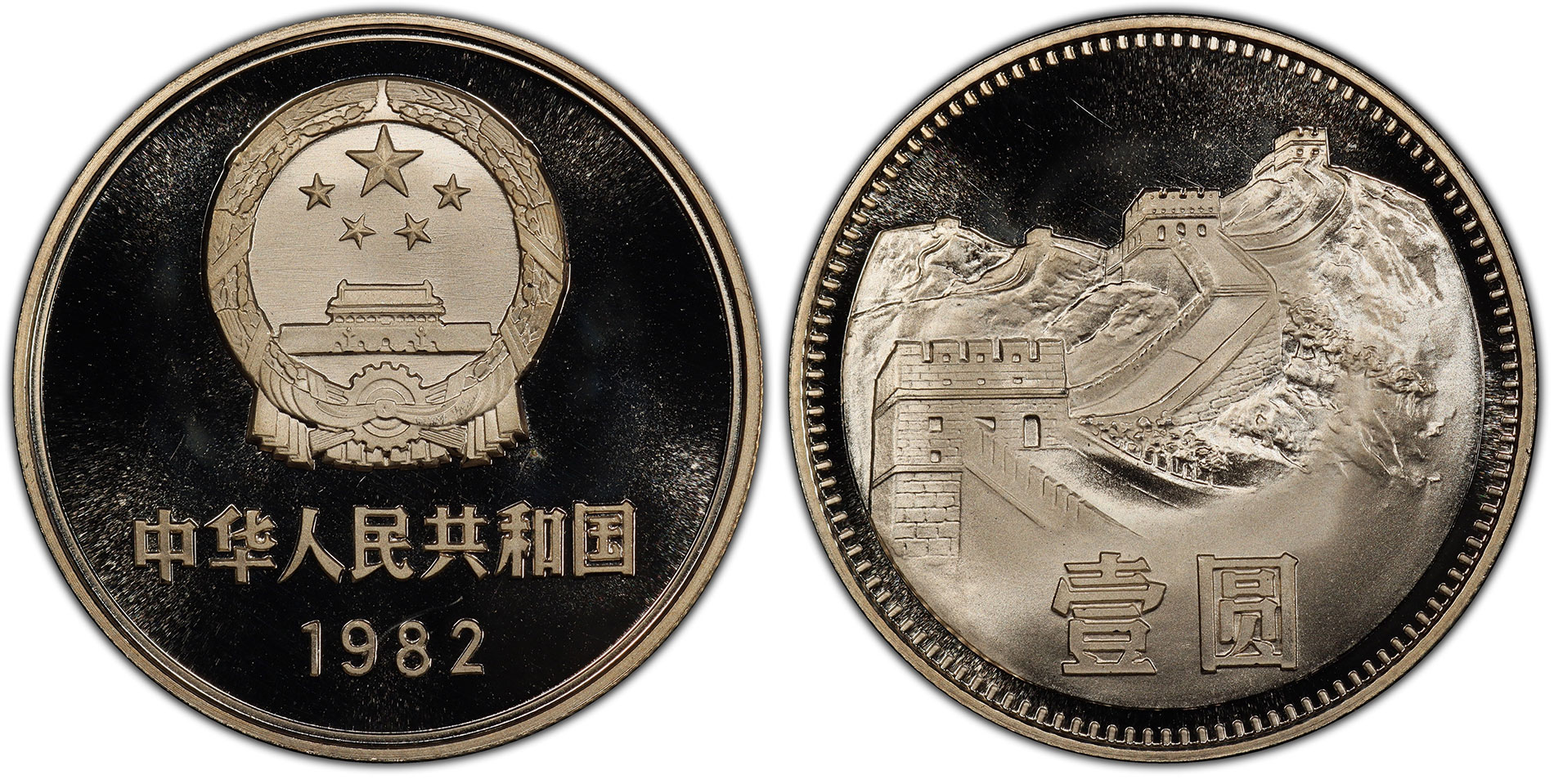
When I had started out as a dealer over 10 years ago, I was trying to make as many connections as possible to source coins. With some sleuthing I found someone who had access to parts of the Franklin Mint inventory after they wound down operations during the early 2000s. I was offered a bag of 714 China 1 Yuan coins for $1.50 each, which would be, for me, $1,071 for the entire bag. I offered him $1,050 for the group. He immediately accepted my offer. I saved a whole 1.96% on the entire group. Negotiating wasn’t one of my strong suits back in the day, but I’m much better now.
I drove back to Bridgeville, Pennsylvania, with my father, who accompanied me on the trip. Once we got back home, I started looking through the Uncirculated pieces that were purchased. One coin caught my eye particularly – it had a mirror-like finish, some frosting, and very sharp relief. When I started looking through more coins, I would occasionally spot another one of these coins, which I determined were to be proof. Proof! I ended up finding a little under 10 proof pieces and sent them all to the grading service for encapsulation.
I sold all the 1981 1 Yuan Proofs on eBay for a little over $200 each and the coins were a little chattery. Most of them graded PR63 and PR64. What puzzled me the most though was how in the heck did these proofs end up with circulation strikes? These were $200 coins in the same bag as the $1.50 coins! Could the Chinese Mint have dumped their excess inventory of 1 Yuan Proof coins in with the circulation-strike issues? This would remain a mystery to me up until 2018.
I had been chatting with Jim Anderson at the past 2021 American Numismatic Association World’s Fair of Money. He’s been in the coin business for several decades. Jim is also an auctioneer that calls lots for Stephen Album Rare Coins (SARC), which is in Santa Rosa, California. In addition to Jim’s full-time business, he’s been an active dealer as well when time permits and has been traveling back and forth to China for several decades from his home base in California. I’ve known Jim since 2013, and in 2018 we were randomly having a conversation about Chinese Proof Sets of the past, which we never got to finish.
The following conversation took place on August 13, 2021, which Jim allowed me to record and transcribe:
Sanjay: “Jim, one time we were at a show, and we were talking about 1980 or 1981 Proof Sets? I can’t remember...”
Jim: “Yep, there are several dates in the [19]80s.”
Sanjay: “They we’re trading for how much the last time we had spoken? $1,000?”
Jim: “It depends on which year. 1981 trades for around a $1,000.”
Sanjay: “At one time, you mentioned that you had several hundred sets in your possession. How did you come across them?”
Jim: “I had 500, 600 sets at one time. Well, I was traveling back and forth to Shanghai, and these sets were for sale in what were called the Friendship Stores. You could only buy things with hard currency. There was a separate currency called “FEC” which stands for Foreign Exchange Certificates that locals could not get. But, if you had FEC, you could buy Marlboro cigarettes, Budweiser beer, or some of the electronic goods or things that had to be imported with hard currency.”
Sanjay: “We’re these Proof Sets for Friendship Stores only or for tourists or not.”
Jim: “No, not really… Maybe they were developed then, and according to the wording, these coins were from the People’s Bank of China, China Mint Company, but it didn’t have a cute tourist theme. The sets are bilingual and the sets display both English and Chinese on the packaging. I’m sure they had the tourist in mind and the sets cost 6 FEC, which was equivalent to one U.S. dollar.”
Sanjay: “One U.S. dollar?”
Jim: “Yes. When I bought these in the late ‘80s, the sets were dated 1981, 1982, and 1983. I never really looked at the dates and just bought stacks of them.”
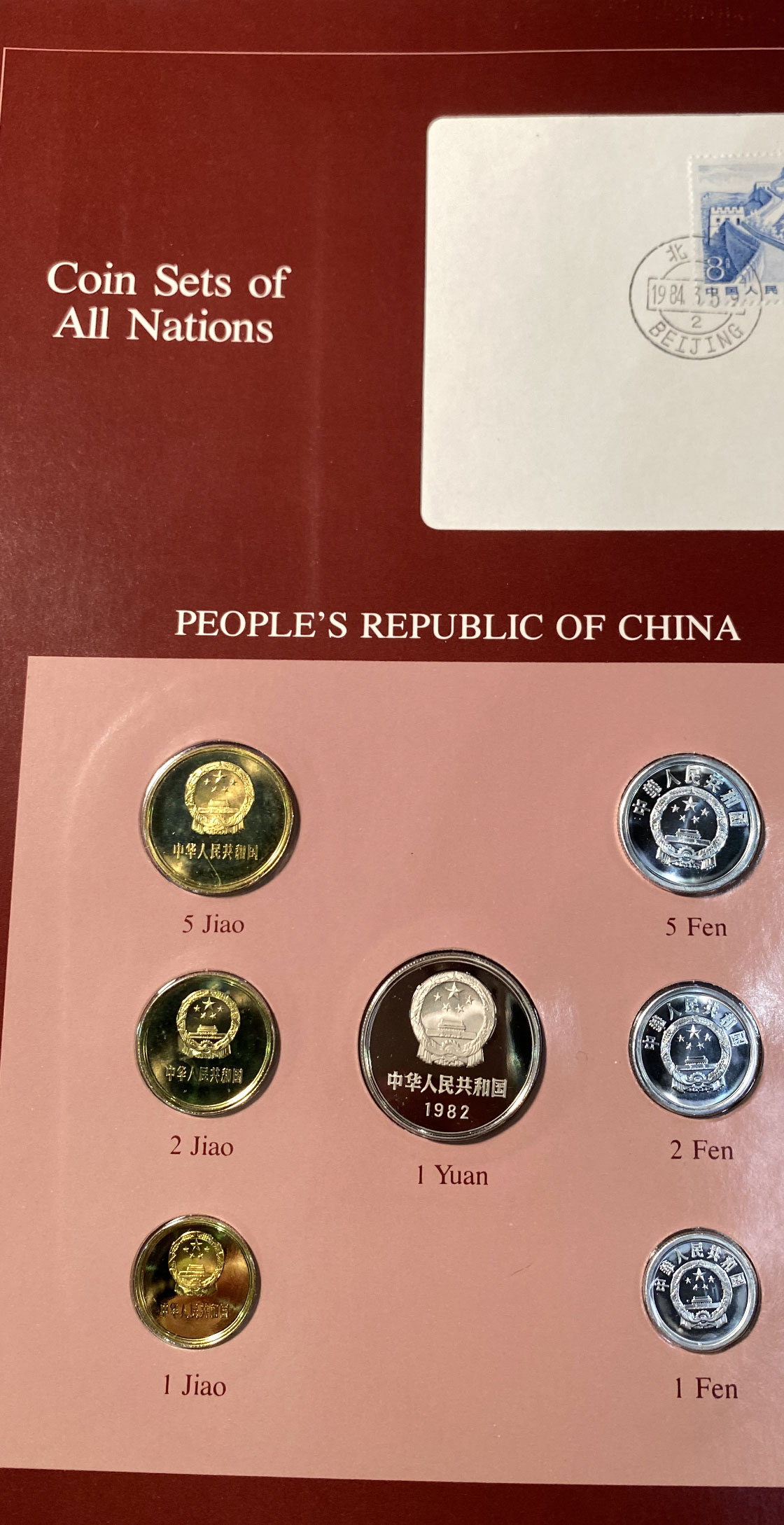
Sanjay: “What year did you purchases these sets?”
Jim: “I bought these between 1986 and 1987. In those days I would go once or twice a year to China. I would do a little coin trading in those days, which was small potatoes. I showed the set to a Chinese dealer and told them I was paying 6 FEC for these sets and they were appalled that I would pay that much for these sets. The face value was 1.88 yuan at that time, and I was paying 6 FEC. Not only was I paying a premium, but I was also paying in foreign exchange which had a 25%-30% premium as well. He was so appalled at how foreigners would pay $5 for a $1 bill. He thought we were silly.”
Jim: “I had them with me when I first started setting up as a coin dealer at the Long Beach Coin Show in about 1987. I didn’t have much to sell and didn’t quite know what I was doing. I had these sets out and was going to sell them for $3, just those cheap sets.”
Sanjay: “That’s a 200% markup!”
Jim: “Yeah, no one seemed to want them and as time went on and I needed some money. I didn’t have much security, there was no market for Chinese coins, and a guy came by that owned Educational Coin Company.”
Sanjay: “In New York.”
Jim: “Yeah, David Laties, we talked back and forth about these Chinese Proof sets. He asked, how much for all of them, and I quoted him $2.”
Sanjay: “You doubled your money.”
Jim: “Well, yeah, but keep in mind the transportation cost to China, which is 10,000 miles away. So anyway, he bought the whole stack of them, and they went away. Years later, when I would start to buy these Franklin Mint sets, Coin Sets of All Nations, occasionally, the sets would be proof sets – 1981 or 1982 proof sets. And that’s apparently what happen. I understood from David Laties that he sold the whole batch to Franklin Mint.”
Jim: “It was hard getting to China, hard getting BU [Brilliant Uncirculated] coins and sets, and everything was bureaucratic. This was a fairly easier transaction just to buy these sets.”
Sanjay: “And those sets after they went to the Franklin Mint, they retailed for maybe, I’m not sure, $37.99 or $34.99.”
Jim: “Oh yeah when they were issued, I didn’t subscribe to it, but one country could be $19.99, $29.99, and $39.99. They were marketed with different prices and these Chinese Proof Sets were not $100 back then when they were marketed. These coins were not sold at a premium because they were proof, because I’ve seen some since then and sometimes there will be one or two proof coins.”
Sanjay: “Yeah, sometimes they will be mixed.”
Jim: “Normally, how they were distributed, there are Uncirculated 1981 coins, with a couple 1982 coins… There is a consistent distribution from what I’ve seen. Certain rolls of certain denominations were on hand when these sets were made. The most complete proof sets I have seen are the 1981s and some 1982s exist, and then a smattering of mixed dates and strikes.”
Sanjay: “Sometimes I’ve seen three brass [1 Jiao, 2 Jiao, and 5 Jiao coins], the 1 Yuan being proof, and the others are Mint State. But any combination could exist from what I’ve experienced.”
Jim: “Could have been. Well, I’m sure they were all treated the same when they went to facility at the Franklin Mint to be packaged. Here is a bin of Zimbabwe, here’s a bin of Albania, here’s a bin with Chinese coins, and the packager was given instructions to follow. For example, make 100 sets of China, the proofs were mixed in with the business strikes. There was no distinction between proofs and business strikes. They were simply treated as a normal product to be marketed.”
Sanjay: “Were you actively buying and selling these sets throughout the years?”
Jim: “Yeah, yeah, I would buy more and sell more and did all the sets for a long time.”
Sanjay: “When did these sets really take off?”
Jim: “Well, it wasn’t long after that, in the 1990s they were 1,000 RMB, which was a $150, and that was only five years after I had sold the group of 500 to 600 off to Educational Coin Company.”
Sanjay: “They were $150?”
Jim: “Yeah, only in the original packaging. When collectors started to first collect modern Chinese coins, none of these coins were sold to Chinese collectors in China. The gold and silver issues had been sold overseas by Panda America and marketed to German collectors. There was no distribution to Chinese collectors in the 1970s and 1980s. All those issues, the Olympics in the ‘80s, Marco Polo, the Historical set in ‘84 and ‘85, Year of Peace, there wasn’t a single coin sold in China. All of these coins were sold through foreign distributors. Taisei in Japan, Panda America and MTB Bank in the U.S., MDM and Emporium Hamburg in Germany… The products went to foreign distributors because Chinese people had no money. There were even restrictions on owning silver and gold in those days that slowly changed. It went from being illegal to it was legal, but there was a big premium, you could buy it from the state, and gold or silver could be bought at a 20% premium.”
Sanjay: “So, it wasn’t like a show here where you could just walk in and buy bullion out of a dealer’s case.”
Jim: “Oh no, you couldn’t even see it. If you had it [silver or gold], people couldn’t see it because the government had a rule that they could confiscate it from you in the 1980s, and it was slowly opening up, and there was still fear. Everything had been confiscated in the 1950s and 1960s. It was illegal to own gold or silver.”
Sanjay: “I didn’t know that.”
Jim: “People had some buried in their wall, or hidden away, or something like that and they weren’t going to show it. They would keep it stashed away and they were very slow to show it to others. When the Chinese collectors had money the coin market was slowly opening little by little by little.”
Jim: “I went to China in the late 1980s for business and I remember taking a circulated silver Canadian quarter with me. There was a coin market located on the ground where people mainly would buy and sell old copper cash coins/ancient coins that had no silver or gold content, which were cheap.”
Sanjay: “Different cast coins?”
Jim: “Oh those were just Ching Dynasty and were selling for half a penny apiece. But I showed someone a worn silver Canadian quarter, the guy looked at it, and his eyes went wide, and he said, ‘Is this real silver?’ The guy hadn’t seen silver in 20 years.”
Sanjay: “Wow. That must have been a special sight and a special experience.”
Jim: “Yeah, it’s amazing to see how far China has gone numismatically, from being less than zero to being the big buyers, buying this and that, and setting the market prices for Chinese coins.”
Sanjay: “You had mentioned the set we were talking about that went from $2 to $150, which you were actively buying and selling. When was the first year it went to $1,000? Would it have been 2010? Roughly? That was my first experience with these sets, when they were about $1,000.”
Jim: “The market crashed terribly in 1998 and 1999 when Hong Kong returns. There was a big wave in the mid ‘90s and then it crashed. The market was dead for about 10 years and the market started waking up from 2008 to 2010. So probably back then, once China got back on its feet financially, the market never crashed again. That’s when these sets went above a $1,000 again. More books were written about modern coins and there would be bloggers that would talk about these modern issues as well.”
Sanjay: “These modern issues that were distributed outside of China started going back to China, from what I understand.”
Jim: “In the early days 100% of these modern issues would be sold overseas. As time went on, 80% would be sold abroad and 20% of the coinage would be distributed within China. And then there would be a period where the coins would go overseas, but the coins were worth more in China, and the coins were [to] be shipped back to China. The overseas distributors would not sell them to their German or U.S. customers. The allotments from the China Mint were sent right back to China and sold at higher prices. This was a transitory period when modern Chinese coins that were to be sold overseas were not distributed within Germany, Japan, and the U.S., as they had been in the past. The market had taken off domestically, these coins were put back on to a boat to China and resold to Chinese distributors that paid more money for them. Past dependency on foreign distributors was becoming less and less as the years passed and the wealth of the Chinese had also grown. Less coins were being sold overseas as the domestic demand in China was strong. The market had taken off year after year and now the overseas distributors are not needed at all.”
Sanjay: “How much of the Chinese Mint product is distributed overseas nowadays? Or how much product is sold outside of China? Have the roles reversed now and does China distribute 90% of their product domestically and 10% internationally?”
Jim: “It’s probably not even 10%, but more of a courtesy. Peter Anthony would know more specifics, but it’s an afterthought, and the previous distributors are not needed as they once were. They are not necessary at all, and the China Mint might say, Well, maybe you have been a distributor for a while, and we might give you 50 of these and 50 of that as a….”
Sanjay: “A courtesy.”
Jim: “A courtesy, of an old relationship, but no overseas distributors are necessary as they had been in the past.”
Sanjay: “Well how much is that set now?”
Jim: “Which set?”
Sanjay: “The set you have in front of you.”
Jim: “This one, about $2,000.”
Sanjay: “1981”
Jim: “That’s a 1981 in the original China Mint packaging, this is a 1982 in the Franklin Mint packaging.”
Sanjay: “How much is the Franklin Mint packaging with the coins?”
Jim: “That’s uh, $1,500 or $1,600. Because it’s nice. It kind of varies if the brass is not spotted or not, and you know how coins are…”
Sanjay: “We could have some hazing.”
Jim: “Yeah”
Sanjay: “But they are well protected like you mentioned?”
Jim: “It’s good packaging and all the Franklin Mint packaging was really nice.”
Sanjay: “Can we get our time machine and go back and get those 500 sets you sold for $2”
Jim: “Yeah, I wish… I wish….”


 Copper & Nickel
 Silver Coins
 Gold Coins
 Commemoratives
 Others
 Bullion
 World
World
 Coin Market
 Auctions
 Coin Collecting
 PCGS News