
Click image to enlarge.
People made and used money long before coinage was invented more than 2,600 years ago. Abraham, believed to have lived around 2000 BCE, bought a burial plot for some 400 shekels of silver, which he weighed and paid to Ephron, a landowner in Hebron. If people in antiquity were paying with weighed pieces of silver, why was coinage invented? This question has occupied scholars since the 19th century, and ultimately, we still do not have a definitive answer.
Invention Of Coinage: Electrum Coins
In 1904, British archaeologist David G. Hogarth unearthed a large number of the earliest coins from the ancient Western world in the remains of the temple of Artemis (Diana) at Ephesus. Hogarth had been sent by the British Museum to excavate what was once one of the seven wonders of the ancient world, a temple greatly admired in antiquity for its size and architectural beauty.
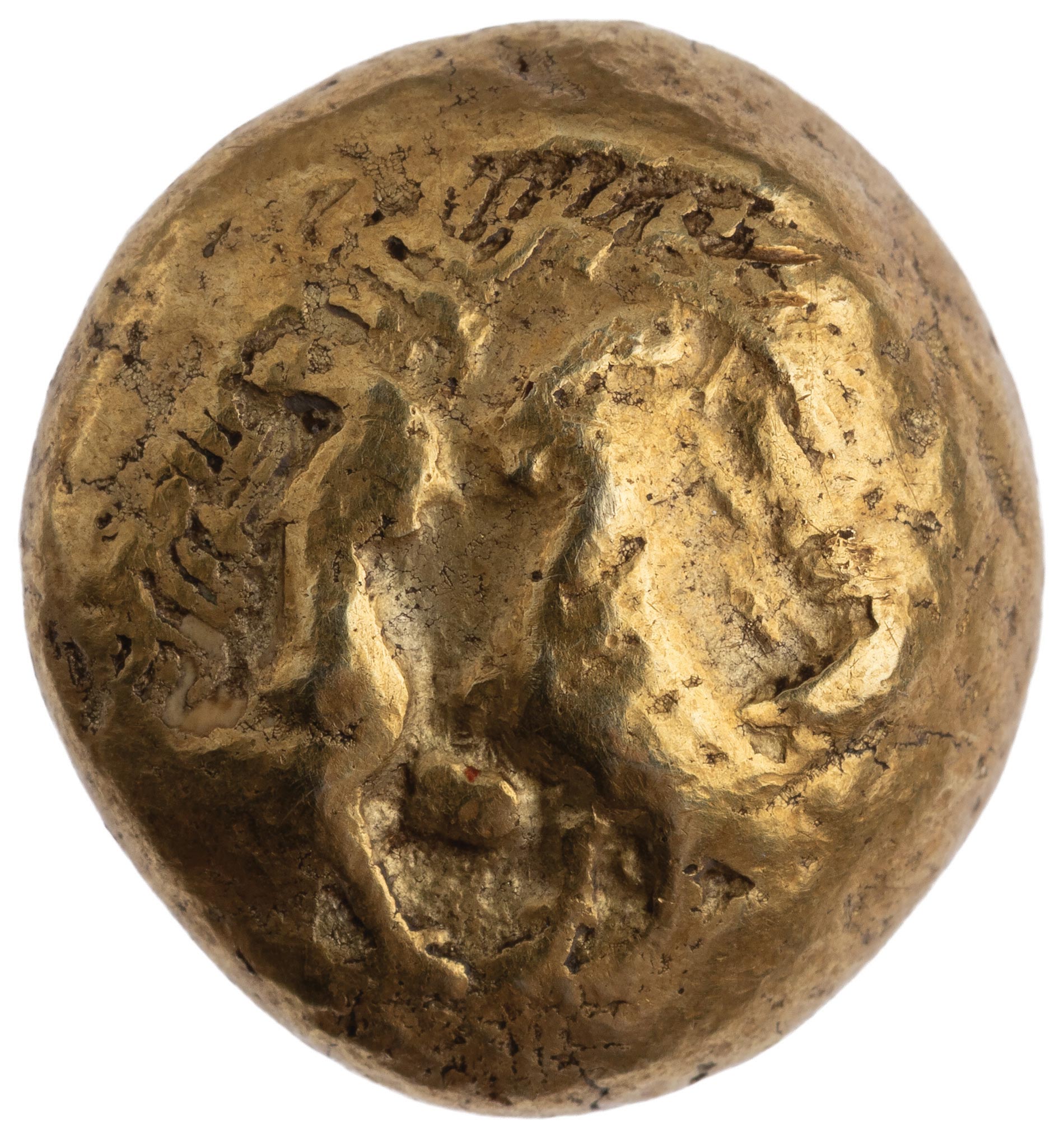
The early coins he found there look deceptively primitive. They are made of an alloy of gold and silver known as electrum, bearing simple designs on the obverse, often animals or geometric patterns, while the reverse has one or more deep punches. The coins were struck in many different denominations, from a full stater down to a tiny 1/192nd division of one weighing just 0.06 grams. What is astonishing about these very small coins is that they carry a fully engraved design and are often precisely produced to a weight standard.
While it was long thought that electrum was chosen simply because it occurred naturally in the rivers of Lydia, metallurgical studies during the last decade have established that the alloy was in fact manufactured specifically for these coins. These early electrum coins from Lydia and Ionia, regions in what is now western Turkey, clearly fulfilled a major need in the economy of the Archaic Greek world. It was a period that also saw other bold innovations, such as the first monumental stone temples and large-scale sculpture, advances in which the influence of Egypt and Babylonia are evident.
Click image to enlarge.
Spread Of Coinage: The Introduction Of Silver Coins
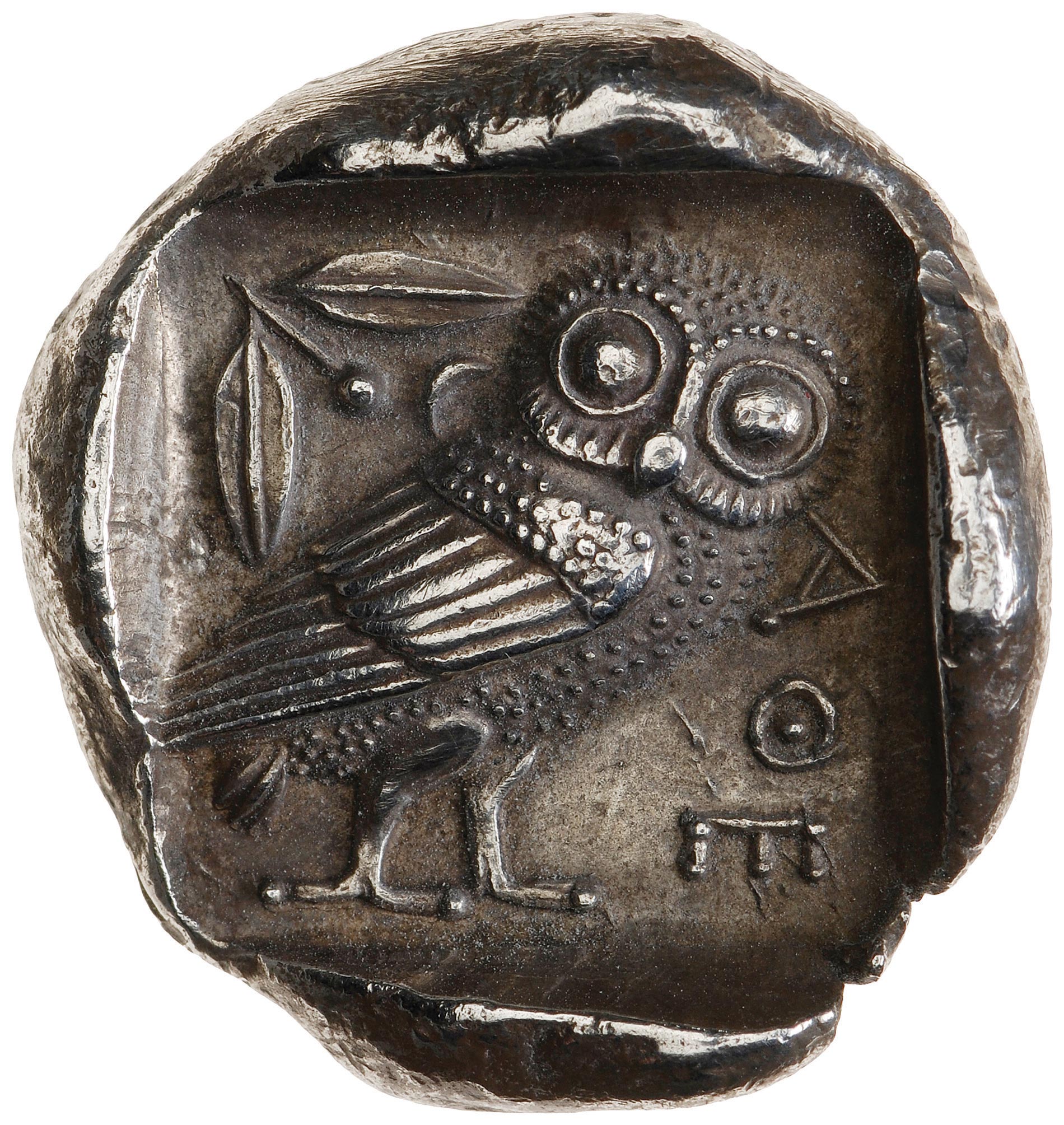
The earliest electrum coins were made by the early Lydian kings, under their last king, Croesus, and ancient coinage took a major step forward. Around 560 BCE he introduced the first separate gold and silver coins. This development allowed the production of coins of lower value. Within a few decades, hundreds of Greek cities minted their own currency. They used coins to trade with one another, paying for wars, constructing public buildings, and supplying citizens with currency for the local markets. Among these cities was Athens, which rose to become a major power of the ancient world. Athens' most famous silver coins are known as "owls" (Athenian Tetradrachm) which refers to the bird on the reverse of the coin. This type of coin became widely trusted internationally unlike the dollar today.
Just as the U.S. dollar's dominance was underpinned by the California Gold Rush of the late 1840s and 1850s, Athens owed much of its economic transformation to the discovery of a particularly rich vein in the nearby silver mines at Laurion. Initially, that silver windfall served a more urgent purpose: in the final years of the war against Persia, it helped Athens and its Greek allies to build a fleet that defeated the enemy at the sea battle of Salamis in 480 BCE.

Click image to enlarge.
Click image to enlarge.
Exceptional Design And Usage Of Greek Coinage
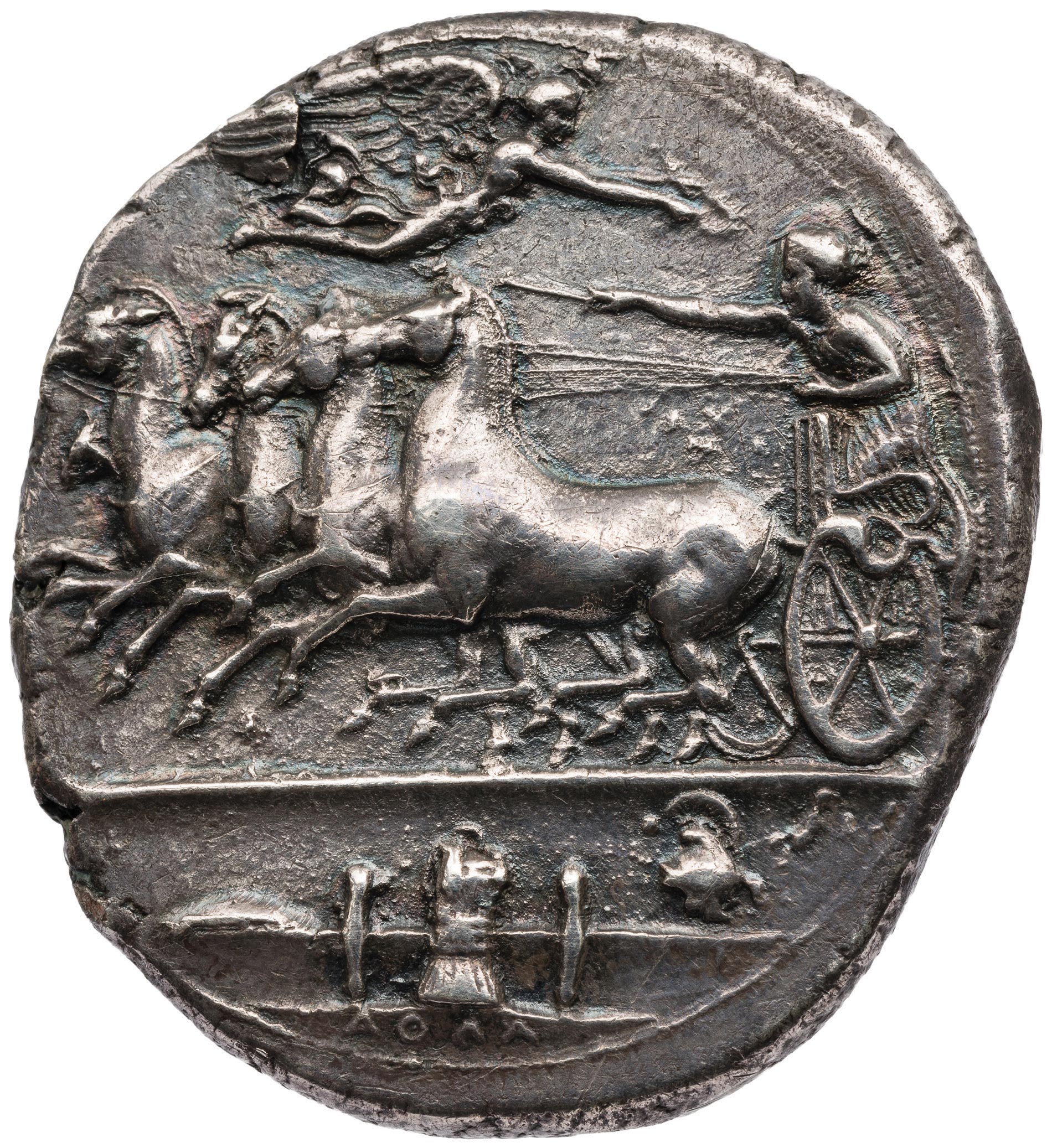
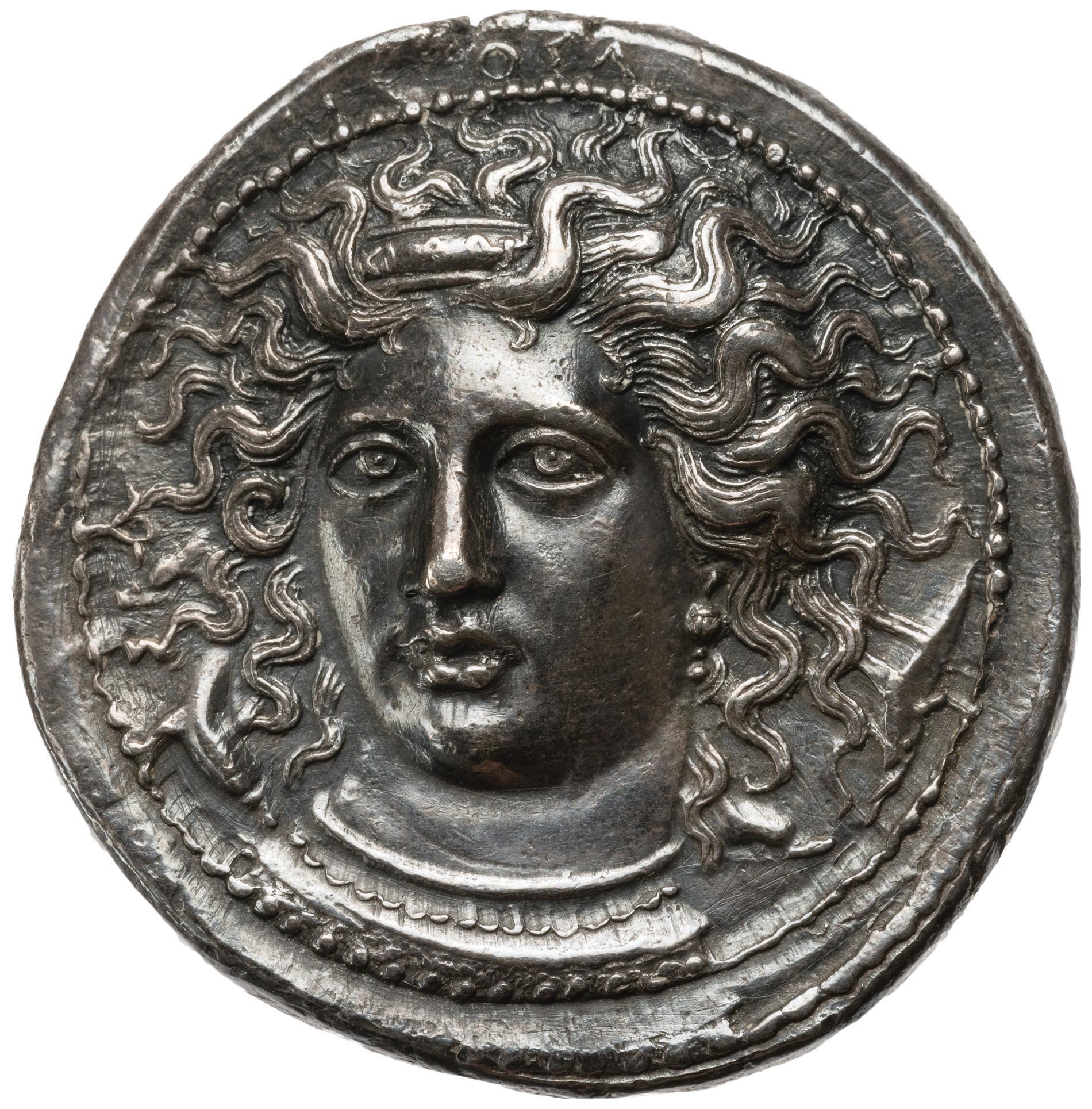
Coinage of the Classical period (480-332 BCE) is characterized most notably by beautiful designs, which have attracted collectors since the Renaissance when ancient coinage was rediscovered by scholars. The designs are often of a deity, an animal, or a plant associated with the city that struck the coin. Through these images numismatists and historians may learn about a coin's history. In Sicily, the city of Syracuse minted some of the most beautiful coins of antiquity, signed by the artists Euainetos and Kimon.
A racing chariot drawn by four horses is the main theme on the obverse of a silver decadrachm engraved by Euainetos. Such sporting competitions were commonly held at the Olympic and other venues like the Colosseum in Rome, Italy. These sporting events allowed rulers to display their wealth and the winners were celebrated with special honors by their respective cities upon returning home. The nymph Arethusa, a water deity whose spring was crucial to the survival and well being of the inhabitants of Syracuse, is depicted on a spectacular silver tetradrachm.
Not all coins were large silver tetradrachms. Small silver denominations such as the obol and drachm became more widespread for payments. In Athens, jurors were paid initially two obols per day to attend trials to make up for lost income during their jury duty, which was raised in 425 BCE to three obols. Cities therefore needed to forecast and supply coinage for these types of payments. Around 400 BCE, a further innovation made coinage more useful: the introduction of bronze coins. Bronze, not being a precious metal, was of significantly lower value than silver and allowed smaller denominations to become more commonly used in commerce.
New Coinage Of Alexander The Great
During the 4th century BCE, Greece and many of its cities came under the influence of Macedonian King Philip II. The city of Macedonia, Greece is located in the northeast part of the country, which played a significant economic and political role during the wars against Persia in the first two decades of the 5th century BCE. It was under the rule of Philip II's son, Alexander III, also known as Alexander the Great (356-323 BCE), that the ancient world was transformed. He conquered the vast Persian Empire and seized its extraordinary wealth, thereby opening up immense gold, silver reserves, and much of it was turned into coinage.
After Alexander III conquered many territories across Asia and Europe, coinage took on a different look. The coins under his rule seemed to carry a message expressed through the images on the coins themselves. Herakles, whom Alexander considered his ancestor, was on the obverse of the silver coins known as tetradrachms. Zeus, who is the father of all Greek gods, is on the reverse. The reverse of the gold stater coinage displays Nike who is the Greek goddess of victory. These coins became very popular and continued to be minted by Greek cities well after Alexander III's death in 323 BCE.
Click image to enlarge.
Click image to enlarge.
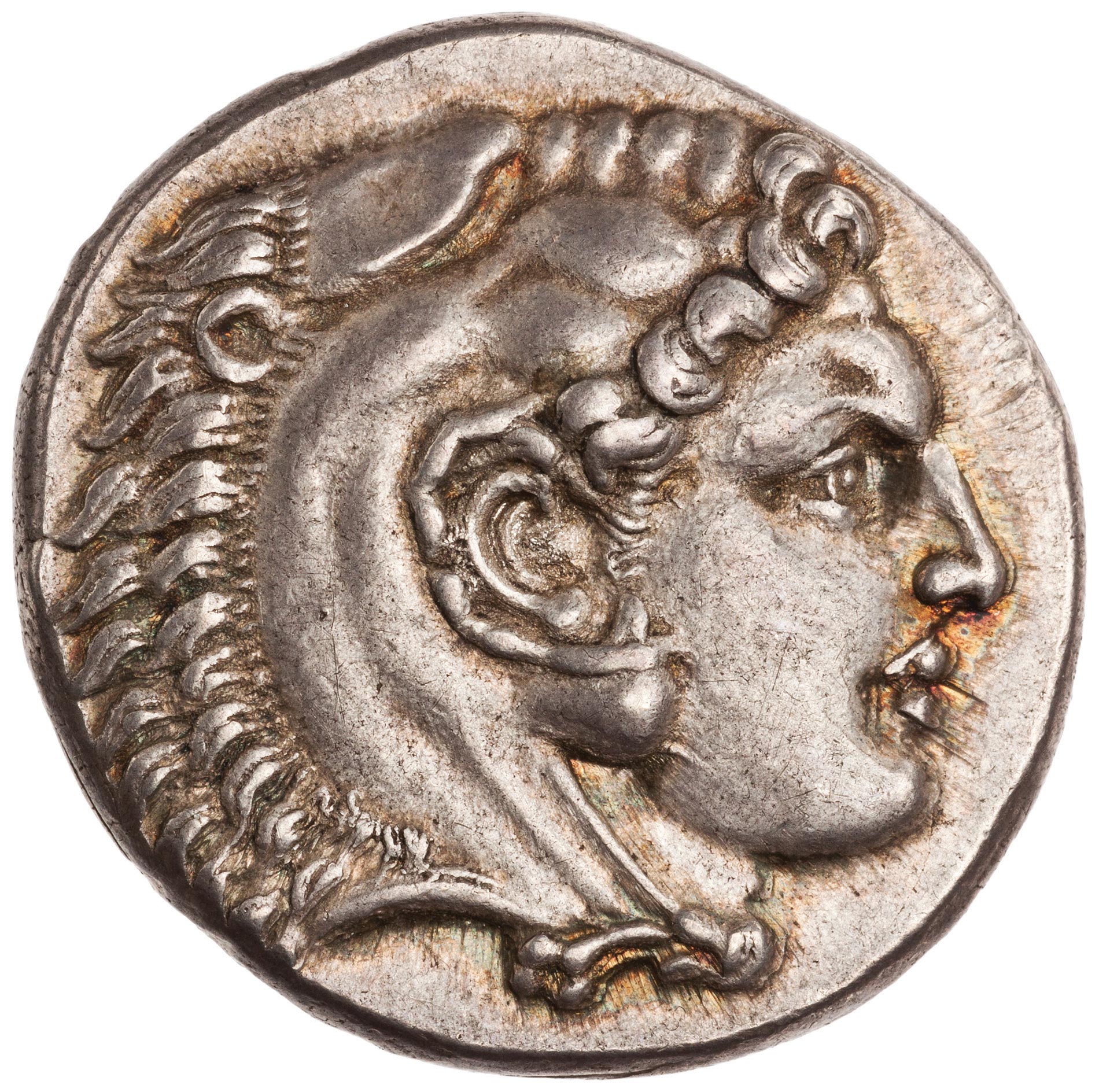
Click image to enlarge.
Hellenistic Kings And Queens
Greek cities like Athens and Syracuse during the Hellenistic period (323-31 BCE) lost much of their influence to large kingdoms. These cities were ruled by dynasties of Macedonian origin such as the Ptolemies in Egypt and the Seleucids in Syria and the Near East. Although these cities still produced coins, kings now almost always using their portraits issued coins to pay for military and other expenses. The queens of Egypt also issued coins, such as the powerful Queen Berenice II, who issued a spectacular gold decadrachm with a veiled head from 246-221 BCE.
Early Roman Coinage
When Rome began minting its own coins around 300 BCE, it was still a modest Italian city-state, and far from its greatness that it would soon achieve. Rome's earliest coinage clearly showed this: the aes grave, heavy cast bronze lumps, were made of cumbersome pieces of metal to carry. Although these objects served as currency, they reflected a society deeply rooted in its agricultural origins.
By the late 3rd century, Rome's aggressive, expansionist wars changed this picture. As its armies advanced across the Mediterranean against her enemy Carthage in North Africa, and the republic needed silver to finance the war efforts. In about 211 BCE, the first Roman silver coin known as the denarius was minted. This denomination would secure Roman currency for more than four centuries while influencing other currencies throughout history like the dinar, denier, and denaro. The first denarii featured the helmeted portrait of Roma on the obverse with the twin horsemen, Castor and Pollux on the reverse.

Click image to enlarge.
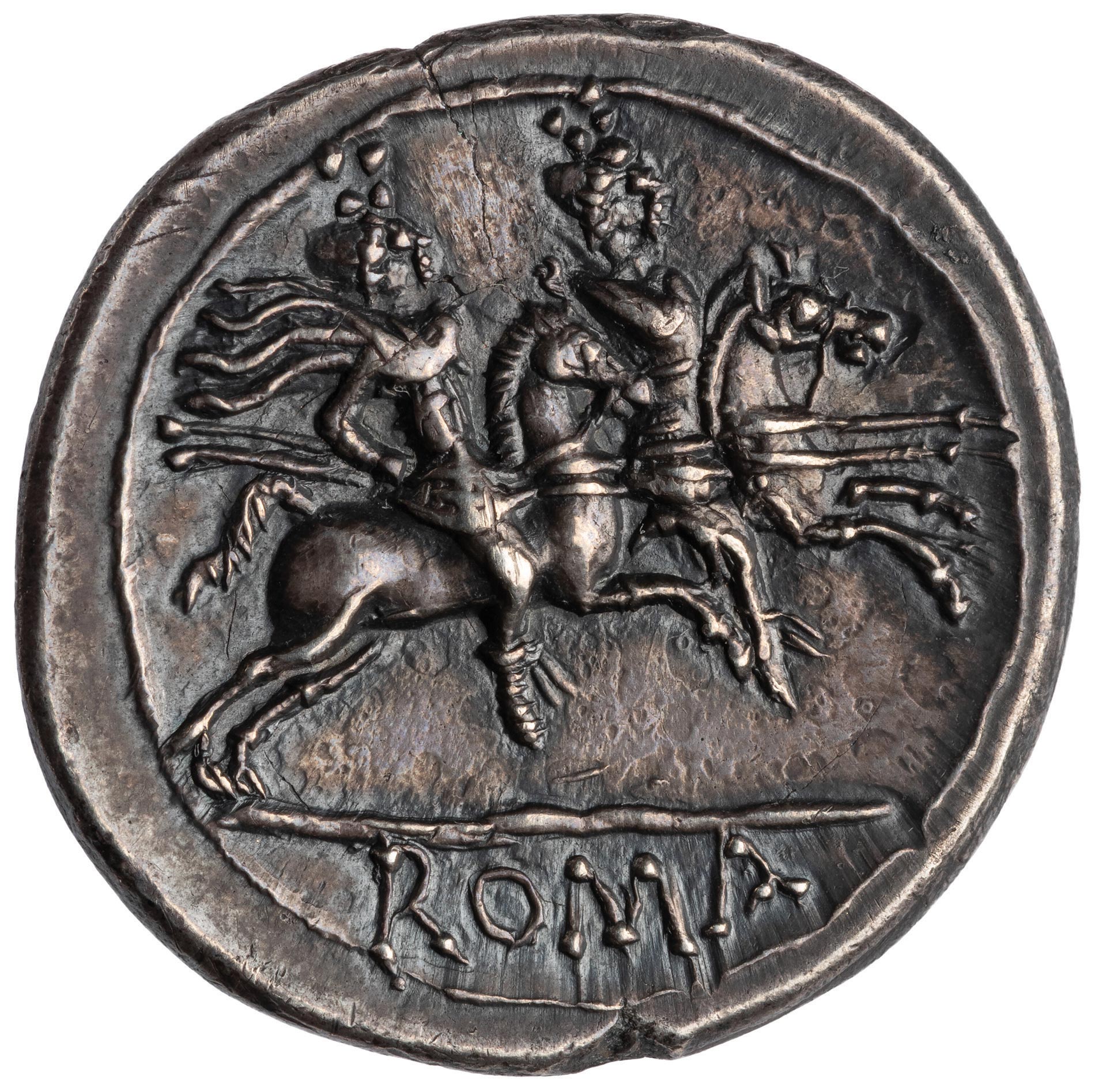
Click image to enlarge.
Messages On Roman Republican Coinage
Unlike Greek city coinage, which often featured the same god or image for decades or even centuries, Roman coinage differed in its imagery. Young aristocrats, often relatives of the elected consuls of the Republic, were chosen as a moneyer (an official chosen for minting money). Republican denarii often show images of historical battles, monuments, and myths related to an aristocratic family of a serving moneyer.
Julius Caesar took this idea of messaging through coinage a step further than conventional standards. In the winter of 44 BCE, he became the first living Roman whose portrait appeared on a coin. His enemies viewed this as the act of a king, which the Romans would not tolerate.
A few weeks later, on the Ides of March, which is recognized on the 15th of the month, Caesar was assassinated by approximately 60 senators. The assassins' numismatic response was equally explicit. Brutus issued a coin showing two daggers, a liberty cap, which was given to freed slaves, and the inscription "EID MAR," symbolizing their declaration of having killed Caesar to free the republic.

Click image to enlarge.
Coinage Reform Under Augustus
Caesar's heir, Augustus, who reigned as emperor from 27 BCE to 14 CE, understood the power of coinage and its imagery. After decades of civil war, his coins projected images that suggested peace and restored order within the Roman Empire. The beautiful gold aureus shown here depicts Augustus in an idealized profile, looking calm, ageless, and serene, suggesting stability. Augustus also changed the production of coinage under his rule. Gold aurei and silver denarii were now brought under the control of the emperor. A new system of brass and copper coins for everyday transactions was introduced, which featured the large letters "S C," Latin for "by decree of the Senate." This reformed currency gave the empire a unified monetary system stretching from Britain to Syria, enabling well-organized tax collection, military payments, and economic activity across the empire.

Click image to enlarge.

Click image to enlarge.
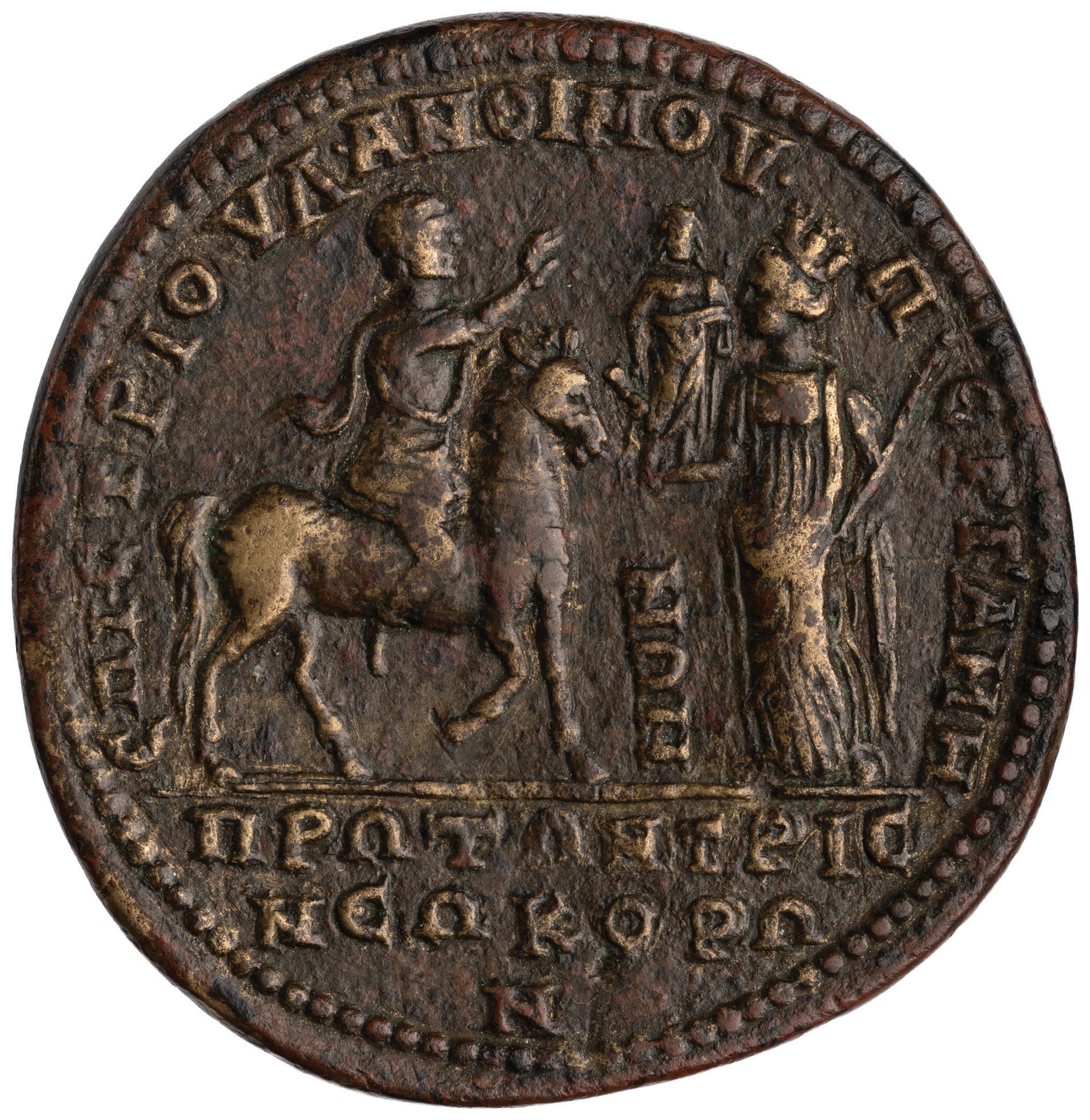
Click image to enlarge.
Coinages Of The Roman Empire
Unlike earlier Greek city coins with city emblems, Roman coins have various designs that reflect current events, such as wars and building projects. They also depicted social and moral values, which were shown as personifications. When the emperor Vespasian crushed the Jewish revolt and sacked Jerusalem in 70 CE, his coins announced: "the famous Judaea Capta sestertius showed a mourning woman seated beneath a trophy of arms, a blunt image of conquest was broadcast across the empire." When Emperor Trajan built his great forum in Rome, his coins depicted its column. A military victory, a new building, and an emperor's munificence all appeared on coins. Cultural interests such as the latest women's fashion in hairstyles also found their way onto the Roman imperial coinage.
When Rome conquered Asia Minor (present-day Turkey), it took control of the Greek-speaking world where coinage was originally invented. Interestingly, Rome allowed hundreds of cities to continue striking their own coins. This fascinating category of coinage, now called Roman provincial coinage by modern scholars, includes coins issued not by Rome but by cities across the Roman empire. These coins were struck under Roman authority, generally featuring the portrait of the reigning emperor and sometimes an empress. These coins were struck to local weight standards, often in bronze, and only circulated locally. The legends were usually written in Greek rather than Latin and their imagery drew on local traditions such as religious cults. Sometimes historical stories about a city's founding or similar themes were used. A coin from Ephesus, which existed in modern-day Turkey, might depict the great temple of Diana.
Roman Provincial Coinage
A visit from Emperor Caracalla to the city of Pergamon in 214 CE was commemorated by a bronze medallion. He was said to be a major follower of Asclepius, the god of healing, and the visit might have been a pilgrimage. We see the emperor on horseback, greeting a female figure who personifies the city and holds a small statue of the local god Asclepius in her hand. As this medal illustrates, such provincial medals served a dual purpose: they declared loyalty to Rome and the emperor, while also celebrating local identity or events such as an imperial visit.
The variety of designs on such Roman provincial coins is vast. Hundreds of cities across Asia Minor, Syria, Egypt, the Balkans, and North Africa produced their own coins. The different types of reverse designs that exist may be well into the thousands. Some cities struck coins prolifically over several centuries; others issued only a few. Provincial coinage ended in the late 3rd century CE as the Roman Empire centralized its monetary system under Diocletian's reforms. The last major provincial city issues date to the 270s, after which the patchwork of local mints was replaced by a network of imperial mints.
The Last Centuries Of Roman Coinage
As the empire faced increasing pressure from civil war, economic decline, and military invasions in the 3rd century, so did its money. Successive emperors debased silver coinage, reducing its precious-metal content until it was barely more than a bronze coin with a thin silver coating.
During the time of Emperor Gallienus in the 260s, the currency had nearly completely collapsed, along with public trust in the money, and the economy. Diocletian attempted a radical reform of the empire by dividing authority between two emperors and two junior colleagues in 293 CE. This was known as the tetrarchy, a Greek term meaning "the rule of four." Diocletian and Maximian held the senior titles of Augustus governing the east and west respectively. Also during tis time, Galerius and Constantius Chlorus served as their Caesars, who were junior partners and also designated as future successors. Each ruler was based in capitals close to the empire's frontiers, in Nicomedia (Turkey), Milan (Italy), Sirmium (Serbia), and Trier (Germany). This strategy ensured that imperial authority could respond quickly to outside threats without relying on military support from Rome.
Coinage was also changed by introducing a heavier gold aureus, a silver coin known as an argenteus, and a large bronze piece known as the nummus. These new denominations were introduced to restore consumer confidence after decades of precious metal debasement. Alongside the monetary reforms, the famous Price Edict of 301 CE established prices for roughly 1,200 goods and services, which included grain, teachers' wages, and even enslaved individuals.
Despite its wide-ranging goal, the edict proved largely unenforceable and was abandoned within a few years. Nevertheless, it is of great interest to modern scholars as it provides an overview of the late Roman economy.
Apart from coins being used for payments, so-called medallions, which are large coin-like pieces often made from gold, survive today from the late Roman period. These medals were originally used as gifts given to officials and other people in the imperial court. A notable example of this medallic issue that weighs almost two ounces of gold was discovered in a famous hoard unearthed in 1922 near the Belgian town of Arras. It probably represented the property of a senior officer who was involved in the recapture of Britain from the usurper Carausius. The piece today resides in the American Numismatic Society and displays double portraits of the members of the tetrarchy, facing each other on obverse and reverse.
Click image to enlarge.

Click image to enlarge.
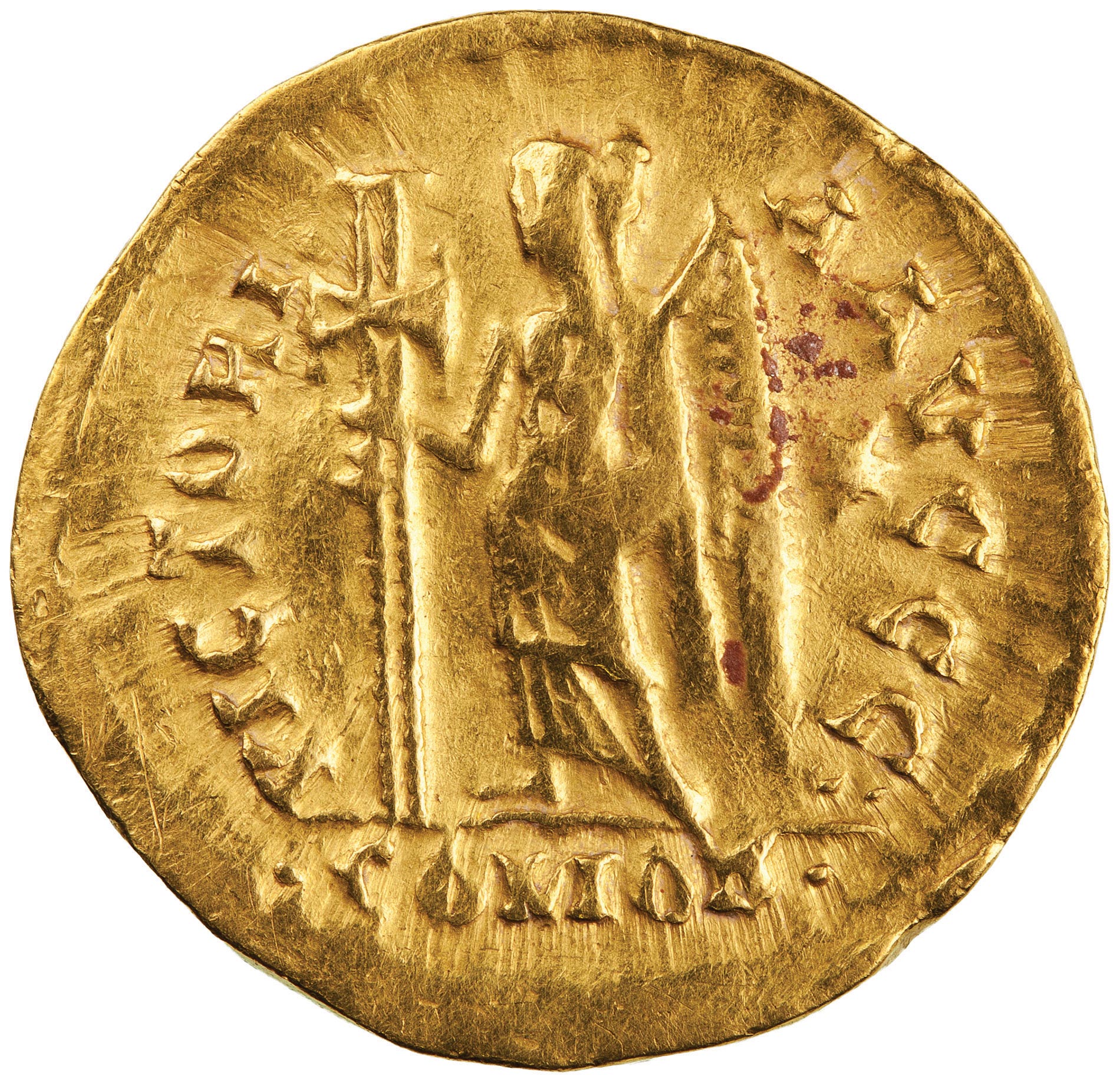
Click image to enlarge.
Constantine's New Gold Coinage
It was Constantine 307-337 CE, who found a lasting solution to the monetary problems by creating new gold coinage. The first Christian emperor abolished the aureus and replaced it with the solidus, which weighed approximately 4.5 grams of pure gold. This new denomination became the stable currency of the late empire and lasted for centuries. The solidus outlived Rome and became the foundation of the Byzantine monetary economy.
Having converted to Christianity, Constantine plundered the vast reserves of gold in the old pagan temples, and this partially funded the minting of the new gold coinage. Silver played a much smaller role in the economy. Bronze denominations continued to shrink in size, and value throughout the 4th century that reflected persistent inflationary pressures on everyday transactions.
As the Western Empire became fragmented in the 5th century, coin production became increasingly irregular. Barbarian successor kingdoms such as the Ostrogoths, the Visigoths and the Franks initially imitated imperial types to lend their currencies legitimacy before gradually developing their own tradition. The last Western emperor, Romulus Augustulus, was deposed in 476. A solidus in the American Numismatic Society collection shows Victory holding a cross that illustrates the end of Roman imperial coinage.


 Copper & Nickel
 Silver Coins
 Gold Coins
 Commemoratives
 Others
 Bullion
 World
World
 Coin Market
 Auctions
 Coin Collecting
 PCGS News