“I dare you!” challenges the footbridge, “I dare you!” An icy Sichuan wind bangs it back and forth, but no tourists block the way — there are few visitors here at Dujiangyan (pronounced Doo-jong-yon) on a gray February afternoon. I grab a handrail rope and wobble forward. Atop each railing post a bright scarlet ribbon flaps around as if it’s about to take off. Below, the blue-green Minjiang (Min-jong) River splashes against the bridge supports; its waves are like white threads on dark silk. Crazily, for an instant, I think, “What sort of fish lives down there?”
Two crows caw as they ride a chilly air current though the afternoon shadows. A Hoopoe bird, its crown swept backward and a grub in its beak, speeds by. It ignores the little boy with his fishing pole. Xiaolong’s (Shao-long) eyes follow his line of twisted bamboo fibers, baited with a cricket, into the water. He remembers Father – why did that tiger take him? Now, although only eight years old, Xiaolong feeds himself and his mother by fishing in the Minjiang. Anything he catches he can sell in town for one or two measures of rice. One by one the minutes slip by.
Finally, a slight tug. The boy waits as the fish swallows the bait, then he jerks the pole hard. A-ya, this fish has fight! Xiaolong fears the line will snap so he splashes into the icy water, the bamboo rod clutched in both hands. Finally, the fish tires and he lands his prize. What a prize it is, too! Despite the dim light its scales glitter like gold.
“Wah, you will fetch a good price in the village!” Xiaolong exults as he shivers. “Wait until I tell Mother!”
Then, to his shock, the fish says, “Oh, please, please don’t hurt me. If you let me go you will be rewarded. You will see. Please let me go!”
Finally, the boy sighs and places it back in the water. What can you do with a magic fish? “Now, we will go hungry again,” he says sadly. But a moment later, a gold head pops up and drops a beautiful white pearl at his feet.
“Take good care of this and it will take good care of you,” the fish announces. Then, with a splash, it is gone.
“Look, Mother!” Xiaolong cries as he runs through the doorway.
Mother Zhu stares at the pearl and starts to weep. “Oh, Long-Long, we cannot sell this. People will say we stole it.” In despair, she hurls the pearl across the room and it bounces off the wall and out of sight.
Later, Mother Zhu checks the food bin to see if there is anything left to make even a small meal for her son. “What is this?” she cries. The container overflows with rice. That night Xiaolong and his mother have their best meal in ages. The next evening it is the same. So, they invite some friends over to share their good fortune. One of them says, “What is the secret of this bin?”
Everyone crowds around. At the bottom they find the pearl. Word soon gets out that Miss Zhu has a magic pearl. People she barely knows come to beg for rice. She fills all their bowls. One day, though, she looks out and sees Mr. Hu, the landlord marching toward her door. “Quick, Long-Long, hide the pearl!” she whispers.
Hu barges in followed by two big men. “I hear that you have something precious. It must be stolen. Hand it over,” he demands.
“Oh, good sir,” Zhu trembles, “we have nothing of value here.”
“Liar! Search the place!” the landlord orders. His men turn everything upside-down and dump all the rice on the floor, but find no pearl.
“Hey, you, boy, what do you know about this?”
Xiaolong stands frozen. The landlord walks over and shakes him, “Tell me the truth, or you will be sorry!” Xiaolong stares at the floor. Hu curses and stomps around, but he finally departs.
Xiaolong, though, does not move. “Good heaven, Long-Long, where did you hide the pearl?”
Xiaolong gasps, “I need water!”
“You swallowed it?” Zhu shrieks and runs out.
Xiaolong drinks the entire pitcher. “More!” he croaks. Outside at the well he drinks bucket after bucket. Then he runs toward the river and, as he does, he grows!
By the time Xiaolong reaches the river bank his back is covered in scales. Tears run down Zhu’s cheeks as she realizes what is happening. Her son dives in and drinks the Minjiang River water as he transforms into a giant dragon. Xiaolong looks back and calls, “I am sorry, Mother, I must go!” Ever after, Miss Zhu would walk to the river’s edge each day. And to this day locals call this shoreline, “The goodbye look banks.”
Hills rise sharply from the Minjiang River’s inner banks. Their summit overlooks the Dujiangyan canyon with its high mountains, river valley, and the Yulei hillsides dotted with Ming Dynasty-style buildings. This is the very scene on the reverse of a 2005 coin. It is one of 10 gorgeous 5 Yuan, 30-millimeter diameter brass commemoratives that were released between 2002 and 2006 to celebrate 10 UNESCO World Heritage Sites in China. The obverse features the national emblem of the People's Republic of China and the date. Eight million of the Dujiangyan circulating coins were struck by the Shenyang Mint.
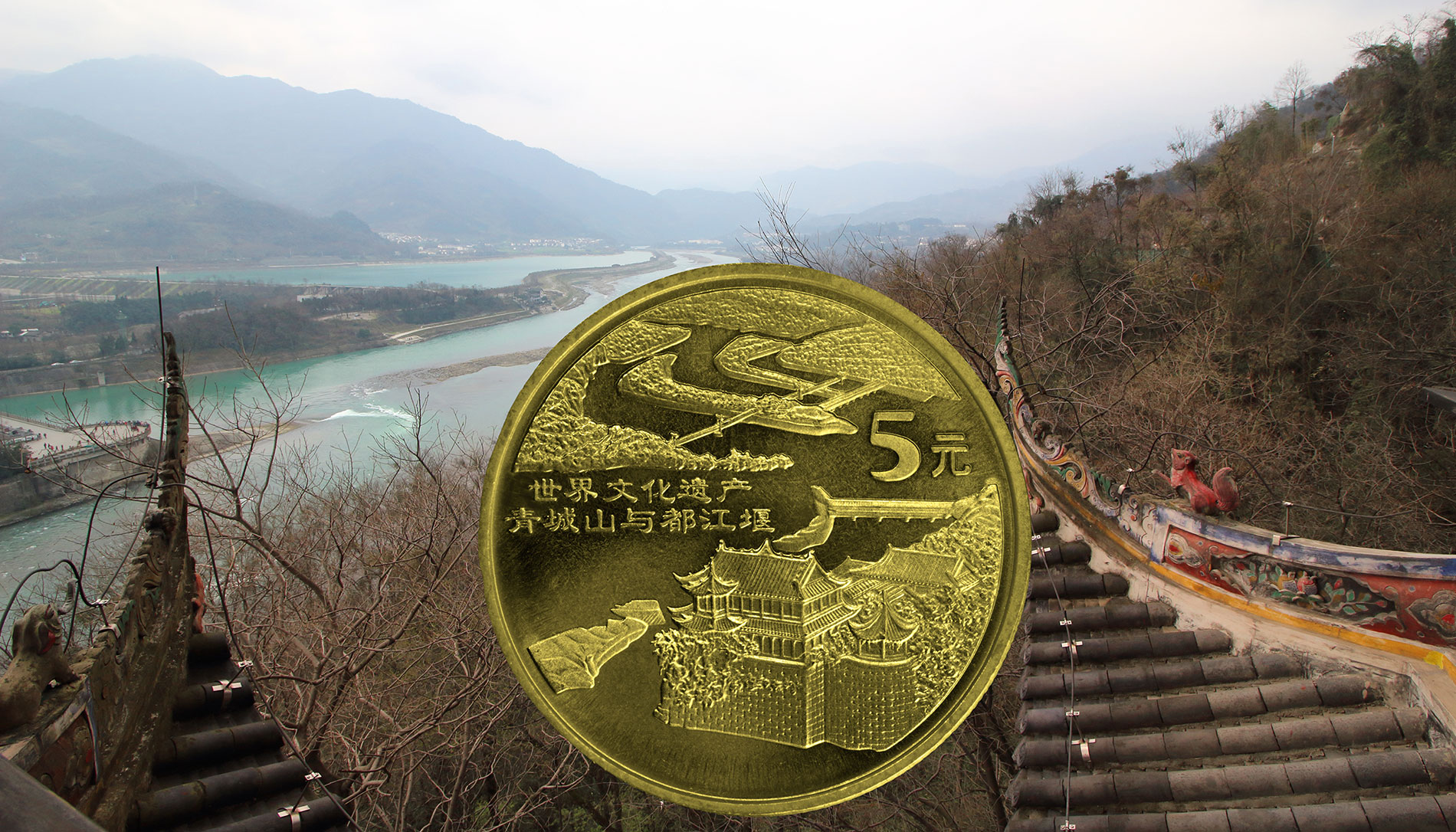
The view on this coin shows the solution to an age-old problem. For thousands of years, the Minjiang (or Min River) was both a blessing and a curse to Sichuan, or Shu as it was called long ago. With headwaters 5,000 meters (16,000 feet) above the plain it flows into, the Min – like other rivers in Sichuan – runs downhill fast. Along the way it erodes the surrounding rocks. When the water reaches the flats, it slows, and silt gets deposited to make a rich, fertile soil. That’s a blessing.
The curse is that when the silt arrives each year, it may come on a wall of water that drowns everything in its path. That’s why the Shu region was once called, “the inundated area.” To make matters worse, when the floods dried out, water was hard to find.
The Qin Dynasty conquered Shu in 271 B.C. Fifteen years later it dispatched Li Bing, a resourceful administrator-engineer, to be its governor. He knew that the Min River must be tamed to make the region secure. Li, however, also understood that the local population might not support this. They believed their lives depended on the favor of a powerful river god who demanded a sacrificial bride each year. Landowners had long manipulated the people through this tradition.
Li Bing’s army built a temple to honor the Min River deity. Then he offered his own daughters as brides. When the river god did not appear at the ceremony, Li Bing acted deeply insulted and ran off with a sword. Soon the crowd’s attention turned to the river bank where they saw two bulls fighting. It was quickly understood that one of the bulls represented the spirit of the waters. His sword bloody, a breathless Li Bing ran back and asked his officers for help. One then killed a bull. The crowd came away convinced that Li Bing had bested the river deity.
The governor’s next goal was to subdue the Minjiang itself. Surveys measured the river’s depth throughout the year. Li then devised a divide and conquer flood control system. First, a diamond-shaped “Fish-Mouth Levee,” or “Yuzui water-dividing dike,” splits the river into outer and inner channels. The outer part passes downstream unhindered. The inner side flows toward two areas: the “Flying Sand Spillway,” or “Feisheyan” and the “Bottleneck Channel,” or “Baopingkou.”
The Bottleneck Channel directs the diverted water downhill to a network of canals that gently irrigate the Sichuan plain. The “Flying Sand Spillway is the system’s safety valve. Elevated above the Min’s natural riverbed it is only covered at flood levels. Water that enters this spillway rejoins the outer channel. This balances the volume on both sides so neither is ever too full.
But, how to carve out the “Bottleneck Channel” from the Yulei hillsides? Tools bounced off its rocks and, in 250 B.C., explosives were a thousand years in the future. Tradition has it that one night, as Li Bing sat around a campfire, someone tossed water on the flames. When the cold water hit the rocks one split in half. Engineer Li had his solution. To break the mountainside, he would fill its natural crevices with wood and kindling. These would be set on fire. His men would then toss cold water on the hot rocks to crack the walls! That task took seven years.
For more than 22 centuries Dujiangyan’s ingenious flood control system has brought water and prosperity to the plains of Sichuan. It’s the only ancient irrigation system anywhere without a dam that’s in use today. If someone asked Li Bing how long Dujiangyan would last, he might have answered, “As long as the hills stand.”
Dujiangyan well deserves to be the subject of a gold coin. In 2021, the People’s Bank of China and China Gold Coin, Inc., minted 10,000 of the 80 Yuan, five-gram gold Dujiangyan coins. Like the 2005 issue, it features a bird’s-eye view of Dujiangyan and the Minjiang River. The coin’s designer, Mr. Qiu Yanxin, observed, “I am a native of Sichuan, and I have always been full of special emotions for Dujiangyan… The unique style of integration of mountains, waters, cities, forests, dikes, and bridges forms a harmonious unity between nature and people, and between people and ecology.”
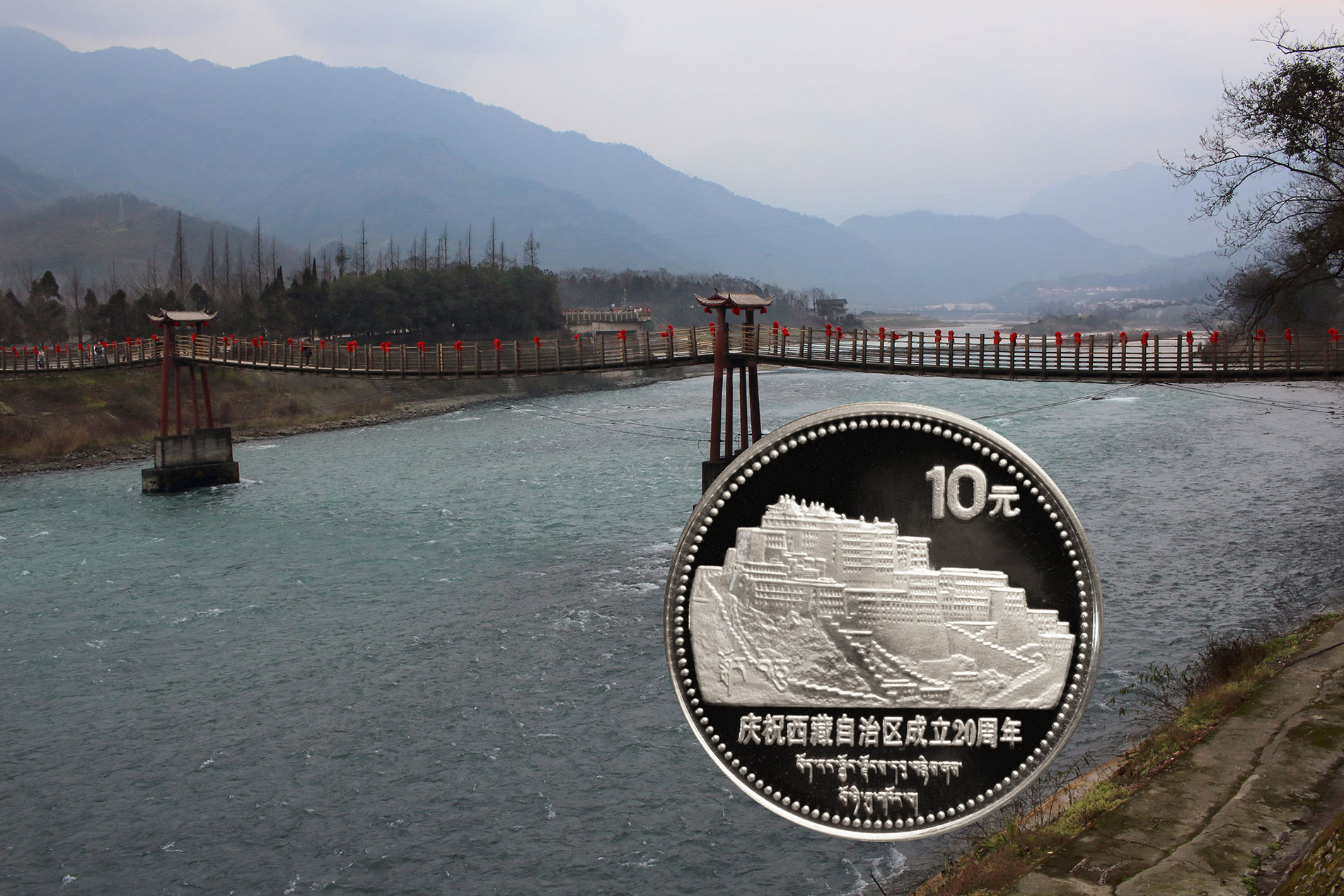
The footbridge I crossed to reach the Fish-Mouth Levee reflects that spirit of unity. In Sichuan it used to be said that, “You can travel all over the world in happiness, but you will find sadness when you try to cross the Minjiang River.” In a sense the river needed to have a rope put on it. Two thousand years ago they called rope made of twisted strands of bamboo fiber “ruo.” One old source quotes an even older source that credits Dujiangyan’s first ruo bridge to Li Bing, himself. In any case, this span of rope and boards quickly became a key link for trade between Tibet and Sichuan.
That continued for centuries until the bridge was destroyed by fighting as the Ming Dynasty fell in the 1600s. A ferry replaced it. On May 15, 1803, however, the old lament proved true again; the ferry capsized and more than 100 people drowned.
Motivated by that tragedy a local couple, Mr. He Xiande and his wife Yang, set about to replace the bridge. They studied historical records, consulted architects, and talked to workers. Mr. He then petitioned the government to fund a new crossing. The project was approved. Sadly, during construction two workmen fell into the river and drowned. The ferry owner lobbied the authorities to hold Mr. He responsible for the deaths. Mr. He was convicted and, by Qing Dynasty law, executed.
Perhaps to the ferryman’s surprise that didn’t stop the project. Mr. He’s wife Yang directed the bridge’s completion – and sank the ferry business. People called the new span the Anlan Bridge or Husband and Wife Bridge. Their bridge connected the shore to the levee for more than a century until a steel-reinforced one replaced it.
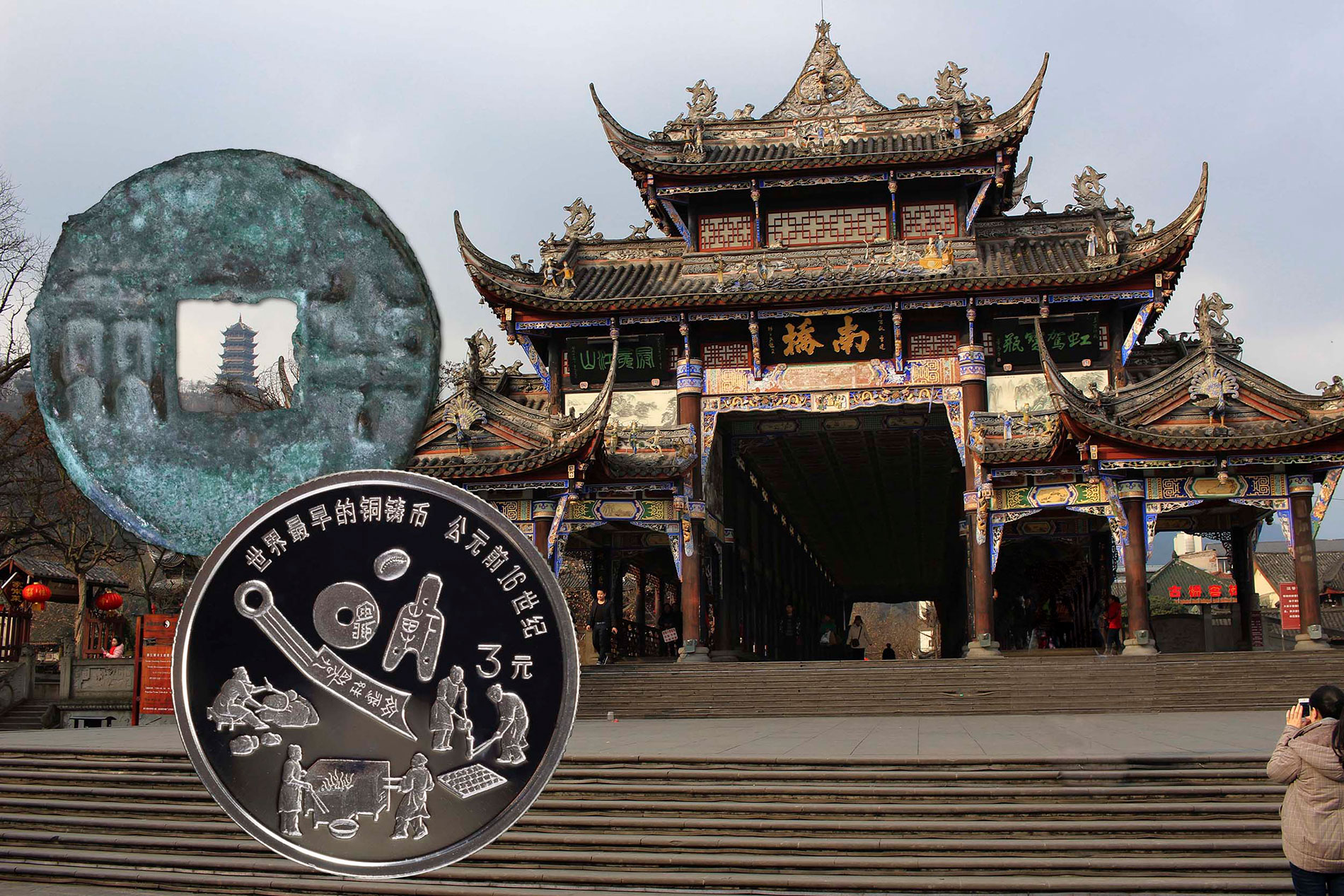
Today, an open-air shuttle runs from one end of that levee to the other, across a concrete overpass and then to a plaza. There, past a big model soft-serve ice cream cone, stands a grand Ming-style bridge. Halfway across this I stop to admire the hills when a movement catches my eye. A cat slinks along the river bank. Two birds swoop above it and the feline head swivels instantly to follow them. Below, water diverted from the Minjiang River rushes through the Bottleneck Channel, its waves like white threads on dark silk. For one instant I think, “What sort of fish lives down there?”


 Copper & Nickel
 Silver Coins
 Gold Coins
 Commemoratives
 Others
 Bullion
 World
World
 Coin Market
 Auctions
 Coin Collecting
 PCGS News