Some amazing coins and banknotes crossed the auction block leading into the summer, including many top rarities that scored six- and even seven-figure hammer prices. Let’s showcase some of the lots that really sizzled.

1795 9 Leaves Capped Bust Gold Eagle, PCGS MS63+
There are only 20 to 25 known examples of the 1795 Capped Bust Eagle with 9 Leaves variety. Regardless of its rarity, the 1795 Eagle is a special coin, as it is the first year that the United States Mint produced the $10 gold denomination. It was during this first year of issue that the 1795 Eagles were produced in two varieties – the one featured here with nine leaves and the other with 13 leaves. The leaves can be seen on the reverse, underneath the eagle. Both varieties are considered scarce. However, the 9 Leaves variety is by far much scarcer, especially in Mint State. A 1795 Eagle with 9 leaves variety graded PCGS MS63+ recently sold at a GreatCollections auction for an astonishing $2,711,000.

1792 Silver Center Cent Judd-1, PCGS SP61
The 1792 Silver Center Cent Judd-1 is a significant coin in numismatics, as 1792 is the first year in which the United States Mint produced coins. Additionally, the Judd-1 Silver Center Cent is extremely rare, with only about a dozen or so examples known in all grades combined. The design of the coin is also very captivating, giving us a glimpse of the talented artistry from the 18th century. The obverse features a Liberty bust facing right with its prominent flowing hair details. The reverse is anchored by a laurel wreath motif framing the inscription “ONE CENT” and fielding the inscriptions “UNITED STATES” and “1/100.” An example of this coin seldom appears at auction or in the marketplace, but when one does appear, it tends to attract a lot of attention. A remarkable 1792 Silver Center Cent graded PCGS SP61 was offered by Stack’s Bowers Galleries, where it realized an impressive $576,000.
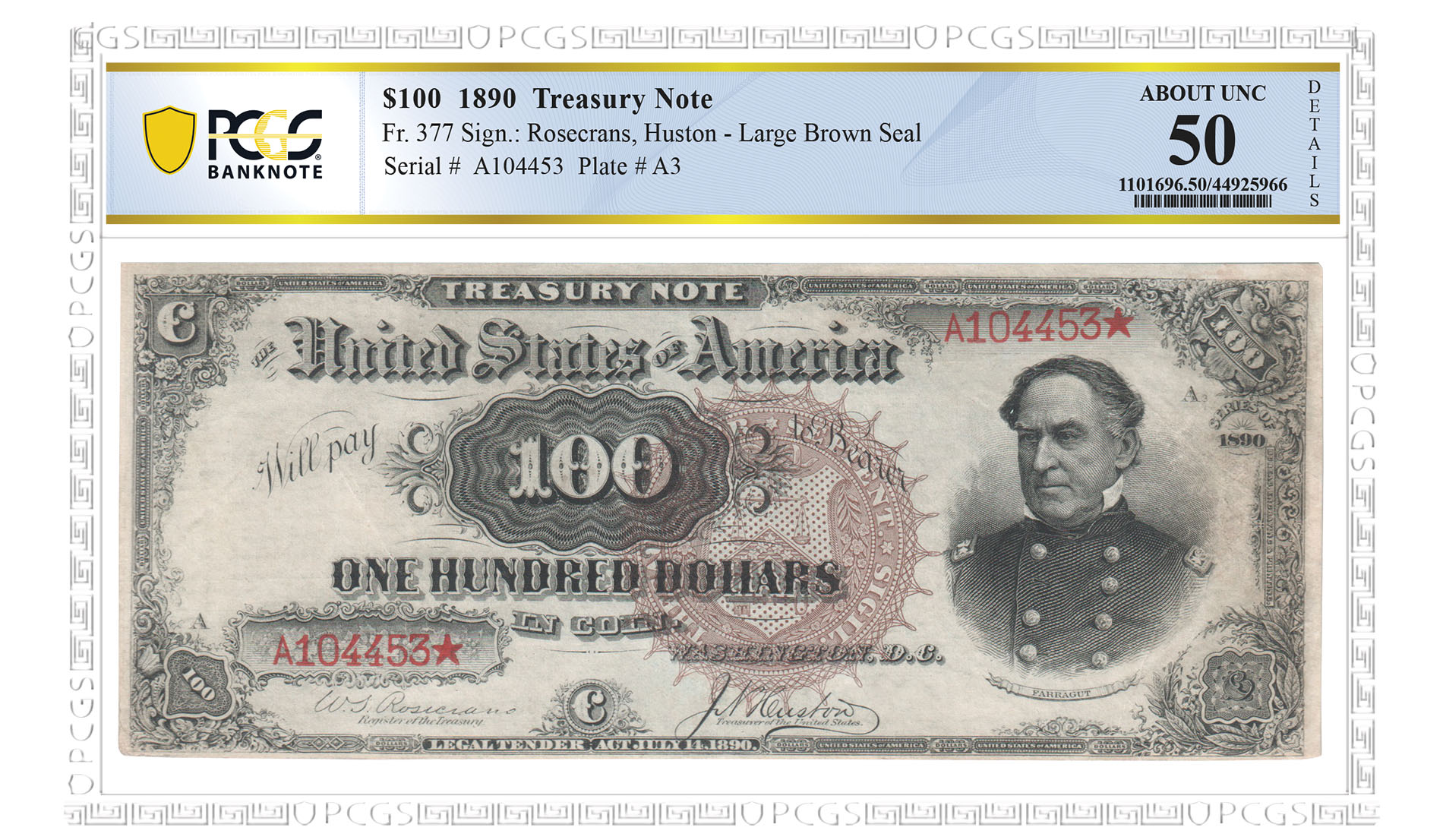
1890 Fr. 377 $100 Watermelon Banknote, PCGS About Unc. 50 Details
The 1890 $100 banknotes are referred to as “Watermelon Notes” because of the appearance of the two large zeros on the back of the banknote design that resemble watermelons. So, for years, many collectors have referred to these as Watermelon Banknotes. There are approximately only 35 known banknotes of this issue in existence, with several examples of these rare banknotes held by museums or by the government; few are available for collectors. So, obtaining an example of this banknote in any condition is next to impossible for most collectors. Heritage Auctions recently offered an exceptional example of a $100 Fr. 377 1890 Watermelon Banknote graded PCGS About Unc. 50 Details. The banknote realized an incredible $264,000 at auction.


 Copper & Nickel
 Silver Coins
 Gold Coins
 Commemoratives
 Others
 Bullion
 World
World
 Coin Market
 Auctions
 Coin Collecting
 PCGS News