
Editor’s note: What distinguishes your collection from a simple accumulation of coins? If you have trouble settling on a series or theme for your collection, the following article may give you a few ideas. This article is reprinted with permission from Q. David Bower’s book "The Numismatist’s Bedside Companion."
What to collect? Undoubtedly this question has run through your mind if you are a typical numismatist. The vast panorama of American coinage offers many possibilities. Liberty Walking half dollars are attractive, Barber dimes form a challenge, Morgan dollars are high on the popularity list, Vermont copper coins of 1785-1788 seem interesting, and there are hundreds of other possibilities.
Why collect with a purpose? Why not just accumulate coins? In the writer's opinion, to do so would be to lose much of the fun numismatics has to offer.
Around 20 years ago a gentleman named Terrell commissioned my firm to build for him a type set of United States copper, nickel, and silver coins. Not being inclined to be a collector, he considered investment to be his prime objective. Still, he wanted something that was oriented with a plan in mind, something with a purpose. We suggested a type set would be ideal, and he followed our advice. Looking over our shoulder, so to speak, he watched us buy for him superb early American silver coins, Uncirculated and Proof Liberty Seated and Barber coins, and numerous other pieces which comprise such a grouping. After much effort on our part, and after a good deal of check-writing on his, the type set approached completion. No, it did not have one of each and every design type in the finest possible condition, but it came fairly close. His interest turned in other directions, and he commissioned us to sell his holdings. An auction catalogue bearing the inscription Terrell Collection was issued. Perhaps you remember it. The offering of such a fantastic grouping of United States coins attracted considerable attention, and when the hammer had fallen on the last lot,
"The price record book had to be thrown out the window," as one observer said. Many new realizations were set. In the process our consignor reaped a rich return on his original expenditure. A businessman with his fingers in many pies, the consignor told me that no investment in his lifetime had yielded such a high return. Just before I wrote this article I telephoned him to say "hello," and he mentioned that since his collection was sold (something he regrets, as it would be worth much more now!) he has not had another investment which equaled it.
The Terrell Collection was an instance of two plus two equaling more than four. The coins in the group, while desirable on an individual basis, were worth more as a collection. True, the collection was not sold intact; it was broken up. But, the collection was offered all at once, and this is what attracted so many people. Similarly, when the Garrett Collection was auctioned by my firm in 1979 through 1981 the prices realized were substantially over the market value, mainly because bidders wanted to own an item with the Garrett pedigree.
As you chart your numismatic course, I recommend that you have some sort of a plan. Type set collecting is a popular way to go. A modest budget can be stretched a long way in this fashion. When your coins are sold--and everyone sells someday--you will find that a collection of coins is worth more than an accumulation. At least that's my opinion.
Specialization is another route. There are many challenges within the field of United States coins. Some pieces which seem to be common really aren't once you look for them. In the Rare Coin Review (No. 50, January-March 1984) we list a wide array of Barber half dollars for sale from the 1892-1915 years. These are not MS65 or Proof-65 pieces but, for the most part, are graded Extremely Fine and AU. And yet we make the claim in that listing that the pieces are elusive, hard to find, seldom seen. This may sound strange coming from the pen of a cataloguer who has described 1804 silver dollars, 1827 original quarters, 1787 Brasher doubloons, and the like. While EF and AU Barber half dollars aren't in the category of those landmark rarities, still within the context of coinage of the past century they are more difficult to track down than the somewhat nominal catalogue values indicate. Try putting together a set of EF to AU Barber halves. There are no "impossible" rarities, but there are some strong challenges! Liberty nickels offer a somewhat similar challenge. No, I can't say that we have a detailed listing of EF and AU Liberty nickels in this catalogue, for we don't, but this doesn't mean that you shouldn't make a beginning here, perhaps filling out your set with some future offerings.
Sometimes specialized sets can be made within a given area. Thus when a Washington numismatist telephoned to express an interest in Liberty Walking half dollars, I suggested that rather than buy three or four each of a half dozen different dates, he commence building a collection from 1934 through 1947, a "collection." In this way, I reasoned, he could form a display that would be meaningful and interesting. Tom Becker told me of a West Coast client, actually a prospective client (when he first called), who contacted him with the idea of spending around $25,000 on commemorative coins. His initial inclination was to buy five to 10 pieces each of four or five different dates, but Tom steered him in the direction of building a type set. By the time you read these words, our West Coast friend (for we have come to know him quite well through our telephone conversations) will have one of the nicest type sets in existence of commemorative half dollars from 1892 onward. And, at this point he lacks just a few pieces. This is far more interesting, to my way of thinking, than having a dozen or so 1935 Hudson half dollars (or some other scarcity) and no others!
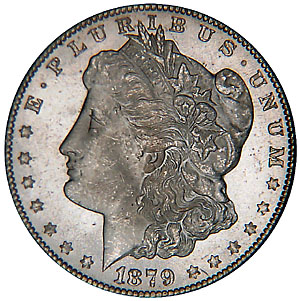
Perhaps the Carson City Mint interests you. A number of collectors have opted to acquire Morgan dollars of the Carson City years from 1878 through 1885 and again from 1889 through 1893. Indeed, plastic holders are available shaped like Nevada and with appropriate spaces for each of these issues. With the connotation of the Comstock Lode, such Carson City silver dollars have an interesting romantic flavor to them. Curiously, I don't recall anyone aspiring to collect Morgan dollars from New Orleans only but there is no reason why such a grouping cannot be put together. Silver dollars from Philadelphia only or San Francisco only present additional opportunities.
Among commemorative half dollars it is possible to build a type set or a date and variety set. These methods are well known. However, within this series one can build mini-type sets. For example, with my copy of A Guide Book of United States Coins in my hand I note that a collection of Civil War related commemoratives could be formed to include the following: 1937 Antietam, 1918 Illinois (with Abraham Lincoln's portrait on the obverse), 1925 Stone Mountain, and in a related way, representative Booker T. Washington and Washington-Carver issues.
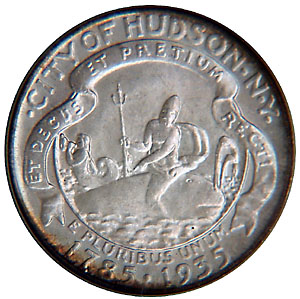
Topical collecting, or collecting by design motifs, is very popular among stamp collectors, but for some reason it has never caught on with numismatists. Still, there are some possibilities. In the field of commemorative half dollars further consider, for example, that the following issues depict different types of ships: 1936 Bay Bridge, 1892-1893 Columbian, 1936 Delaware, 1935 Hudson, 1924 Huguenot, 1936 Long Island, 1936 Norfolk, 1920-1921 Pilgrim, and 1936 Rhode Island. Commemorative half dollars pertaining to New England, issues pertaining to exploration in the West, and other categories represent still further possibilities. As still another example I mention that I have never seen a collection of commemorative half dollars limited only to issues produced at the Denver Mint.
When you plan your collecting objectives, a sense of market strategy is helpful. It is oft times desirable to collect what no one else seems interested in. This takes some willpower to do, for it is ever so easy to follow the crowd. Collect something that is being promoted or trumpeted, and you feel you are in good company and you are "doing the right thing." However, at the same time you are probably paying a strong market price. March to the beat of a different drummer, and prices are apt to be less expensive, competition will be less intense, and you have a better chance of completion. In numismatics every series has its turn whether it be commemoratives, silver dollars, Barber issues, Liberty Seated coins, Capped Bust half dollars of 1807-1836, tokens of George Washington, or whatever. Collect now, and when the time comes to sell, the market in your particular area of interest may well be much stronger, to your obvious financial reward.
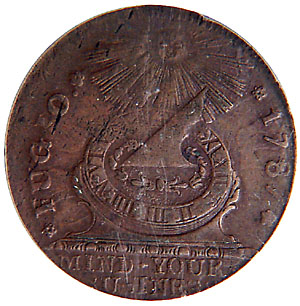
Right now colonial and state coins are quiet in the marketplace. Why is this? First, in general these pieces have suffered from a lack of publicity. Scarcely a single investment newsletter or market "expert" recommends them! Indeed, most numismatic writers in this vein would not know a Double Head Washington token from a plugged Hibernia farthing! Second, right now the field is missing some of the great individuals who have helped build the market. John Roper, one of the country's leading colonial specialists, and Richard Picker, the foremost specialist dealer in the area, both passed away. Ted Craige, another super-collector, also is no longer with us. The voids left by these gentlemen have yet to be filled. Current market popularity trends point toward MS-65 and Proof-65 conditions, something entirely possible in the field of Liberty Walking half dollars, Morgan dollars, and other issues of the past century, but grades seldom seen among colonial and early United States issues. "If it is not MS-65, I won't buy it!" I have seen beginning collectors take this stance more than once. Denied to such collectors, then, is the entire field of copper coinage of Vermont, Massachusetts, Connecticut, New York, and New Jersey of the 1785-1788 era, unquestionably one of the most numismatically fascinating of all collecting areas.
Another interesting way to collect would be to assemble a group of coins with interesting stories. Such a grouping would be somewhat like a type set, but it would not necessarily have one of each design type represented. What is an interesting story to me might not be an interesting story to you, so such a collection would have an intensely personal characteristic. I like the 1909 V D.B. Lincoln cent, an inexpensive piece but one which certainly played an important part in American numismatic history. On the other end of the price scale is the MCMVII (1907) High Relief double eagle, an expensive and beautiful coin representing the work that noted sculptor Augustus Saint-Gaudens did at the request of President Theodore Roosevelt. In between are many other interesting pieces such as the 1883 Without CENTS nickel, the 1938-D/S Over mintmark nickel (the first such over mintmark to be discovered), and so on. Three of our friends and clients have specialized in the coins of a single year, 1873. Harry X Boosel started things going a long time ago when he wrote a series of articles on 1873 coins for the Numismatic Scrapbook Magazine. Roy Harte, one of our favorite numismatists (he has consigned three separate collections to us for sale at auction!), formed a beautiful collection of the 1873 year, as did a commercial firm, Royal Coins.
Have you ever thought about collecting the coins of your birth year? If you were born before 1940, such a collection might be more difficult and extensive than you might at first think! Consider, for example, that a set of 1938 coins contains not only Philadelphia, Denver, and San Francisco examples of the cent, nickel, dime, quarter, and half dollar, but also includes a number of commemoratives. On the other hand, a set of 1949, 1953, or later coins would be easier to put together.
If you have no coins at all, then I recommend that you acquire coins of different design types. For example, rather than buying a half dozen different Barber half dollars, buy one Barber half dollar, one Barber dime, one Barber quarter, and so on--as these will fit nicely into a type set of United States coin designs. Later, if you want to specialize then you can build a set by date and mintmark varieties. If you have decided upon a specialization, say Morgan silver dollars, then buy as many different issues as possible, do not buy just a group of five or 10 of a single date or mintmark variety to the exclusion of others.
Form a meaningful collection--whether it be a type set, a date set, or whatever--and when time comes to sell you will be far ahead of your fellow numismatists. As an auctioneer of important coin properties over a long period of years, time and time again I have seen great excitement shown when collections are offered for sale.
The text above is an excerpt from the book The Numismatist’s Bedside Companion. This article originally appeared in Rare Coin Review No. 50, January-March 1984. This is reprinted with permission by the author. If you would like to order a copy of this book or any other books by Q. David Bowers, visit the website for Bowers and Merena. Or you may send an e-mail to [email protected].


 Copper & Nickel
 Silver Coins
 Gold Coins
 Commemoratives
 Others
 Bullion
 World
World
 Coin Market
 Auctions
 Coin Collecting
 PCGS News