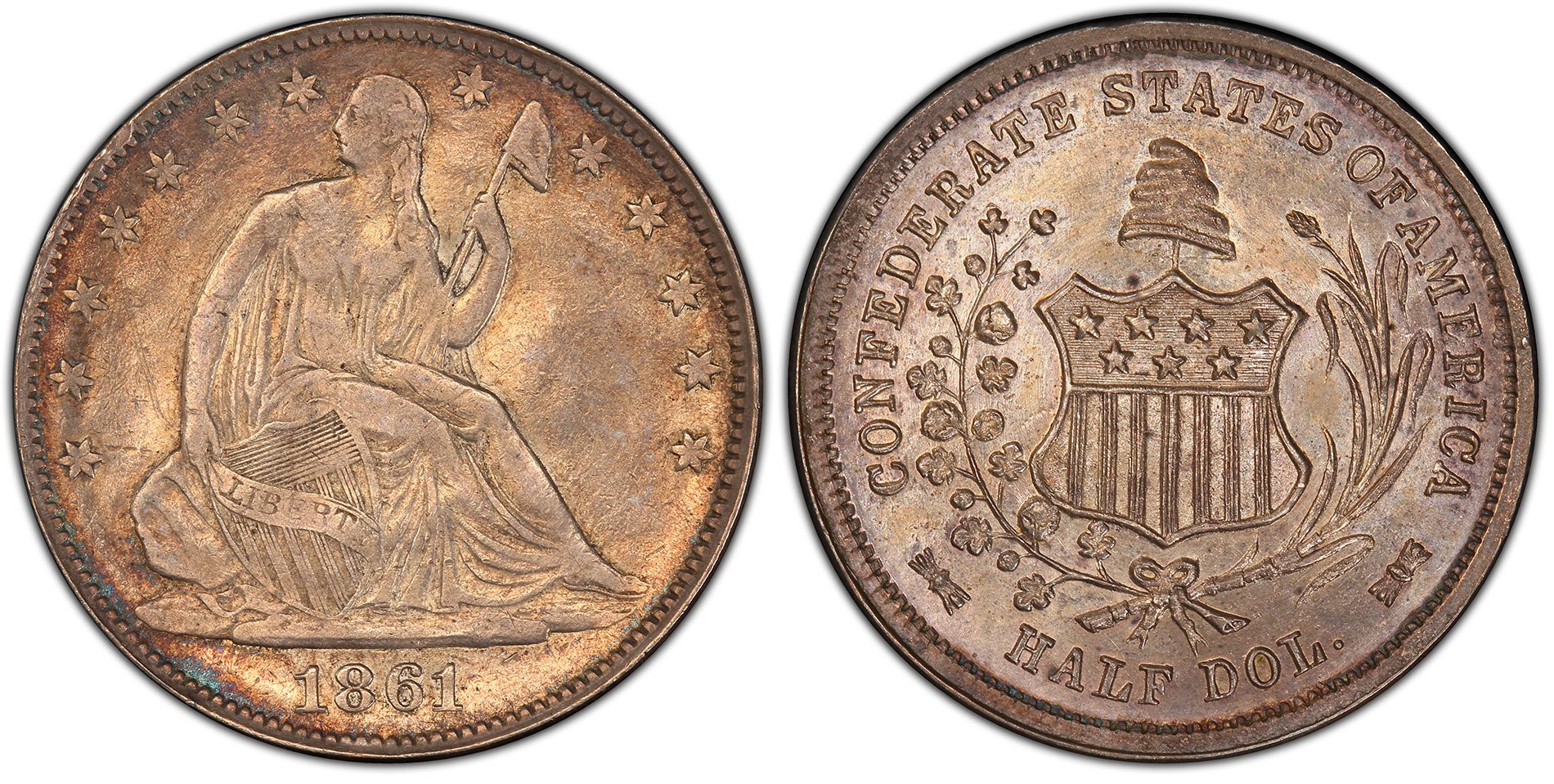
Confederate States of America, 1861 50C CSA Restrike, PCGS MS64. Click image to enlarge.
While the South didn’t rise again, the coins of the Confederacy certainly did – even decades after the United States Civil War ended in 1865. Coin production in the rebel-led Confederate States of America occurred during a relatively brief of just a few months, yet it yielded an eclectic array of numismatic curiosities that enjoy a robust crossover market reaching both the coin hobby and the wide-ranging realm of Civil War memorabilia.
A few coins issued by the Confederates were merely the continuation of regular-issue federal coinage. For example, the New Orleans Mint was commandeered by rebels after Louisiana seceded from the Union in January 1861. The New Orleans Mint was deemed the most well-equipped minting facility in the South and subsequently was dubbed the Confederate States Mint. Yet, even under Confederate occupation, federally hired mint employees were permitted to remain in their positions and produce United States coinage using Union dies.
For example, of the 2,532,633 total 1861-O Liberty Seated Half Dollars produced, 330,000 were made by the United States government before secession, 1,240,000 were struck for the State of Louisiana during governmental transition, and 962,633 rolled off the presses after the New Orleans Mint operated under the Confederate States of America.
Similarly, 9,750 of the total 17,741 Liberty Head Double Eagles struck at the New Orleans Mint in 1861 were made by the state of Louisiana, while 2,991 were produced under the Confederacy. At the Dahlonega Mint in Georgia, all 1,250 Indian Princess Head Dollars struck in 1861 were made either under the State of Georgia or the Confederate States of America.
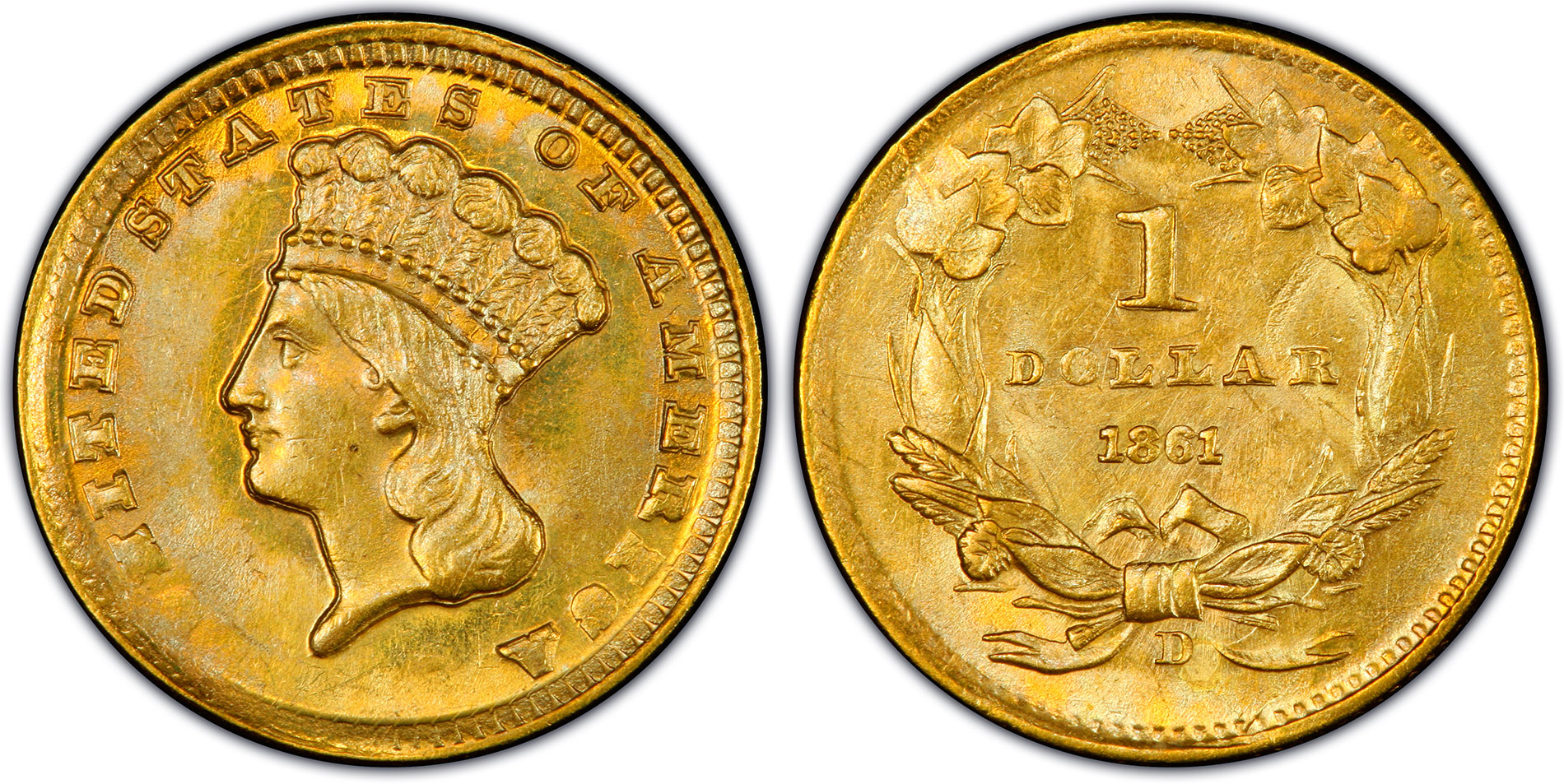
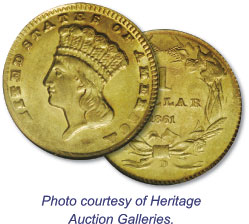
Gold Dollar, 1861-D G$1, PCGS MS64+. Click image to enlarge.
Then there are the four known 1861 Confederate States of America Half Dollars, which marry an 1861 Liberty Seated Half Dollar obverse and “Confederate States of America” reverse. These pieces were struck on a hand press and are considered extremely rare today and easily take six-figure sums on the occasion they cross the auction block. These four pieces remain the only coins expressly designed by and produced for the Confederate States of America. The New Orleans Mint returned to Union control in 1862, and the Dahlonega and Charlotte Mints – the only other minting facilities on land that fell into rebel hands – permanently closed soon after their Confederate seizures.
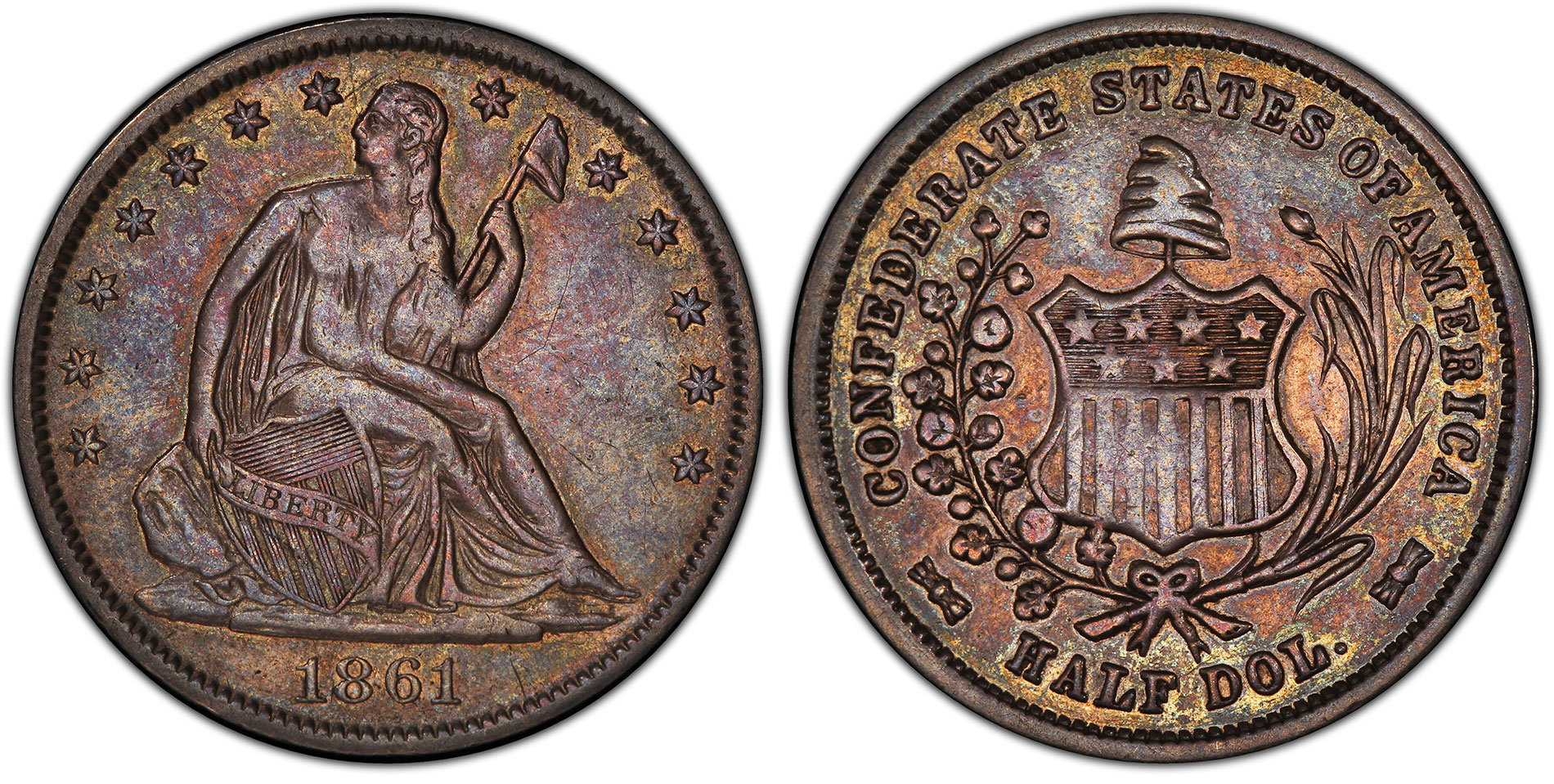
Confederate States of America, 1861 50C W-12 CSA Original, PCGS SP40. Click image to enlarge.
After the Civil War ended in 1865, numismatic interest in the coinage of the confederacy began growing. There were certainly plenty of private Confederate tokens issued during the Civil War, with estimates suggesting more than 50 million pieces representing some 10,000 designs cumulatively were issued on both sides of the Mason-Dixon Line by merchants and other enterprising individuals. There are several restrikes out there, though the collector must be wary of pieces minted after the Civil War and billed as “restrikes” but are rather fantasy pieces – not bona fide restrikes of actual Confederate coins.
By far the best known and most popular Confederate restrike coins are those concerning the 1861 Confederate States of America Half Dollar. Following the Civil War, Confederate Chief Coiner Dr. B.F. Taylor retained one of the Confederate Half Dollars and the distinctive reverse die that was used to produce them in conjunction with the Union-produced Liberty Seated obverse. Around 1879, Taylor sold both items to a coin dealer named Ebenezer Locke Mason, Jr., who in turn purveyed them to J.W. Scott. Rendering minor repairs to the reverse die, Scott overstruck 500 regular 1861-O Liberty Seated Half Dollars (many likely circulated) with the Confederate reverse and sold them to the public as restrikes.
Additionally, Scott struck 500 “white metal” (likely tin) tokens bearing the Confederate Half Dollar reverse and anchored with an obverse reading “4 ORIGINALS STRUCK BY ORDER OF C.S.A. IN NEW ORLEANS 1861 ******* REV. SAME AS U.S. (FROM ORIGINAL DIE : SCOTT).” Today, both of the Scott pieces are considered rare and valuable, with the 1861 CSA Restrike Half Dollar fetching about $12,500 and up and the white metal 1861 Token CSA Scott Obverse Confederate Reverse selling for around $4,000 to $5,000.
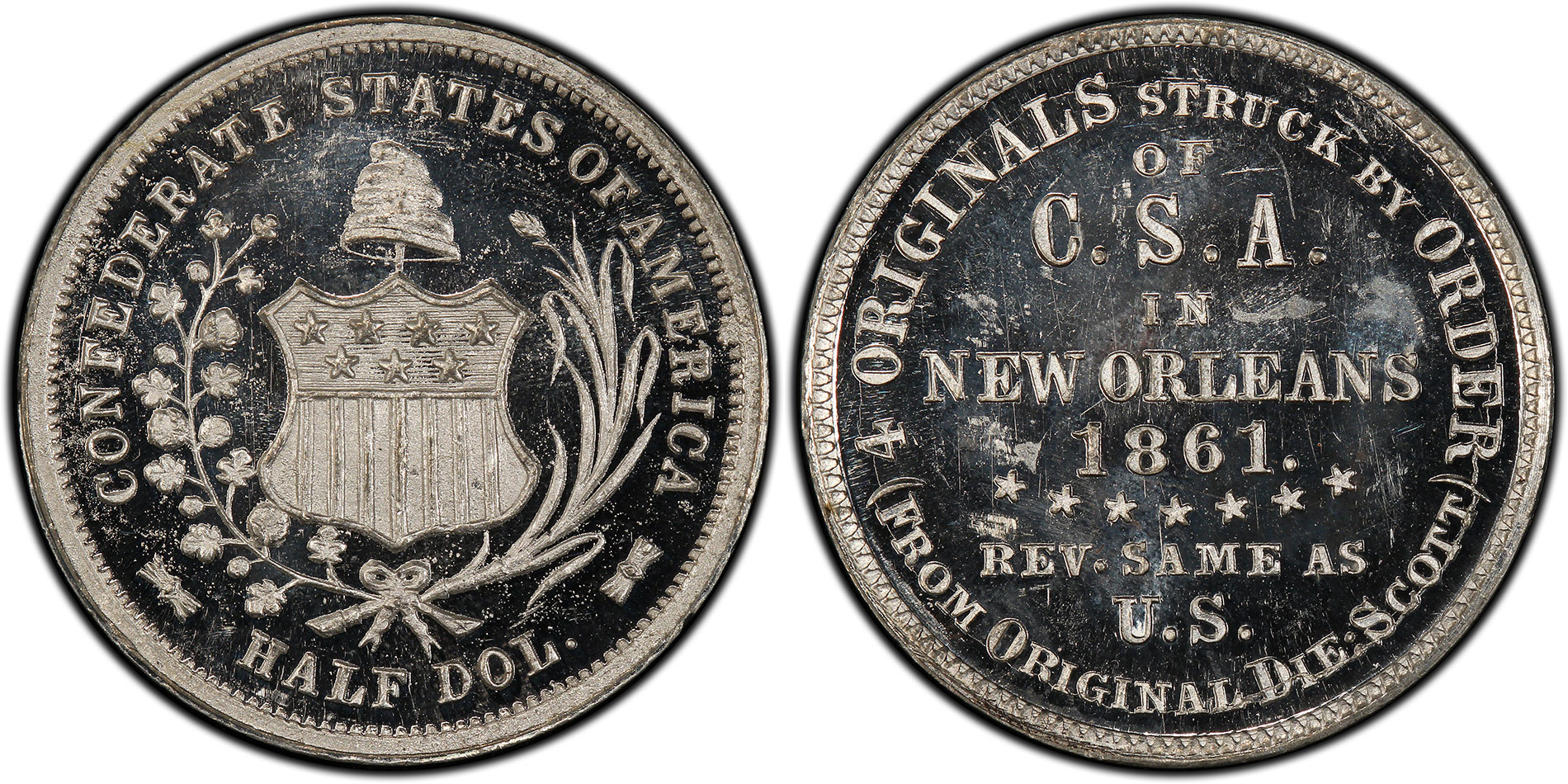
Confederate States of America, 1861 Token CSA Scott Obverse Confederate Reverse, PCGS MS66. Click image to enlarge.
Another popular rebel relic is the 1861 Confederate Cent Restrike, which was originally designed by Philadelphia die engraver Robert Lovett, Jr., who created the piece as a sample production for a potential contract with the Confederacy that would involve creating dies for a one-cent coin. He created around a dozen examples, though they never were parlayed into any further professional opportunities involving Lovett and the production of Confederate coinage – reportedly out of Lovett’s grave concern of being branded a traitor for working with the Confederacy; it could have resulted in a charge of treason. The penalty? Possibly the death sentence.
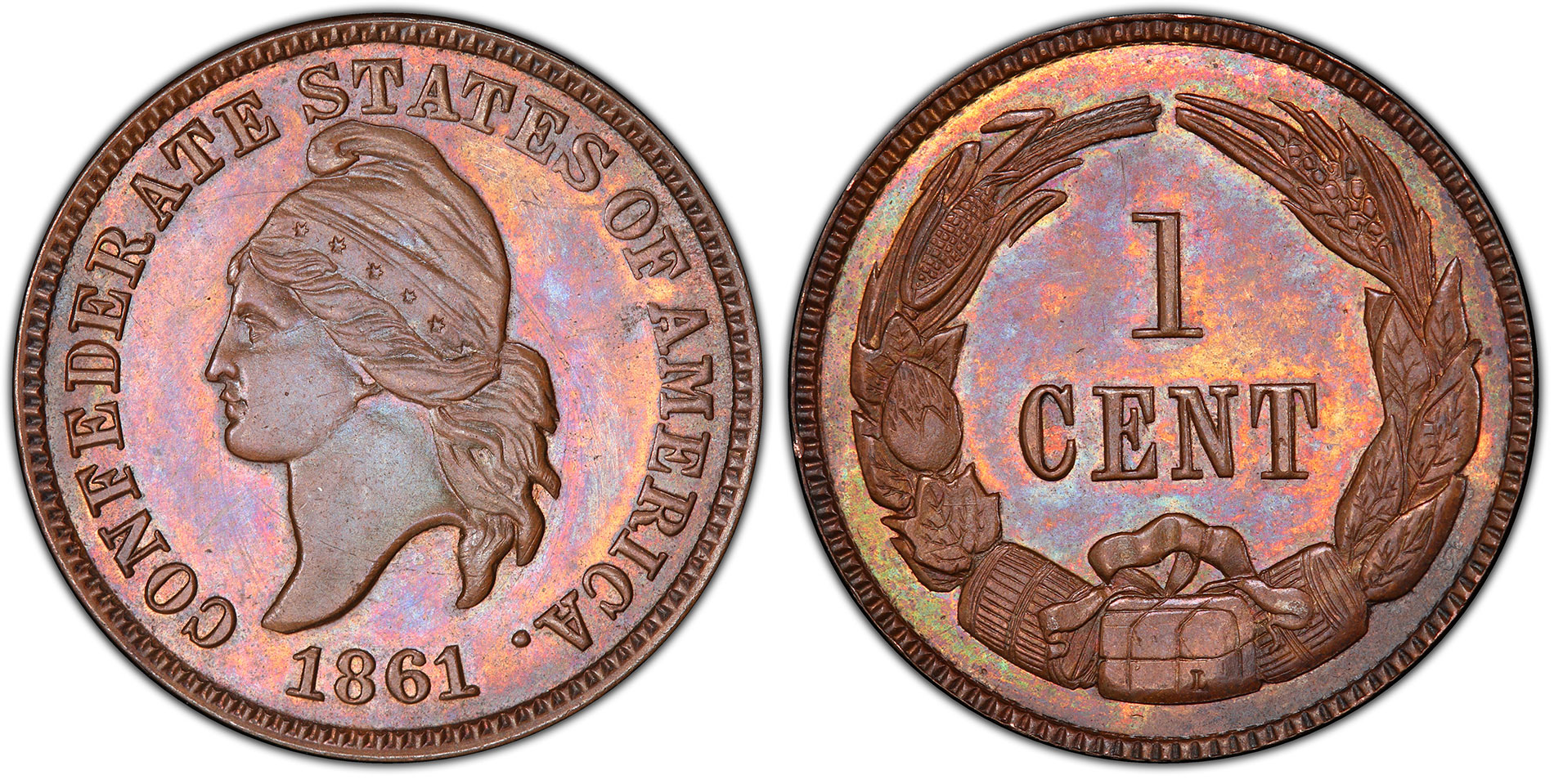
Confederate States of America, 1861 1C CSA Restrike - Copper, BN, PCGS PR64BN. Click image to enlarge.
Accounts further continue that Lovett, who carried at least one of these 1861 Confederate Cents (patterns) in his pocket, inadvertently spent one of them at a bar in west Philadelphia around 1873. The odd coin caught the eye of the bartender, who contacted prominent coin collector Dr. Edwin Maris. In short order, the 1861 Confederate Cents came to the attention of notable numismatists J. Colvin Randall and Capt. John W. Haseltine, the latter of whom reportedly managed to buy at least 10 of the other 1861 Confederate Cent patterns from Lovett as well as the dies. Haseltine went on to produce a number of restrikes in copper, silver, and gold circa 1874 cumulatively numbering into the dozens. All are rare and take several thousand dollars each.
Nearly a century later comes the early 1960s and centennial remembrance of the Civil War, prompting a flurry of interest in the Confederacy – and its coinage. By this time, the Confederate One Cent dies had arrived in the hands of Robert Bashlow. The obverse die had little evidence of wear though the reverse bore some cracks, and both dies had been defaced. Still, they were usable, and thus Bashlow hired an engraver to create transfer dies, which in turn were used to produce “second restrikes.”
The Bashlow restrikes, produced around 1961, are distinct for the ridges across the surface caused by the die defacing or unknown time or origin. Thousands of these Bashlow restrikes were made in various metals, though the most common were produced in bronze and silver, with 20,000 of the former and 5,000 of the latter. These generally trade for around $100 to $200 more or less and depending on the condition and eye appeal of each individual piece.
About that same time, Bashlow struck a series of tokens incorporating the Confederate Half Dollar reverse design, with the obverse declaring mintages of the three alloy options from which the tokens were made, including 5,000 silver, 20,000 bronze, and 5,000 goldine. These mintage numbers are believed to be inflated, and that nowhere near these figures were achieved with Bashlow’s Confederate Half Dollar token restrikes. Still, many of the Bashlow Confederate Half Dollar tokens realize anywhere from $300 to $750 apiece.
Sources
- Bowers, Q. David. “The 1861 Confederate Half Dollar.” Mint News Blog. November 7, 2018. Accessed January 12, 2021.
- Breen, Walter. Walter Breen’s Complete Encyclopedia of US and Colonial Coins. Doubleday, 1988.
- “CSA – Confederate States of America Coins & Restrikes.” COIN HelpU.
- Gilkes, Paul. “Bashlow ‘Restrike’ Confederate Half Dollar Tokens.” Coin World. December 7, 2015. Accessed January 12, 2021.
- Ginsburg, David. “New Orleans Mint.” Southern Gold Society.
- “The‘O’ Mint in 1861.” Greater Atlanta Coin Shows Commentary. January 31, 2017. Accessed January 13, 2021.

 Copper & Nickel
 Silver Coins
 Gold Coins
 Commemoratives
 Others
 Bullion
 World
World
 Coin Market
 Auctions
 Coin Collecting
 PCGS News