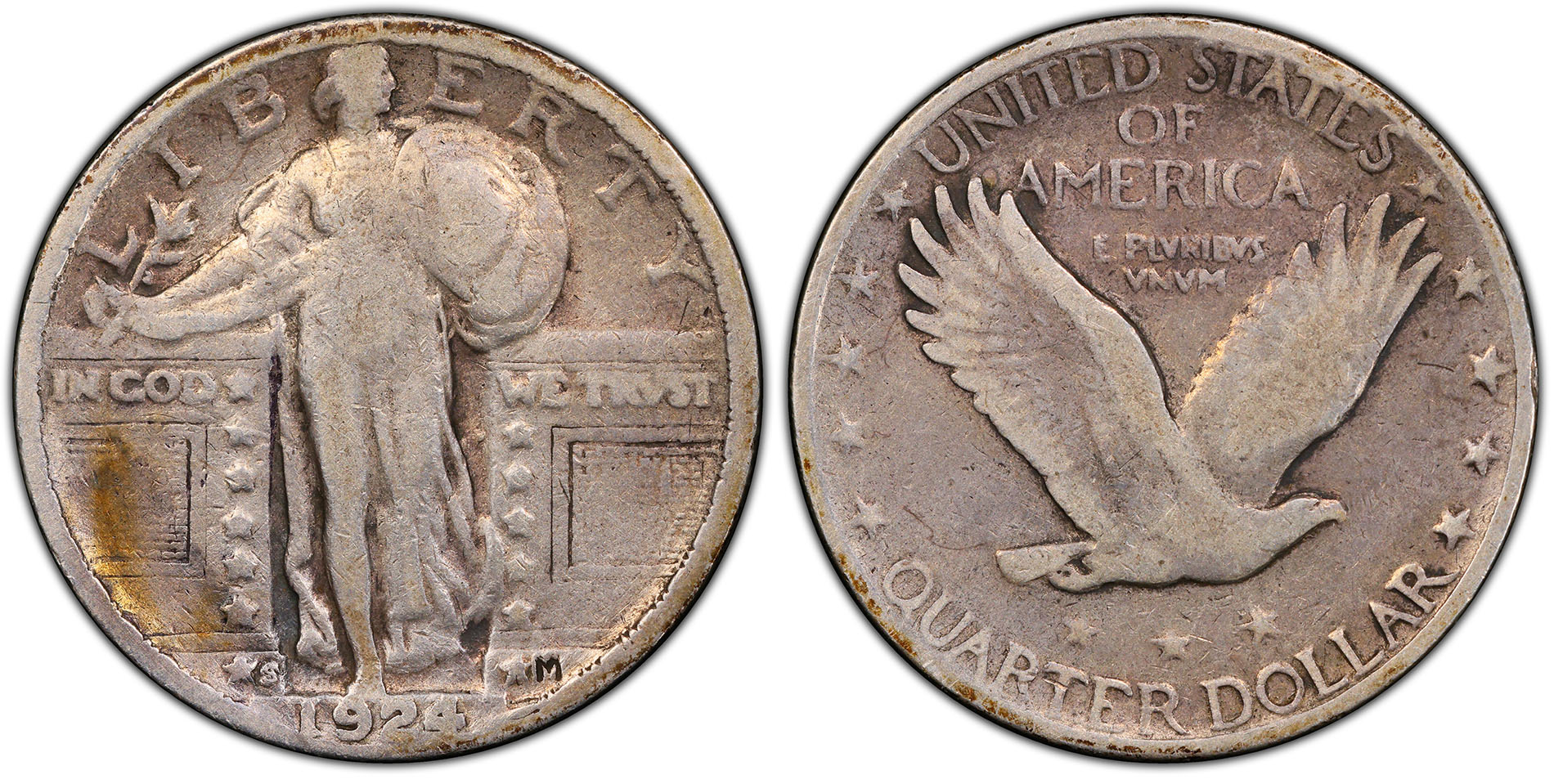
Recently a piece posing as a classic coin was passed around the grading room, stirring great conversation because it was a counterfeit – and a good example of how such attempts at deception continue today.
The piece in question is a perplexing counterfeit because it is unassuming. It’s fashioned as a 1924-S Standing Liberty Quarter, which if real would not be a rare issue. The piece is made with real silver and appears circulated. However, it is published as counterfeit in multiple publications, and several details are incorrect, condemning the piece to the status of counterfeit.


This piece is an incredible example of a transfer-die counterfeit. This means that a genuine coin, in this example a circulated 1924 Standing Liberty Quarter, was used to make a false die. The largest issue with the coin is the mintmark. The “S” mintmark is not of a style used by the mint for this issue. Further at issue is that the mintmark is double engraved onto the die. In the same direction, doubling is seen on the star next to the mintmark showing a reengraving was made to that detail as well. While there are other areas of tooling on the coin, the mintmark style and doubling are clear giveaways for it not to be a United States Mint product.
What is also strange about this piece is that it is made from good silver. Many contemporary counterfeits are debased or made from plated cheap metals, giving the counterfeiters a greater arbitrage in producing money to be spent. This example tested at a higher silver content of 91.5% silver compared to the standard 90% silver issues from the United States Mint. In other publications, tests done on other examples of this counterfeit came back as sterling silver, or 92.5% pure.
One of the keys to success is knowledge. This counterfeit is published in Bad Metal Silver 3cs to 25c by Winston Zack and recently was included in the Cherrypicker’s Guide to Rare Die Varieties as a counterfeit. Indeed, education is key in knowing what exists out there. Also, one should never assume a relatively common coin, such as a 1924-S Standing Liberty Quarter, isn’t a candidate for counterfeiting. After all, a common-date, low-grade and damaged coin isn’t something that most people question for authenticity, and yet some 90 years later the counterfeiter made something that continues fooling those who are not vigilant.




 Copper & Nickel
 Silver Coins
 Gold Coins
 Commemoratives
 Others
 Bullion
 World
World
 Coin Market
 Auctions
 Coin Collecting
 PCGS News