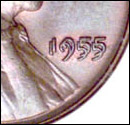
"Hey, I've just found a rare 1969-S doubled die cent! Please grade it for me."
I know those are the thoughts in the minds of many collectors as they send in their 1969-S "doubled die" cents for grading and authentication. Unfortunately, over 90% of the Lincolns submitted as doubled dies from 1969 are in fact coins that exhibit machine doubling. Yes, there is doubling, but it's not a doubled die, and the value is minimal.
There's a good rule of thumb to use when deciding if a coin is a true doubled die. If the mintmark is doubled, then the coin is not a doubled die, because the mintmark was punched after the die was completed. This is true for all coins through 1983, anyway. From 1984 to date, the rules have changed, as the mintmark is now done at the Philadelphia Mint. Why? Too many embarrassing mint errors. Too many "No 'S'"... proof coins!
The true doubled die is created when the die is struck more than once by an improperly aligned hub. This creates die elements that are doubled. The most famous example of the true doubled die is the 1955/55 doubled die cent. Before hubbing was introduced, the dies were engraved or punched, creating doubling only on single elements.
Then what is machine doubling? Sloppy work! The die has loosened, and has a shimmy to it as it strikes the planchet, leaving a residual shelf.
Is your coin a true doubled die? Have it checked out by PCGS, and don't purchase one without the PCGS guarantee of grade and authenticity.


 Copper & Nickel
 Silver Coins
 Gold Coins
 Commemoratives
 Others
 Bullion
 World
 Coin Market
 Auctions
 Coin Collecting
 PCGS News