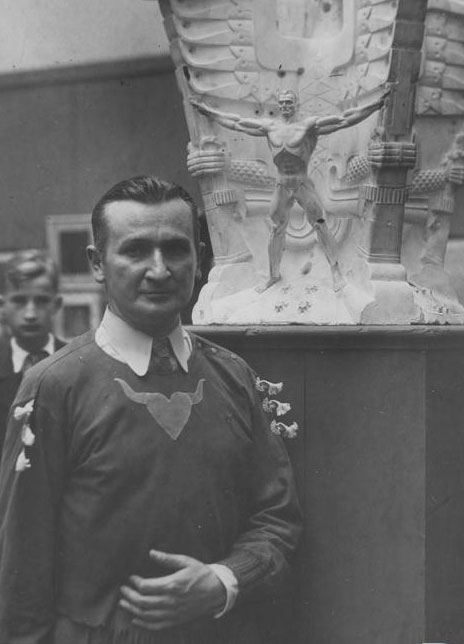
Photo of Stanislaw Szukalski. Circa 1936.
It can be exhilarating to recognize something that was previously unobserved. That moment of discerning that leads to the pulling of the proverbial thread so that you can discover something previously unperceived. This undiscovered insight came in the form of a Netflix documentary. On a sleepless night caused by jetlag, I searched Netflix for something I could hopefully use to fall asleep. "Struggle: The Life and Lost Art of Szukalski" seemed like it would work. Half watching the film, my eyes caught a glance of one of Szukalski’s drawings of Copernicus and I recognized a style of art I had seen before. Suddenly my attention peaked, and I was absorbed.
Stanisław Szukalski was an influential artist born in Poland. At the age of 13, he enrolled in the Art Institute of Chicago and became a vital part of the "Chicago Renaissance" with his paintings and sculptures. His body of work would span decades; from being called ’influential’ by critics, falling into obscurity, and ultimately being rediscovered, all within his lifetime. His most famous work in numismatics is his unadopted design for a Polish 100 zlotych.
Stanisław Szukalski’s Copernicus designs would appear over and over again during his artistic body of work. Dated 1925, his 100 zlotych proba featured a portrait of Nicolaus Copernicus posed upright looking to the heavens. Copernicus holds up one hand with three fingers extending upwards and two down to symbolize the "Holy Trinity". Above his raised hand is the symbol for Earth, a circle with a cross in it. Copernicus’ other hand clutches flames from a circle, which partly obscures his face, representing the sun. There are two distinctly different designs for the Szukalski’s obverse. One that says, "100 Zlotych", and another where an additional ring has been added and below the bust with the text, "Mikolaj Kopernik". The common reverse features a very stylized and detailed Polish eagle. This pattern would be struck in several sizes and metal compositions; however, it would never be adopted as a circulating coin design. Szukalski would design other medals in his oeuvre but no other coins, patterns or otherwise.
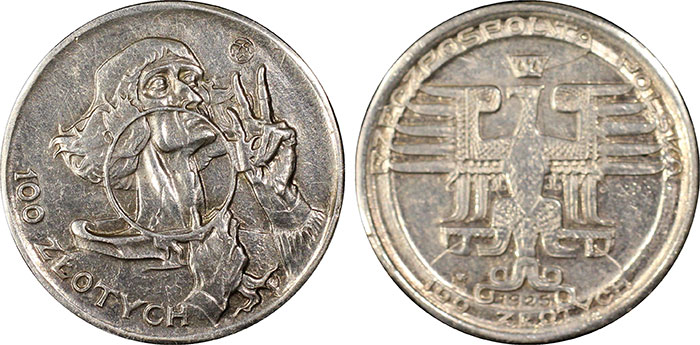
1925 P100 Zlotych. Poland. PCGS SP55. PCGS Gold Shield. Population 1 with 2 higher. Click to enlarge.
As described in the film, Stanisław Szukalski had an obsession with the sun. In his early years, he stared at it for too long and burned out the center of his vision, leaving a dark circle in the middle of his sight. This may account for this Copernicus design, with the obscuring circle in the center representing the sun. It is as if Szukalski is showing people how he would see his design. This obsession with the sun also accounts for his reoccurring use of Nicolaus Copernicus, who formulated the universal model placing the sun in the center of the solar system rather than the Earth. Szukalski’s Polish ethnicity and Copernicus’s Royal Prussian, Kingdom of Poland, nationality also played a role.
I had handled Stanisław Szukalski’s patterns several times in my career, but never knew anything about the artist, his history or the design that had gone into them. Inadvertently watching a random Netflix documentary changed my appreciation for these coins and his art. This is the thrill of numismatics, discovering the history, admiring the art of money and how a new appreciation can come from learning context.


 Copper & Nickel
 Silver Coins
 Gold Coins
 Commemoratives
 Others
 Bullion
 World
World
 Coin Market
 Auctions
 Coin Collecting
 PCGS News