The French Revolution brought about a French Republic, which brought about sweeping changes to remove religious and royalist influences across France and its government institutions. One such change came to its calendar, which would be changed and used by the French Republic for 12 years – including on its coinage.
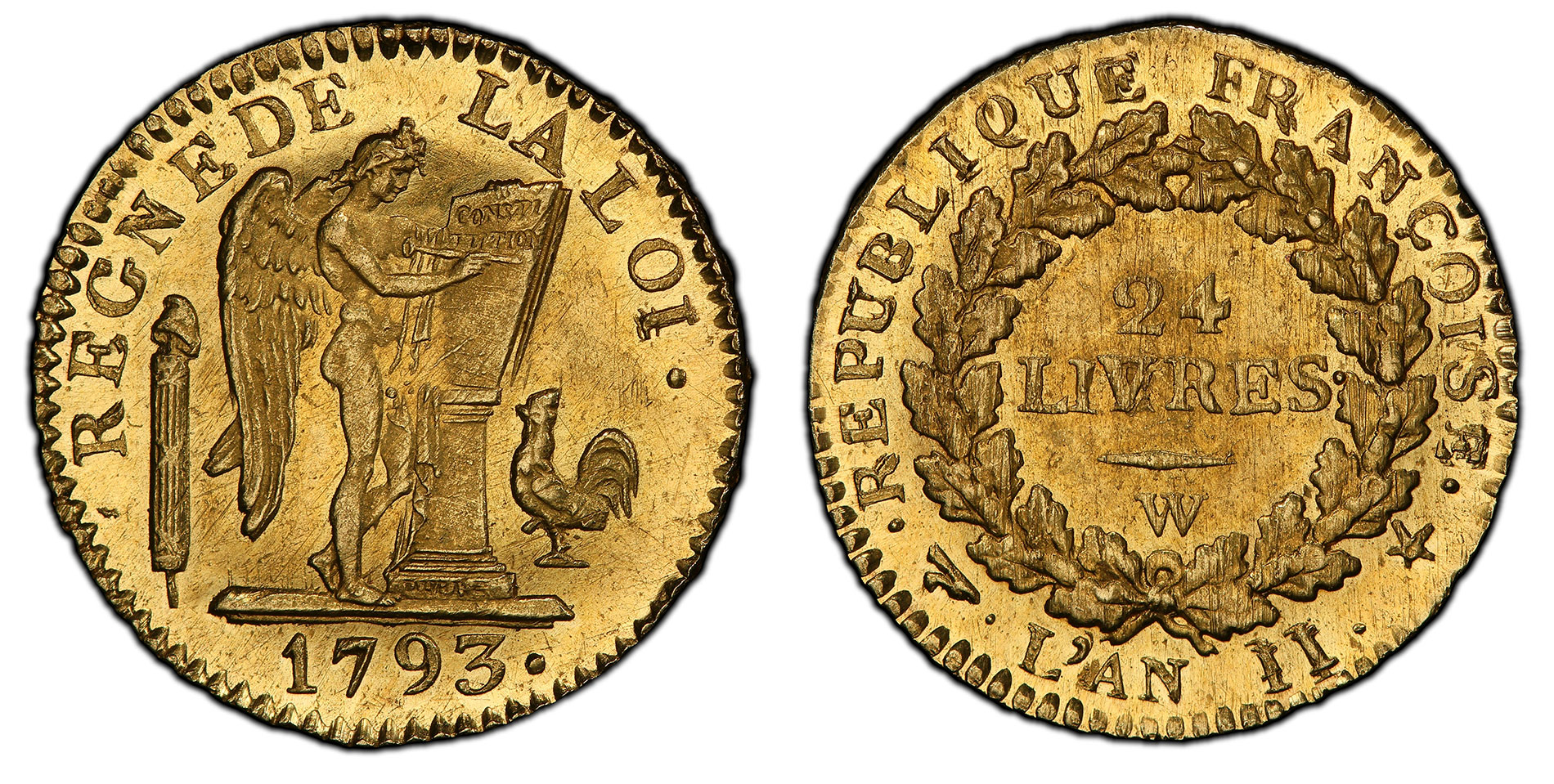
France L’AN II – 1793-W 24 Livres Gad-62 PCGS MS63. Click image to enlarge.
With the new Republic brought about by the French Revolution, the effort to remove the old feudal monarchy systems and replace them with theories of the Enlightenment and look towards ancient Roman Republic and Greek models of the past new systems of weights and measurements were introduced. The idea of using a system of blocks of 10 systems like the metric system were put into place and continue to be used to this day. Yet, implementing a new system for measuring time was something completely revolutionary, but it was put into place. The idea for the revision of the calendar came from Almanach des Honnêtes-gens (Almanac of Honest People), written by the anticlerical atheist Sylvain Marechal, which was a rejection of the calendar system of both Julian and Gregorian systems.
The French Republican calendar was adopted in 1793, but its epoch was set to September 22, 1792. The calendar design was a year divided into 12 months of three 10-day weeks or decades. Décadi, the 10th day of the week, was the replacement for Sunday and was set for the day of rest and festivity. Five or six extra days were needed each year to approximate the solar year, so they were added to the month that ended each year, September, and were called Sansculottides, or complementary days.
Decimal time was also part of the French Republican Calendar in which each day was divided into 10 hours, which each was 100 minutes, and a minute was 100 seconds. The conversion of time meant that the decimal hour was equal to 144 conventional minutes, a decimal minute was 86.4 conventional seconds, and the decimal second was 0.864 conventional seconds. Clocks were made to display decimal time, but this time system was a failure and was officially suspended on April 7, 1795. Some cities continued to use decimal time as late as 1801.

L’AN 7/5 (Overdate) (1798)-A Decime Gad- 187 PCGS AU58BN. Click image to enlarge.
For coins, the French Republican calendar was used starting in 1793. The coins’ date would be written L’AN followed by a Roman numeral or a number to signify the year. In year 11, the L’ is dropped and is AN going forward until discontinued in year 14. For some coins, such as those in L’AN II, the date corresponding for the Gregorian calendar is used on the coin as well. Since the calendar started on September 22 or September 23 during its use, the date conversion is not exact but is normally adopted to the closest year. The coins using this system started in L’AN II, or year 2, and ended in AN 14 or 1805.

France AN 12-A (1803) 20 Francs Gad-1020 F-536 Premier Consul PCGS MS63. Click image to enlarge.
The French Republican calendar, while used for almost 14 years by the government, was abolished by Napoleon when he signed an act on September 9, 1805. Two fundamental flaws were noted for the abolishment – the leap years were not fixed like they are in the Gregorian calendar every four years, but followed the course of the sun instead causing issues; the second major issue was the adoption of the calendar across Europe, America, and the rest of the world would not catch on and with Napoleon’s conquests across Europe introducing a new calendar was not popular. The calendar was not applied in France’s overseas territories and thus the government still had two different systems. For the people living under the calendar system it, too, was very unpopular – one day of rest every 10th day rather than every seventh as dictated by the Gregorian calendar was a conflict with those who practiced religious observances.
Coins from France used this dating system from 1792 until 1805, and with 18 different mints producing these coins it is a difficult set to obtain. Yet, it is a look at a time when France made an effort to rewrite the standards and measurements and succeeded with the metric system but failed with rewriting time and rewriting the dating system.
References:
- French Republican calendar Wikipedia.org


 Copper & Nickel
 Silver Coins
 Gold Coins
 Commemoratives
 Others
 Bullion
 World
World
 Coin Market
 Auctions
 Coin Collecting
 PCGS News