I have often joked with other dealers that if there were a show at midnight in a barn in the middle of nowhere, there would be business to be done. I’ve done coin deals on a tailgate, in a laundromat, and – yes – in quite a few barns! Many dealers will remember the shows at the converted hotel parking garage in Maryland. Because of poor drainage, any precipitation would flood the bourse floor, covered with dozens of extension cords for our lights running all over. My point is that numismatists will follow the deal, or promise of a deal, nearly anywhere.
When I was a kid, just finding coins to buy was an ordeal. When I was 12, the nuances of the post office were just a bit too challenging yet, so mail order wasn’t an option for a couple of years. Incidentally, I was known by my first name at the post office within a couple of years. I collected stamps, too. I would like to think it was because of my inquisitiveness, but they probably viewed me as a pest! Just anticipating a package’s arrival would prove to be a challenge, too.
Two of my closest coin-collecting friends in junior high school were Bill Shamhart and David Williams. We were in seventh grade. I don’t know which of the three of us saw the sale bill first. A local auction barn called Harclerode’s Auctions was having a weeknight (very unusual) auction at their facility – a pole barn. The Harclerode Auction barn was about 10 miles South of Warrensburg, Missouri, near Cornelia. We had to have a parent drive. This time it was Bill or Dave’s parent.
Harclerode’s Auction Barn was a pole barn with a big woodstove and small concession stand in one corner. I think sodas and coffee were about it for refreshments. On a weeknight the concession stand was closed. The restrooms were outhouse(s) and of course outside the building. I can picture the crowd – all 20 of them. Seriously, there weren’t more than 20 people in attendance, including the auctioneer and his clerk wife. In addition, at any Harclerode auction, half of the attendees were neighbors who came over because “they had absolutely nothing else to do,” or so they said. These were warm bodies, not bidders.
The coin collection being auctioned wasn’t special. There were some partial sets of 20th-century coins, partial Morgan and Peace Dollar sets, and two gold coins. One of the partial sets was a Lincoln Cent set with many of the early S-mint semi-key dates. We were very excited, because all three of us needed these same coins for our Lincoln sets.
Country auctioneers, like big-city auction houses to a certain extent, sell what they are consigned. Auction fever, albeit on a smaller scale, was something I was already aware of. I had been attending and helping organize auctions with my family for most of my childhood before that. Often, when attending an auction with my folks, my dad would point out items he had an interest in, but also what his number was for those items. I had studied the sale bill and I already knew what “The Red Book” (A Guide Book of United States Coins) prices were for every single Lincoln that was going to be auctioned.
Part of the reason you attend an auction is in the hope of landing a bargain, but overpaying shouldn’t be an option. Frankly, my family was poor, but we thought we were middle class. My folks’ typical auction budget was $20 to $30. If an item was special, they bought it. They would budget for several weeks after to pay for it. My dad, who had an economics degree, would point out that the value of a dollar not squandered was the big deal!
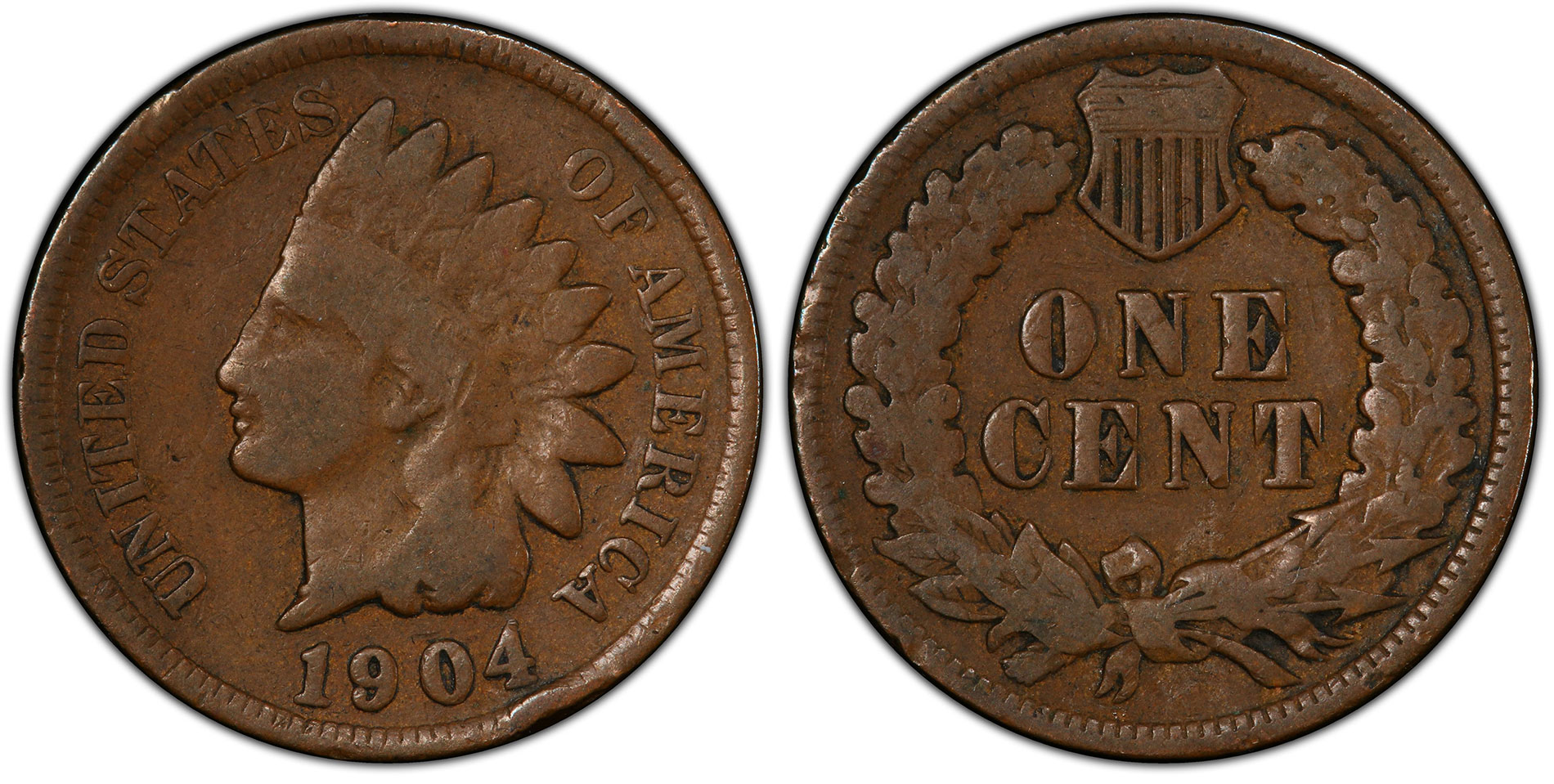
The auction itself was maybe 90 minutes long. As usual, the lots being auctioned followed the sale bill listing order with the Indian and Lincoln Cents leading the charge. Like I said, this wasn’t a special collection. I recollect maybe a dozen Indian Cents, half of which had been cleaned severely, with an average grade of Good, maybe Very Good if you held it just right, and none being better dates selling for more than $2 each. At the time you could buy an average circulated roll of Indian Cents for $20, or 40 cents a coin. I was aware of this. Why were these bringing more?
When the Lincoln Cents rolled around a few minutes later, everyone in the room got excited. Seriously, looking back on it now, it was hilarious. Just as a point of reference, there wasn’t a single $150 coin in the entire auction. The two gold coins were circulated $5 Liberty common dates, one of which had been in a jewelry setting. They brought around $100 each and were probably worth $60.
I already realized there might not be much I could buy but I was going to try! I should have known how foolhardy that would be when the 1909 VDB in maybe a Fine grade brought $12. All three of us had bowed out of bidding for it at $7 or 8. They were worth $4. The next coin up was the 1910-S (there was no 1909-S VDB), which had been cleaned but was still ok looking with a net grade of Very Good. I stayed in until $5 and the coin went for $10. It was worth about $3.
I didn’t bid on another coin all night! David and Bill continued to beat each other up over these less-than-exciting coins. Both were able to buy several coins for their Lincoln sets. I was so disappointed. When I explained the auction to my dad, he laughed and gave me a big hug! He was so proud. “It’s just auction fever, Vic,” he said. “You’ve seen your mom and I walk away from dozens of antiques over the years because they weren’t a fair deal anymore. That’s exactly what you did!”
Some of my early coin lessons are still so fresh to my memory today. Sometime during this same year, my dad and I got up early one Saturday morning to drive to a country estate auction in a small Missouri town near the Lake of the Ozarks. The sale bill promised a plethora of antiques and collectables hoarded for decades by this reclusive old man who had also owned a salvage yard. His estate consisted of three houses on an entire city block of this small town. The houses (and half a dozen out buildings) were in disrepair and there were piles of virtually anything and everything.
My dad was the original treasure hunter. He had a good eye, albeit very limited budget. He convinced me to come along that Saturday because at the very bottom of the sale bill it listed 350 Indian Cents and both a $5 Indian and $10 Liberty. “Cool, I’m in!” I packed some of my better Indian Cents in my coin wallet for the trip and off we went. At that age, I never went anywhere without my coin wallet. I didn’t have a real wallet for a couple more years, but I had about $35 in money I earned from mowing lawns.
The auction was brutal. For continuity purposes and to keep the crowd, a country auctioneer will try to sell many of the bigger-ticket items close to the front of the sale. Depending on the size of the auction, this might be difficult. This auction, because it covered a city block, was going to take a while.
Just like in a big coin auction, pre-viewing is available albeit usually only on the day of the auction just prior to the start. Bidders get their number and check out the merchandise. The largest house, an old rundown two-story clapboard-sided house, held a dozen tables set up on sawhorses in the biggest room. Most of the smaller items of value along with the coins were in the house. I was able to look through all of them. I determined that while there were about a dozen coins prior to 1880 they were pretty beaten up.
For the most part the entire 350-piece lot were mostly 40-cent coins. There were some VF-XF coins, and I remember telling my dad that best-case-scenario bid up to 60 cents a coin to pick and I would buy at least 50 or $30 worth. The two gold coins were VF/XF and out of my price range. My dad was able to buy several items in the auction. While we waited for the coins to be auctioned my dad paid for his purchases and we moved them to our pick-up.
The auction seemed to crawl along. I had time to walk a few blocks and grab two sodas from a two- pump gas station which was the “only show in town.” Around 3 in the afternoon, the auction moved to the big house where the coins were. I squeezed into the house with my dad and they finally got to the coins. The two gold coins were sold first. At that time, the $5 Indian was maybe a $125 coin. The $10 Liberty was perhaps $175. I should have known I wasn’t buying any coins when they brought $300 and $500, respectively.
I’ll never forget it. My dad had his instructions. The auctioneer addressed the bidders with the terms that bidders would be bidding per coin to pick. First pick would pull his coins at his price and then the bidding would reopen. Of course, the odds of the 30 coins I wanted remaining after a couple of bidding rounds were going to be slim in any scenario. The bidding started. It opened at $1.50 per coin and hammered at $3.25 a coin. I was flabbergasted but still hopeful. Maybe he just wanted a couple. That’s why he bid more than six times what they’re worth.
No! He bought all 350 of them at $3.25 each! By this point I was incredulous. My dad was laughing. I was past simmering and close to boiling over. It was the same guy who overpaid for the gold coins. Man… I was angry. “What a fool,” I remember thinking. We walked out of the house and moved to the next area to be auctioned. For the next hour my mind was working furiously.
Eureka! All of the sudden, it hit me… The Indian Cents in my coin wallet had become a lot more valuable. Without even running the idea by my dad, I found the guy who had bought all the coins. He was still standing near the center of the action and buying an item here and there. I was determined to offer my Indian Cents to this guy – who paid too much! When there was a break while the auction moved to a new area, I approached the man and introduced myself.
I told him I was a collector. I was attending the auction with my dad and even pointed him out to the guy. I told him I was interested in some of the Indian Cents and congratulated him on buying them all. I then pulled out my coin wallet and asked him if he might be interested in some more Indian Cents.
Being pretty green at the time, I had all of the coins in cardboard 2x2s with descriptions and prices. My Indian Cents were (at my full markup) about a third of what he had just paid for 350 Indians, which were identical to the coins in my wallet. He asked me what I wanted to get for my Indians. I told him I would like to get the prices marked.
What happened next will puzzle me for the rest of my life. I don’t know if he was trying to save face or if he was just a mean and nasty old man. He told me and anyone within 50 feet that all my Indian Cents were “Fakes” and I should be arrested for “counterfeiting.” Can you imagine the look on my 12-year-old face? I wish I had a picture!
“It’s auction fever,” my dad once again explained to me. “He probably wanted to look like a ‘big shot’ to some of his buddies in the crowd,” he said. “When you inadvertently showed him how foolish he had been, he attacked you to justify his stupidity.”
There was another lesson in this for me, too. Although I’ve bought a substantial amount of merchandise at auction over the decades, I have always preferred a sale or purchase transaction. The seller sets a price, and the buyer can play, counter, or pass. Ultimately, a numismatist must go where the coins are available. A seller’s best option is often an auction house because of the tremendous exposure their advertising will bring to the item. The secret for the buyer is to avoid auction fever!


 Copper & Nickel
 Silver Coins
 Gold Coins
 Commemoratives
 Others
 Bullion
 World
World
 Coin Market
 Auctions
 Coin Collecting
 PCGS News