Across the sky they flew, not one sun, not two suns, but 10 suns, in all. They would pop up whenever they pleased, it seemed, and scare the daylights out of the farm animals. The roosters got so confused about daybreak that they stopped cock-a-doodle-dooing. One day, all 10 suns appeared at once and scorched the people’s crops. This was the final straw.
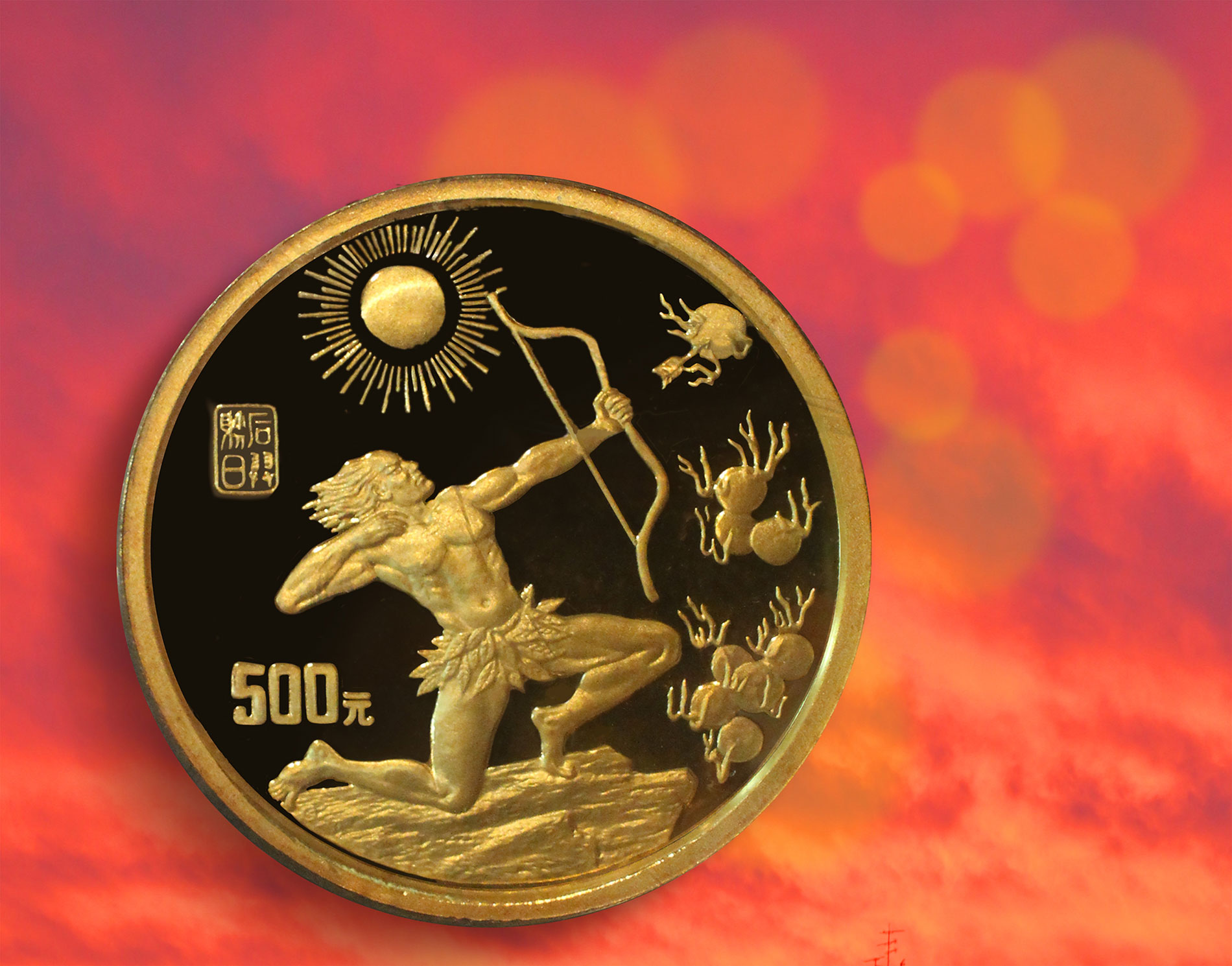
A brave archer named Hou Yi (pronounced Ho Yee), climbed Kunlun Mountain, the highest peak. He called to the suns, but they did not listen to him. Hou Yi spoke gently to them. They did not listen. He yelled at them. They did not listen. He tried every which way to convince the suns to return to their natural places. They did not listen. So, finally, Hou Yi plucked an arrow from his quiver, strung it on his bow, and, one by one, he shot down nine of the suns. The last sun was frightened. Hou Yi sternly told this one, “From now on, you must rise and set on time to benefit the people!” The sun listened.
From that day on, the sun rose and set over the Yellow River valley every day and every night, just as it was supposed to do.
New Coins, Ancient Culture
In the rich soil of the Yellow River valley the civilization of China was planted. The first dynasty, the Xia, ruled here from 2205-1766 BCE. Introduced during this period were irrigation, the beginning of recognizable Chinese writing, bronze casting, the wheeled vehicle, a strong military organization, and China’s first money system. A tradition of innovation was established that grew from generation to generation.
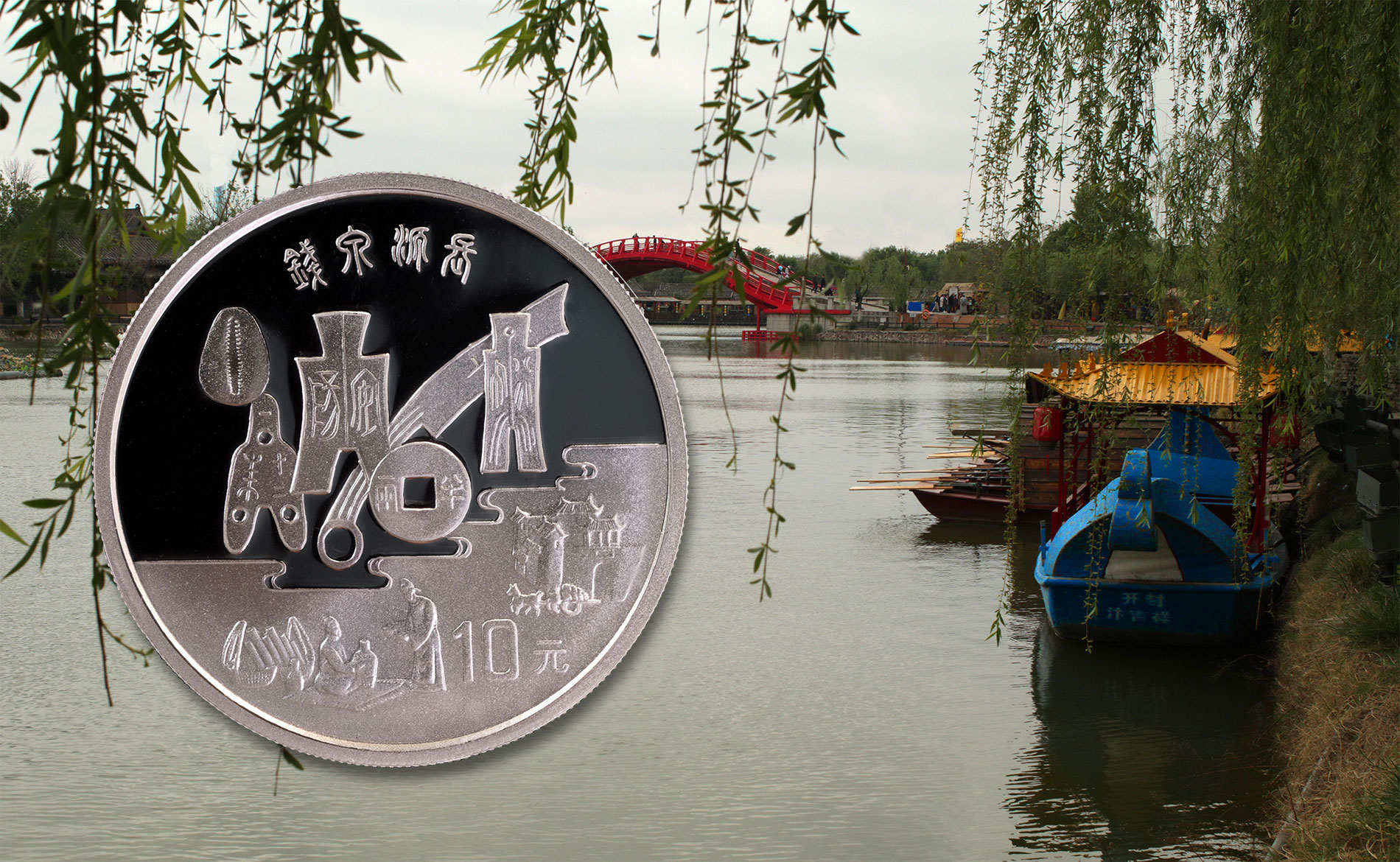
In 1997, the People’s Republic of China recognized that progress with a set of four 10 Yuan, one-ounce silver Yellow River Culture coins. A total of 10,000 of each were struck. One displays early forms of money, such as a cowry shell, knife money, spade money, and a cash coin. The others feature bronze ware, pottery, and calligraphy.
The Yellow River Culture set that same year includes a pair of gold coins that illustrate the “Shooting the Sun” story. One is a 50 Yuan half-ounce gold coin that is 25 millimeters in diameter. A total of 2,135 were minted, according to the Gold & Silver Coins of China Standard Catalogue. The other is a 500 Yuan five-ounce gold coin. It spans 60 millimeters and 156 were minted. The great coin artist Chen Jian, who created the artwork for the 1982, 1983, 1984, and 1987 Panda coins, designed these. Many collectors, like my late friend Nick Brown, consider “Shooting the Sun” among the finest of all modern Chinese coin designs. Mr. Chen says only, “I just try to do things well.”
Mr. Chen worked on both the design and engraving of the gold Yellow River Culture coins. “There was nothing about engraving in school so I had to teach that to myself,” he remembers. “I studied for two years at the Shanghai Fine Arts College before I began to work at the Shanghai Mint. The college had classes in drawing, watercolors, and calligraphy. Drawing is the foundation, and it is important to work quickly.”
Number 6
My thoughts of coins are interrupted as something spirals toward my feet. It’s a yellow leaf! Above me an autumn Beijing breeze rustles the dry gingko leaves like slips of parchment paper. Golden in the sunshine now, by first frost they will carpet the ground.
No tourist guidebook to China’s capital city recommends Number 6 Yuetan Street North for fall colors. The residents of Xicheng District know all about it, though. Three long rows of gingko (Ginkgo biloba), or Maidenhair (Yin Xing, or “silver apricot”), trees line the street. Office workers on lunch breaks, lovers holding hands, children with their families, and an occasional camera-toting tourist come to Number 6 to meet, play, and take pictures.
Half a dozen women of different ages, all dressed in eye-popping pink jackets, gather around a man with a digital camera. I slowly edge closer to also take photos but get noticed. A giggling chorus of, “Hello, hello,” erupts. The group then gets back to its mission. One trick is to scoop up handfuls of bright yellow gingko leaves, toss them into the air like confetti, and snap pictures. A young woman gracefully leaps high off the ground as the others shower her with leaves. Click, click, click!
“Zai jian, bye-bye,” I wave. Behind the trees rises a massive Ming Dynasty gate with three arched passages. These lead into the Temple of the Moon, now renamed Yuetan Park. The 500-year-old Temple was built for emperors to worship the Moon. It was known as “Xi Yue” or “the Moon at night.” Today, its Ming Dynasty structures and flower-filled gardens still delight — and the park is open to all. Admittance costs one Yuan (about 15¢ U.S.), seniors and children get in free.
Autumn Gold
Gingko trees are beautiful but so common that it’s hard to imagine that they were ever rare. But they were. Just a thousand years ago, only a few hundred existed in remote areas of China. It was not until 980 A.D. that they start to be written about. When people found out about gingko nuts, they were compared to “crystal beads in caskets of gold.” An emperor paid roughly 65 ounces of silver for four nuts. Later, Buddhist monks cultivated and spread the trees, which is why many of the oldest ones are in monasteries.
But, the gingko’s roots reach far deeper into time than a thousand years. Fossils show almost the same trees thrived 200 million years ago. Dinosaurs walked among them! That makes the gingko by far the oldest-known type of tree alive today. One botanist compares the gingko to a living Tyrannosaurus rex (I wonder how many leaf-tossers know that? It also makes me think about a Cretaceous autumn. Lovely, if a T-Rex isn’t chasing you).
Then, 125 million years ago flowering plants came along. In the next 25 million years they pushed aside most older kinds of vegetation. By 15 million years ago there were no gingko trees in North America, and by 5 million years ago they had vanished from Europe, too. The last few survived only in remote areas of China.
The gingko trees outside the Temple of the Moon were planted after 1955, when the site was renamed Yuetan Park. In the early 1990s, the City of Beijing planted hundreds of trees there. Along with gingko trees, there are junipers (Juniperus chinensis), cypresses (Cupressus duclouxiana), white-barked pines (Pinus bungeana), Parasols (Firmiana simplex) and pomegranates (Punica granatum). Little signs on some trees show their Chinese and Latin botanical names.
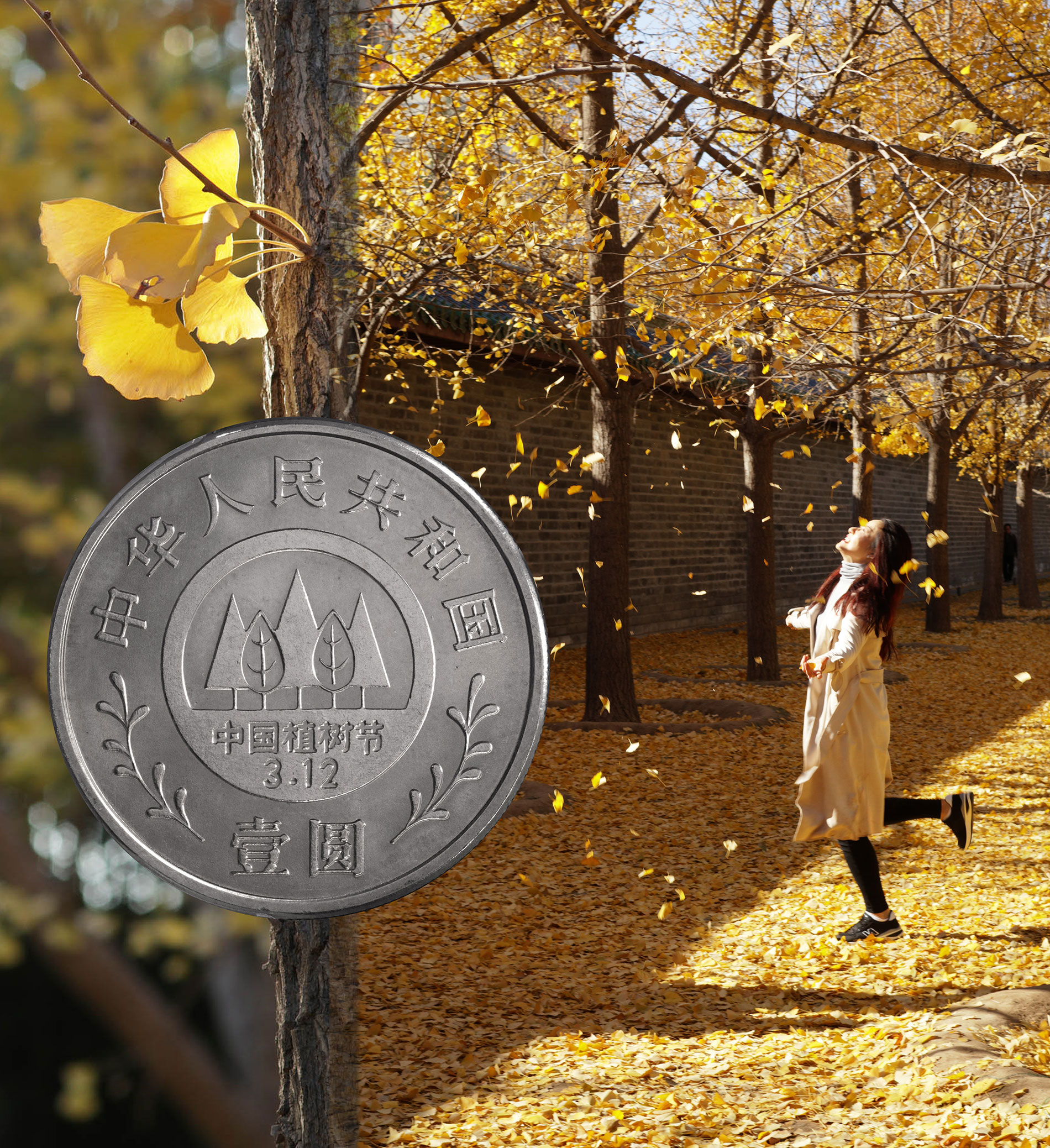
No Chinese money has a gingko on it, but China has honored trees twice with Arbor Day coins. This tree-planting celebration originated in 1872 and was made official in China in 1915. In spring 1991, 10 million nickel-bonded steel Arbor Day coins were minted. An additional 4,000 boxed sets of gleaming proofs were sold to collectors. The obverse design features the logo for China’s Arbor Day: two deciduous and three evergreen trees. All were struck by the Shanghai Mint.
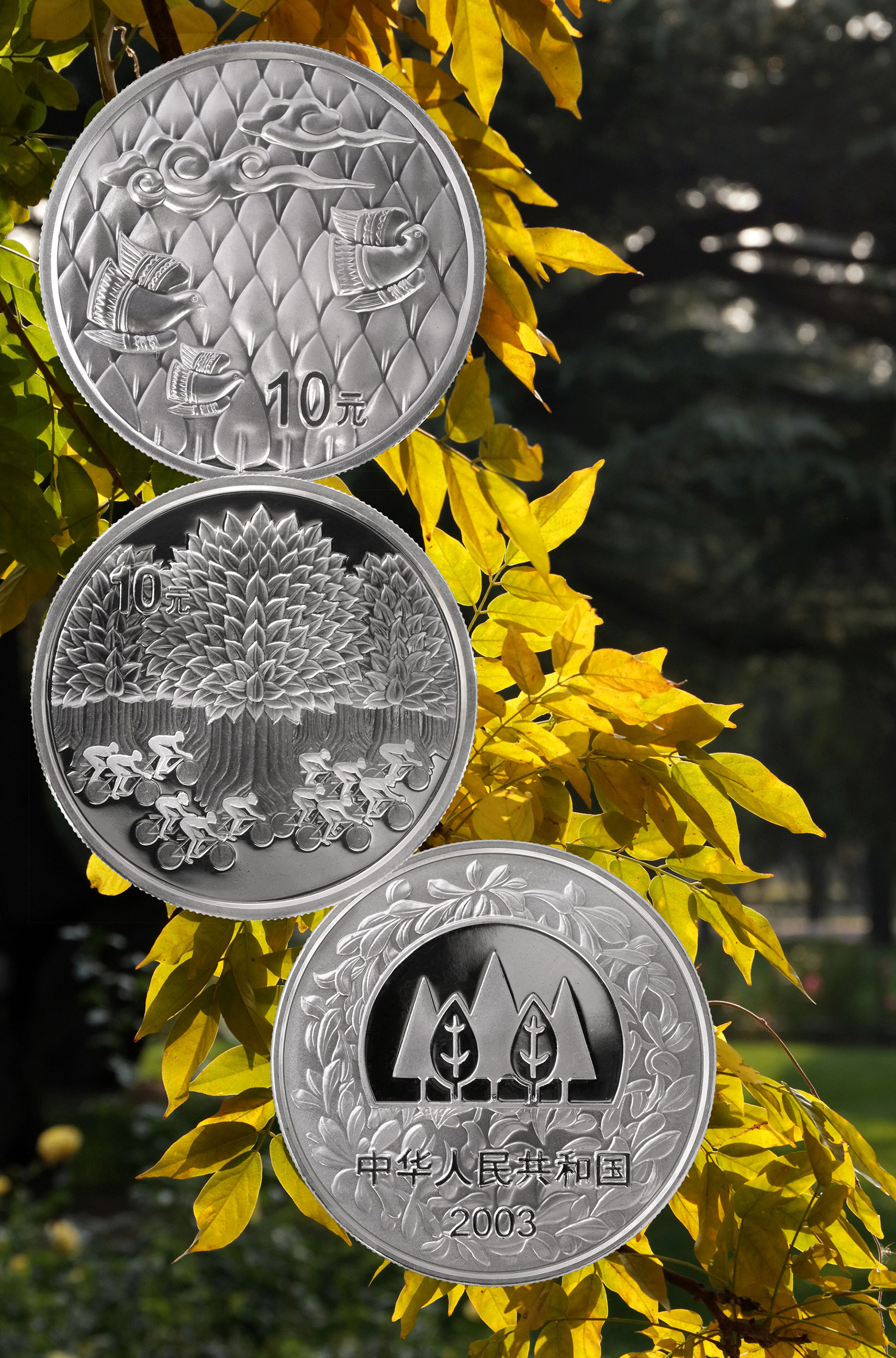
One Lunar cycle later, in 2003, Arbor Day was again celebrated through coins. This time with a pair of very pretty 10 Yuan silver coins, also from the Shanghai Mint. Some 30,000 of each were minted. One shows trees layered like tiles. Clouds drift by as birds soar overhead. It’s an unusual and very attractive coin. The design is by Zeng Chenghu and the engraving is by Zheng Qingyan.
The second coin is called “Cyclists in the Forest.” It’s a lovely and lyrical design by Hu Fuqing and Yue Junfeng that features a dozen bicyclists gliding under a canopy of leaves.
The obverse of both silver Arbor Day coins displays the logo of Chinese Arbor Day encircled by a wreath of leaves. This design is by Gu Hui.
Coins on Blankets
The first chill of winter hangs in the air. As daylight fades Arbor Day feels as far away as the Moon. I am ready to leave Yuetan park when a tune catches my ear. “Are you going to Scarborough Fair? Parsley, sage, rosemary, and thyme.” I wait. The voice hesitates, then resumes, “Remember me to one who lives there, she once was a true love of mine.”
An older man turns, smiles, and asks me in a clear, untroubled voice, “What country do you come from?”
We are inside an open-air pavilion in the Courtyard of Heavenly Scent. It overlooks a pond, black in the near-darkness except for flashes of gold and orange as koi swim by. “I’m from the USA – Meiguo,” I reply.
“I have never been to the USA, but I worked in Russia. When I was younger my job was as a Russian-Chinese translator. Do you know any Russian?”
“Dosvedanya,” I exclaim, and he laughs.
“My name is Peter, what is yours?”
“Wang Xin Fa,” he grins. “You are here for business?”
“Sort of.”
Mr. Wang is intrigued, “What sort?”
“I study coins and there is a big coin convention in Beijing.”
“Ah, old coins?”
“No, modern ones.”
This surprises him. “Why do you like modern coins?”
“For their beauty and the stories they tell.”
“You know, this park is where the first coin market in Beijing would meet. People just laid out coins on blankets,” Mr. Wang recalls.
“When was that?”
“In the 1990s,” he answers.
The light dims more as we chat and the temperature drops with it. “How old do you think I am?” Mr. Wang asks.
“75.”
“85!” he proclaims, “I am 85 years old! Health is what matters, not age,” and adds, “To your health!” He looks very fit. I pat his shoulder and can feel the still-solid arms.
“To your health,” I call as he turns away into the night. “To your health,” he replies with gusto and laughs once more.
That laugh trails after me as I walk through the almost deserted park and consider Wang Xin Fa’s time in Russia long ago. Life moves on. Then, I recall Hou Yi and how his story also did not end with the nine suns.
For his bravery, the Queen of Heaven rewarded him with a potion that would lift him to Heaven and immortality. Hou Yi gave the vial to his wife Chang’e to be kept safe. But, one day a man forced his way into their home to steal it. Chang’e, cornered, swallowed the liquid herself.
That night a terrible sight met Hou Yi’s eyes; high above, Chang’e stood beside a laurel tree on the Moon and looked down longingly at him. “Flying to the Moon,” a 1997 50 Yuan five-ounce silver coin illustrates this part of the story. On it is a wistful image of Chang’e as she floats away. Designed by Gu Xingbao, it is the mate to the “Shooting the Sun” gold coins. Only 1,000 were struck at the Shanghai Mint.
Hou Yi could never forget his wife. In Chinese culture the full Moon represents reunion, so on the 15th day of the eighth Lunar month when the Moon is at its brightest, Hou Yi set out a banquet to honor the Moon. It celebrates the eventual end of his separation from Chang’e. Sometimes called the Moon Festival, the Mid-Autumn Festival is the second-most important holiday of the year in China. Families travel from near and far to reunite, rejoice, and eat small, round baked delights, “The kind of rich, sugary treat that people in the old days craved,” as a friend put it.
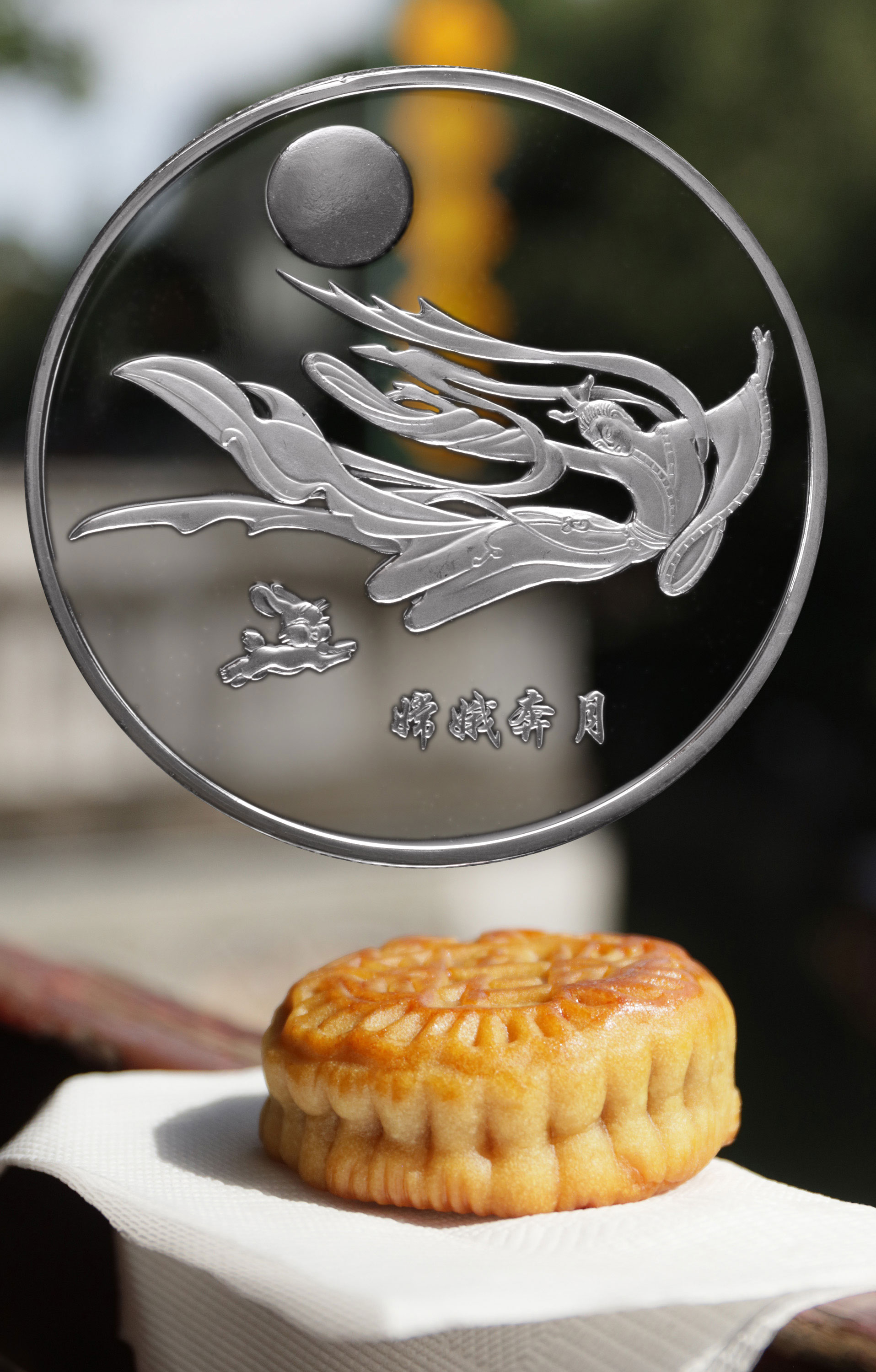
These traditional pastries are called mooncakes. In South China, they stuff them with sweet red bean, or lotus seed, paste, the yolks of salted duck eggs, and sometimes coconut. Northern China’s version is filled with five kinds of nuts. If that’s not to your taste, stores today sell deluxe Belgian chocolate mooncakes.
The sky is totally dark when I reach the Yuetan Park exit. The middle arch of the main gate is open. I turn around and remember my all too-short conversation with Wang Xin Fa about his experiences. A life well-lived is like a crystal bead in a casket of gold. The gingko trees, ancient survivors, their leaves silver in the moonlight, say nothing. I call out, “To your health, Mr. Wang!” and go.


 Copper & Nickel
 Silver Coins
 Gold Coins
 Commemoratives
 Others
 Bullion
 World
World
 Coin Market
 Auctions
 Coin Collecting
 PCGS News