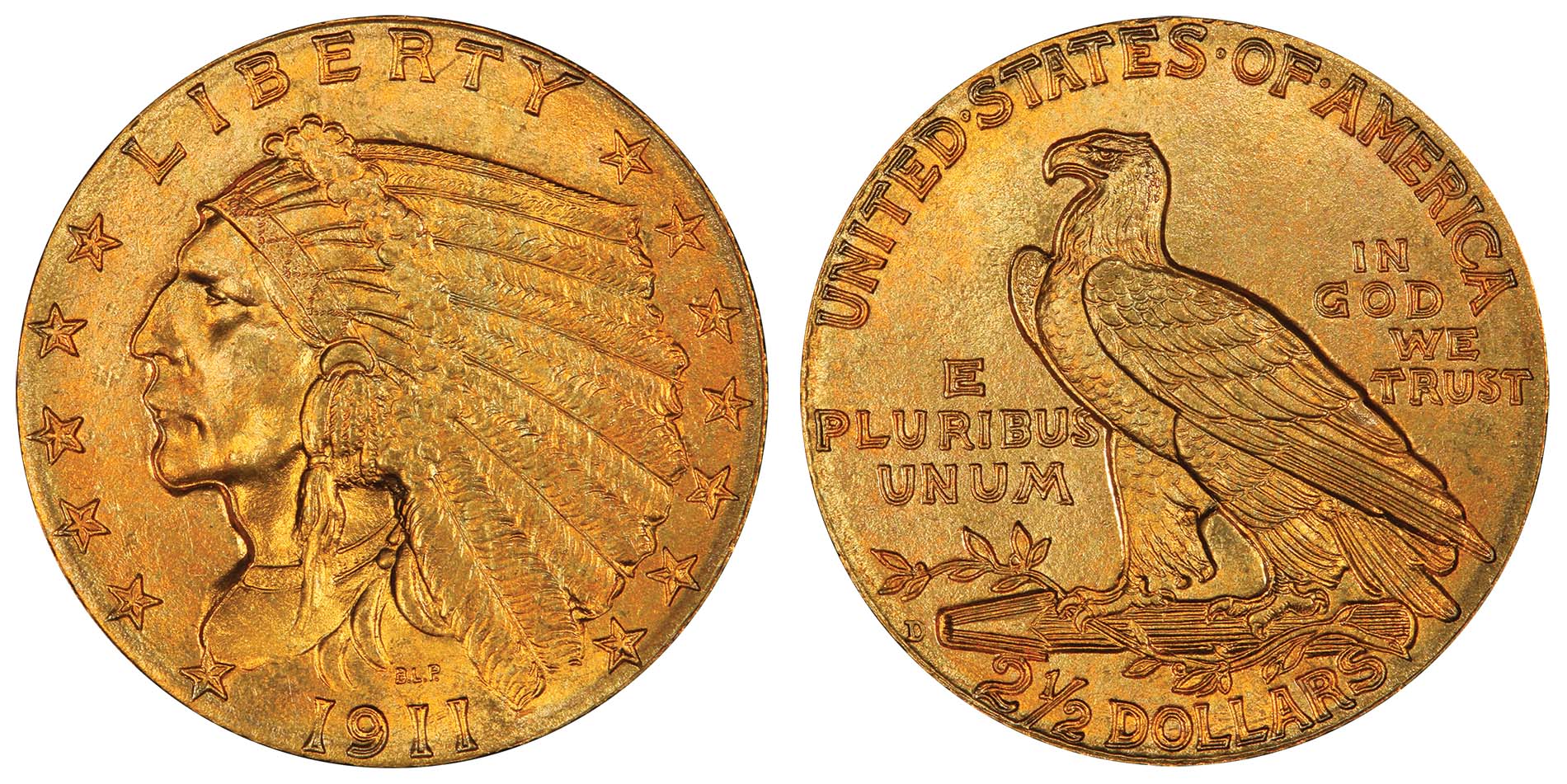
Auction prices are the basis for establishing most values in the PCGS Price Guide. The price guide team analyzes and interprets auction results for each coin and grade, and determines a price point for each one that best reflects the current market. That process can be very challenging when there’s a wide range of auction prices realized for a given coin in a given grade.
If you use auction prices realized in your own research when you’re buying or selling coins, you know what I mean. If you’re new to researching auction prices and would like to explore PCGS Auction Prices data, you can find a quick link at the top of any PCGS website page. Once there, you can sort auction prices for any coin by date sold, price, grade, etc., by clicking on the appropriate column title. You can also select data exclusively for PCGS-graded coins on the button that’s above the titles.
To illustrate the wide range of auction prices realized for a single coin and grade, this article examines the Indian Quarter Eagle series. This is a short series with just 15 different coin issues, struck from 1908 to 1929. Except in the very highest grades, the 1911-D Quarter Eagle is the only stopper, making this series very popular with collectors and investors.
The coin’s “incused” design, in which its details are recessed below the fields, means that the coin’s fields are the high points that receive circulation wear. This design is unlike the designs of most other U.S. coins in which the details are raised above the fields, making the details of those coins exposed to wear from circulation.
First, a few words of caution. While you’re researching auction prices, remember to be on the lookout for high and low outlier prices and check them out to try to determine why those prices are outliers. For example, the highest auction price realized for the 1925-D $2.5 issue is $66,125 for a PCGS-graded AU58 example that sold in a 2005 Heritage Auctions sale. That extremely high price from long ago doesn’t make sense. The current PCGS Price Guide value for this coin issue is just $580 in AU58.
What happened? Did two or more bidders get carried away with auction fever? No. Clicking on the link to the auction lot reveals that the coin is a major error. It was double struck and clearly shows a double image of the coin’s details on both sides. While this is an extreme example of a high outlier price, many more high outlier prices often result from colorful toning on silver coins, for example, or for other reasons. It’s helpful to click on the links provided and to examine photos of the coins to try to determine why. Sometimes it’s obvious, sometimes it’s baffling.
In the MS66 grade, there are three recent prices to consider for PCGS-graded examples of the 1925-D Quarter Eagle. The most recent price is listed first: $9,988, $10,200, and $10,266. This is a very tight price range, resulting in a PCGS Price Guide retail value of $12,500. Those sales took place between July 2022 and February 2023. The next two prices listed for PCGS-graded examples are: $7,800 and $7,200, from April 2021 and September 2020. They indicate how the market trend for this coin in MS66 has appreciated, making the two older prices out of date. So, when doing your pricing research, you’ll need to keep in mind how market trends have changed and how they’ve affected prices.
Overall, the coin market is healthy, with solid demand across the various series. Some areas have experienced a slight pullback in prices during the past year, but nothing dramatic. High-end rarities remain generally strong.
That said, here’s an example of a wide price range for the key coin in this series, the 1911-D Quarter Eagle in PCGS MS64. Five sale prices are found in 2023 and 2022, with the latest sale price listed first: $23,000, $15,600, $17,500, $31,200, and $18,000. Do these prices mean the market has drifted slightly lower? Or are these prices representative of their individual qualities within the MS64 grade? Did the makeup of bidders at each auction affect prices? One thing is for sure, if the bidders were collectors, competition should naturally lessen in future auctions as winning bidders acquire the needed coin for their collections and drop out of contention.
For most people, the above price differences are significant sums. From this data, I interpreted that a fair retail price for this coin should be $22,500, but you might have another price in mind. This is where experience in judging the quality of a coin for its grade could help you advocate for a better price in the marketplace. When buying or selling a coin of this caliber as a collector, a mentor or agent may help you save money when buying or help you make extra money when selling.
The next example of a wide range of auction prices for a coin is an affordable one for most people: 1911 Quarter Eagle PCGS AU58. At this writing, 10 auction prices are listed for this coin, all from 2022, when the market was in a similar state as it is today. Here’s the price range, with the latest sale price listed first: $444, $600, $525, $720, $456, $456, $475, $600, $552, and $540.
First, let’s toss out the sole high-outlier price of $720. Next, the remaining prices in the range could be averaged to value this coin issue at $516 in AU58. If you’re buying or selling one of these coins, I encourage you to not get hung up on an average price. Rather, I suggest you consider how the coin grades for an AU58. If a coin’s luster is dull and/or contact marks stand out, then it’s a coin that will most likely trade at the lower end of the price range. On the other hand, if a coin’s surfaces are lustrous and no large contact marks are present, the coin will likely trade at the high end of the price range. That’s about a third more than the other piece would garner.
So, don’t leave money on the table when you’re selling or pay too much when you’re buying. Instead, realize that you can advocate for a better price using past auction prices and considering the quality of a coin for its grade. Remember, a price point in the PCGS Price Guide serves as a guide price. There are other tools that can help you buy and sell coins, such as PCGS Auction Prices.


 Copper & Nickel
 Silver Coins
 Gold Coins
 Commemoratives
 Others
 Bullion
 World
World
 Coin Market
 Auctions
 Coin Collecting
 PCGS News