We’ll continue our look at some coins, that while we can put into holders, we cannot assign a regular numeric grade to due to various problems.
97 – Environmental Damage. Environmental damage includes such problems as corrosion, excessively dark toning and verdigris. Most of these problems arise from improper storage, either in a humid, warm, or extremely bright environment, or from burial in the ground or in the sea.
One of the more interesting aspects of an Environmental Damage call concerns toning. While natural toning is simply often a product of time, and to some collectors signifies an original coin, it can take on many forms. When the toning forms in an excessively dark, splotchy and unattractive pattern, it loses appeal to a great number of dealers and collectors.
Because one of the tenants of PCGS when it was formed was "sight unseen trading," it was determined that coins which were deemed "unattractive" by a consensus of the graders would not be put into holders. A prospective bidder would likely be faced with an unpleasant surprise when he received the coin from the seller.
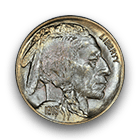
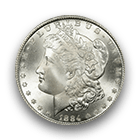
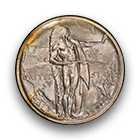
Shown below are three examples of what we’re referring to. Sure, the toning may be natural, but even if beauty is in the eye of the beholder, there would be few eyes that would find any of these to be beautiful.


Three coins, probably naturally toned, that would likely have a tough time finding a place in most collections.
Another environmentally-caused illness is verdigris. It is a metallic corrosion (usually on copper and bronze coins) and often appears as a powdery green growth. It can be progressive, and is quite a serious problem. In fact, it is sometimes referred to as "coin cancer." It can even spread if an infected coin comes into contact with other coins, and therefore should be avoided by all collectors. Below are a couple of examples.


Both of these poor coins are very sick indeed.
Finally, there are the most obvious environmentally challenged pieces, those which were likely buried in the ground for an extended period. This could have been accidental, as in the case of a lost or dropped coin, or intentional, in order to safeguard from theft or plunder. In fact, a majority of the ancient coins found today are the result of burial at some distant time in the past – almost surely to avoid being lost to invaders.
Here is a small group of coins whose surfaces have been irreparably damaged from burial.


All of these coins spent some time in the ground. Not much more to be done.
We’ll continue our look at problem "No Grade" coins in our next installment.
Series Links:
http://www.pcgs.com/news/no-grade-coins-pt1
http://www.pcgs.com/news/no-grade-coins-pt2
http://www.pcgs.com/News/no-grade-coins-pt3
http://www.pcgs.com/news/no-grade-coins-pt4


 Copper & Nickel
 Silver Coins
 Gold Coins
 Commemoratives
 Others
 Bullion
 World
World
 Coin Market
 Auctions
 Coin Collecting
 PCGS News