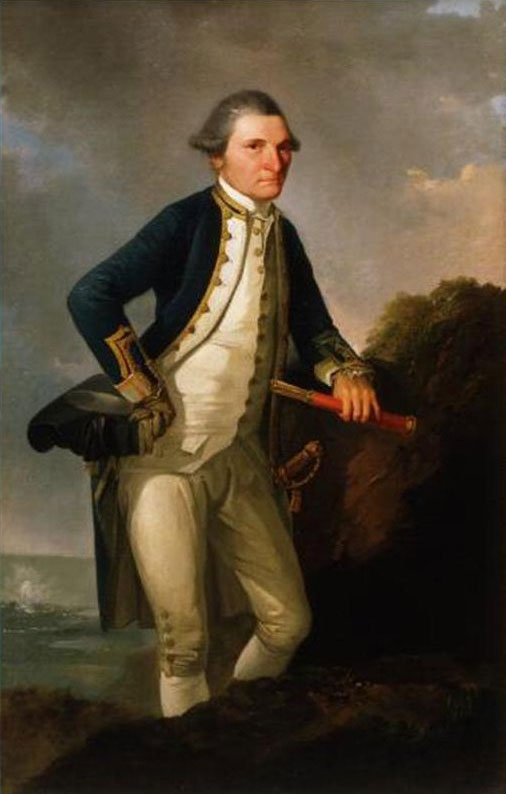
Click to enlarge.
Portrait of Captain James Cook circa 1776, on oil canvas. Image courtesy of Wikipedia
Royal Navy Captain James Cook and his 94-person crew boarded the H.M.B. Endeavour in 1768 on a mission directed by King George III to explore the Pacific Ocean and its inhabitants. The ship was designed to navigate through shallow waters while withstanding the power of the open seas. A fearless and adventurous explorer, his voyages helped to fill in the blanks on the developing world map and educate society on unknown places, communities, and plants. This voyage would take three years and one full cycle around the Earth’s oceans to return.
The ship began its journey by departing from the Dockyard in Plymouth, England and making its way South down the coast of South America, rounding Cape Horn (the most southern point of Chile) and then sailing into the vastly uncharted south Pacific Ocean. Exactly one year from departure, September 1769, Cook reached New Zealand and by May of 1770, the ship reached Botany Bay, by Sydney Australia.
It was on this day, June 11, 1770 (249 years ago), Cooks ship ran aground by suddenly impacting the Great Barrier Reef. The crew was able to dislodge the ship from the reef’s grasp by unloading cannons (which are still embedded in the reef today) and catching a high tide. Finding safety on a nearby shore, now named Cooktown on the now Endeavour River, Cook and his crew spent seven weeks on repairs all while collecting plant samples and engaging with the local Aboriginal people. It is from this trip that the word ‘kangaroo’ would enter the English language.
This would be the first of three expeditions Cook and his crew would take to explore the Pacific islands until his death in 1779.
Medals commemorating Captain Cook and his achievements in exploration were created in the late 1700s in Silver, Bronze, and Copper by the Royal Society and designed by artist Lewis Pingo.
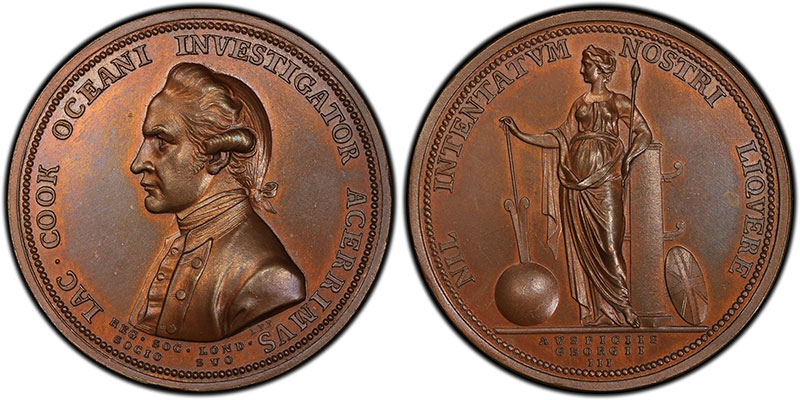
Click to enlarge.
(1776) Medal Betts-553 Copper James Cook PCGS MS65BN
As part of the Silver Commemorative Program (1892-1954), the 1928 Hawaiian Half Dollar commemorates the sesquicentennial (150th) anniversary of Captain Cook’s landing in the Hawaiian Islands in 1778, during his third and final voyage. The original mintage of 10,008 coins sold out immediately by the Bank of Hawaii, even though the issue price of $2.00 a piece was the highest price of any commemorative half dollar to that point.
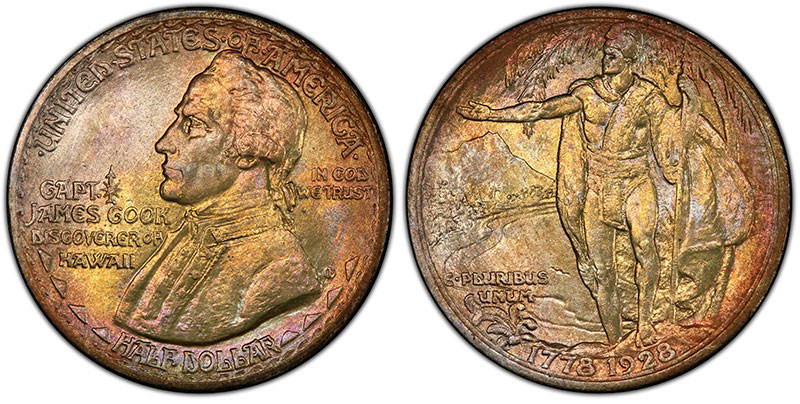
Click to enlarge.
1928 50c Hawaiian PCGS MS67


 Copper & Nickel
 Silver Coins
 Gold Coins
 Commemoratives
 Others
 Bullion
 World
World
 Coin Market
 Auctions
 Coin Collecting
 PCGS News