“I have a dinner to go to,” Mr. E. announces as he walks toward a long, shiny black car. It is rush-hour, and the Beijing International Coin Expo (BICE) is done for the day. Me, I like the subway. The China National Convention Center, home to the expo, is on the outskirts of town and traffic usually jams up at this hour.
One exit from the Olympic Green metro station is across the street from the convention center. Another way leads past a movie theater, a big department store, an arcade, and too many eateries and shops to count. Out of curiosity I go this direction and eventually reach an outdoor concrete plaza. The November air is frosty, but the sound of voices pushes away all other thoughts.
To my right a small crowd stands outside a concrete, but traditionally styled, open-air pavilion. Within it stand a chorus of several dozen men and women. Their condensed breaths cloud the space, but they pay no attention. Rather, they focus on a sturdy man with short hair who mouths the lyrics and gestures this way and that to them as only one person sits — an elderly accordionist who pumps out a bass line.
All wear regular street clothes. There is nothing unusual in this; people in China often get together to sing or dance in public – often with great skill like this group. Several of the performers smile at the curious foreigner and, cold hands and all, I crouch inside their circle to snap photos. The music sounds patriotic and I recognize one song.
It’s a funny thing about songs, sometimes the words change, but the tunes go on. Take “Yankee Doodle”; its melody may be as old as the 1400s, but during the American Revolution the British army put lyrics to it that mocked the American rebels. By the time the fighting ended in 1783, the rebels had flipped the meaning to taunt the Brits.
A similar remake happened to a Shaanxi province folk tune. It came into the world as a love song, but in 1942, as Mao Zedong and the Chinese Red Army battled Japan, a farmer rewrote the lyrics. “Dong fang hong, taiyang sheng – The east is red, the sun is rising.” This new version took the country by storm. During the 1960s, the performers around me would have started each school day by singing Dongfanghong.
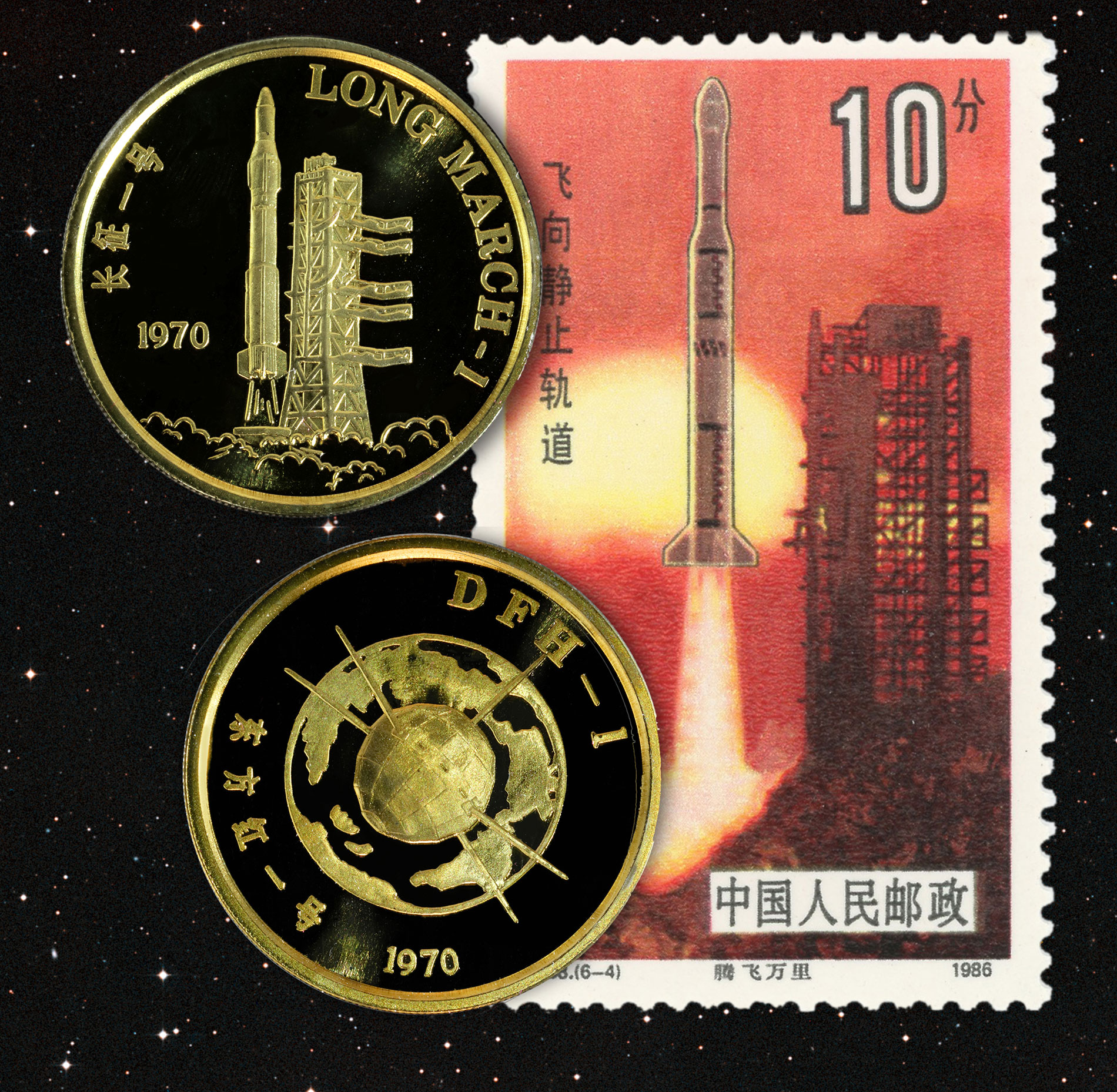
So, what does this have to do with coins? The quick answer is that in 1970 China named its first satellite the Dongfanghong, and this appears on money and medals. One example is a 50-millimeter-diameter gold-colored medal that weighs 30 grams. The satellite occupies one side while the Long March Rocket that launched it is on the other. How many were minted, or where, is unknown, but it doesn’t look like an official mint product. The medal has no date but probably was struck between 1988 and 1993. That’s because of the initials “MOA,” which stand for “Ministry of Astronautics.” This name was only used during those six years.
Like a beautiful lotus flower that rises out of mud, the satellite program has roots in dark water. On February 2, 1932, Walter Brown, an American reporter in Shanghai, wrote, “On Friday morning the Japanese marines came ashore manifestly expecting a clear path thru Chapei (the Chinese-controlled part of the city). But they reckoned without their ‘hosts,’ the Chinese. Forty of the occupiers were clipped off by Chinese soldiers and snipers, and from that moment the unfortified city was doomed.”
“No advance warning was given of Japan's intention to bomb the city… It was a terrible sight, this dropping of bombs on a crowded territory… Down below I could see houses and shops tumbling down, with those inside caught off guard… The wind off the Whangpoo River spread the fire westward. Nothing could stop it. The less-substantially built houses went up like kindling on a stove. Poor families ran out in a panic.”
It was the first deliberate aerial bombing of civilians and anticipated by five years what the fascists in Europe would do at Guernica. All of Shanghai’s universities shut down for three months and the students were sent home. A young man named Qian Xuesun was among them. Two years later, when his class at Jiaotong University in Shanghai finally graduated, he was number one in railway engineering. Although his career path was secure, Qian understood that mastery of the skies would be the key to the future. So, he accepted a scholarship to study physics at M.I.T. and moved to Boston.
After getting his master’s degree, he came west and joined Caltech’s pioneering Graduate Aeronautical Laboratories in California. It was led by Theodore von Kármán who later wrote about Qian, “…he was an undisputed genius whose work was providing an enormous impetus to advances in high-speed aerodynamics and jet propulsion.” Mr. Qian had a scruple; he refused projects that were designed to be used against the people of China. In 1950, despite protests from his colleagues at Caltech, the U.S. government severely restricted Qian’s movements, teaching and research activity.
Finally, in 1955 the scientist returned to China – reportedly in exchange for 11 American pilots captured in Korea. He was immediately placed in charge of the new Chinese space effort. Resources for the program were limited, especially in the early days, but determination was not, and Qian’s knowledge and talent sparked new progress. October 1957 saw the world’s first satellite, Sputnik I, launched by the Soviet Union. In January 1958, the USA followed with Explorer I. One major obstacle to China’s satellite program was that its single-stage rocket could not achieve enough altitude. A second engine would have to ignite after the first shut down to propel the spacecraft higher. Then to reach orbit, one more stage was needed. A Qian concept led his team to piggyback solid and liquid fuel stages and develop the first Long March Rocket.
The final preparations for a satellite launch began in 1965. A group of scientists met in Beijing to set a course, but they couldn’t agree on one item: a name. Almost to break the tension, “Dongfanghong” was offered. This was approved on the spot. As the work moved ahead, one extra task was added to the list – to broadcast “East is Red” from space.
How do you produce sound in airless space? Eventually, a hand-made electronic box was designed that could do this. With the music box onboard, the Dongfanghong satellite was mounted on the nose of a Long March rocket. It is said that the night before the launch, Qian Xuesun did not sleep. The next day, April 24, 1970, the rocket roared off the pad and a short while later radios all over China played, “The east is red, the sun is rising,” transmitted from earth orbit. Everyone in the country who is old enough remembers that day.
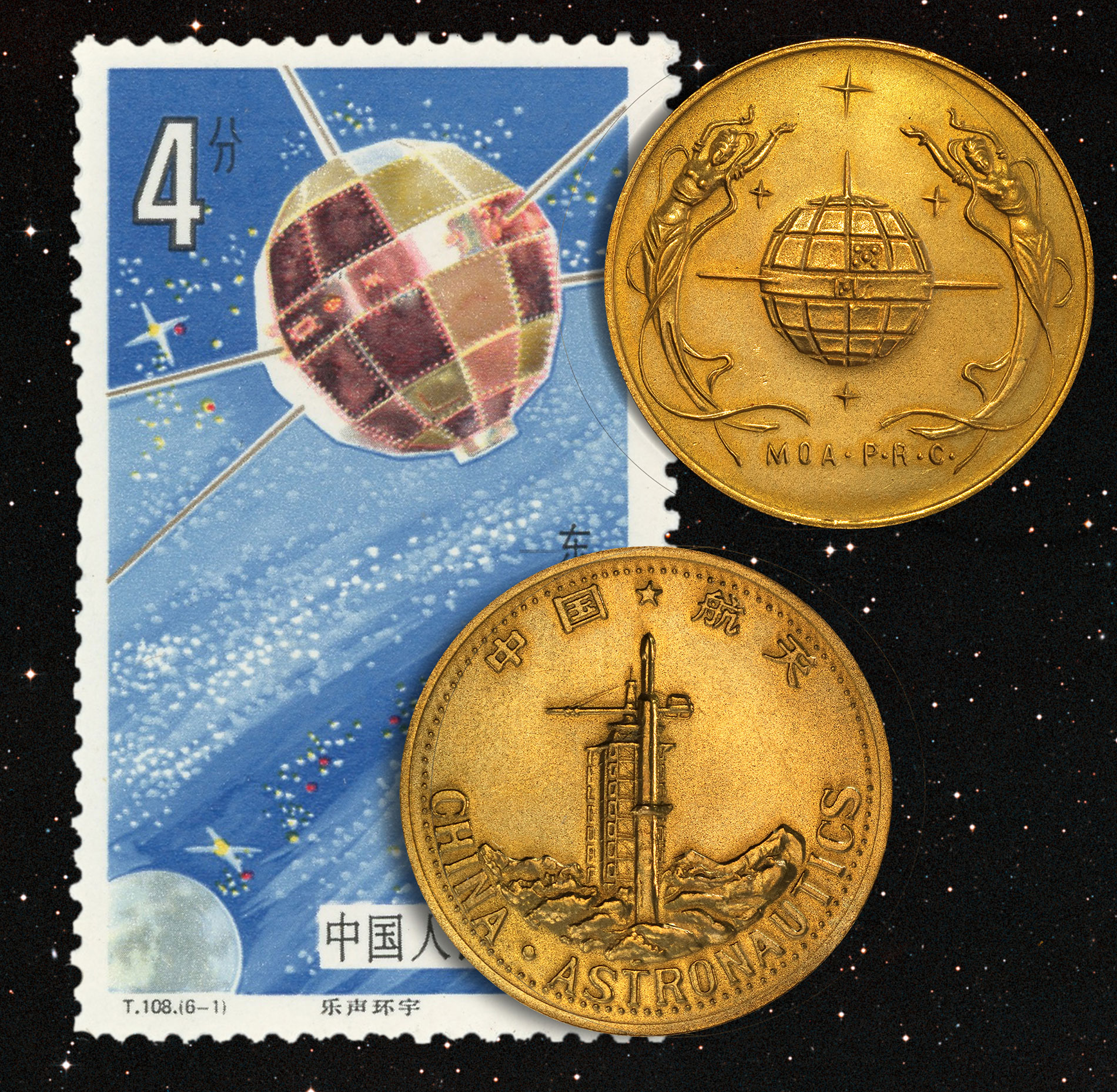
The 1970s, when the Dongfanghong satellite was sent into space, was a period when China produced very few medals and coins. Most Chinese space commemoratives were minted later and feature more recent rockets, but the Long March 1 can be found on at least one other medal. This one is 40 millimeters in diameter, made of brass, prooflike, and 27 grams in weight. One side displays the rocket and the date 1970. An image of the satellite is shown on the other. It is part of a five-piece set of Long March rockets and satellites that was distributed by the country’s space agency, China Aerospace Science and Technology Corp. The most recent date in the set is 1992, so these were probably issued close to that year. The mint and mintage of these medals is not known, but the entire set is designed, engraved, and struck to very high standards.
China’s first satellite continued to broadcast from space to Earth for 28 days and it continues to appear on coins and medals. It is on both a 2015 10 Yuan bimetallic circulating coin and a 2015 100 Yuan commemorative banknote. One side of the aeronautics banknote features the Tiangong-1, or “Celestial Palace,” space station. It served as a test project for a much larger Tiangong space station that’s now under construction. The Dongfanghong satellite appears next to Tiangong-1 in green foil butut that’s not all.
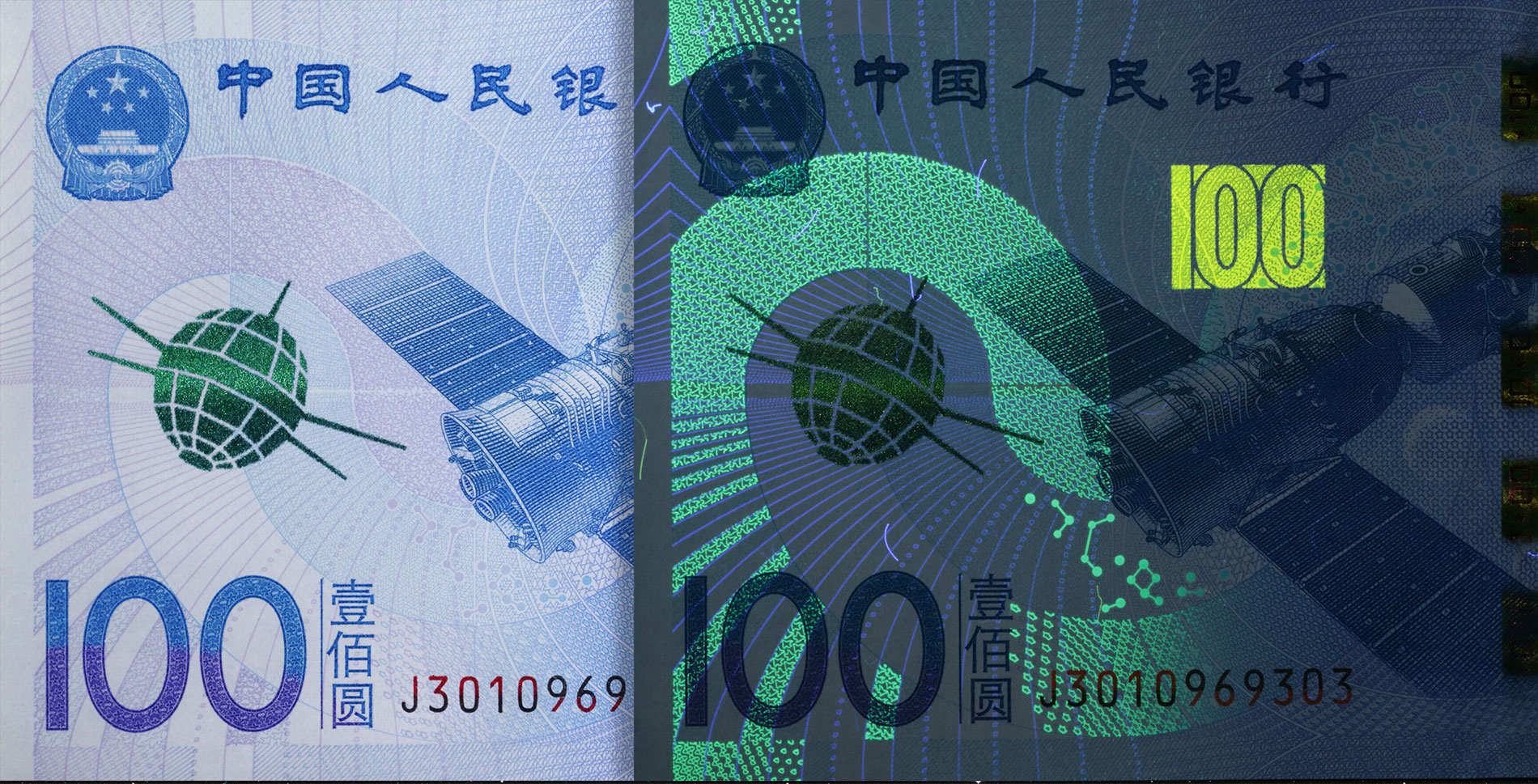
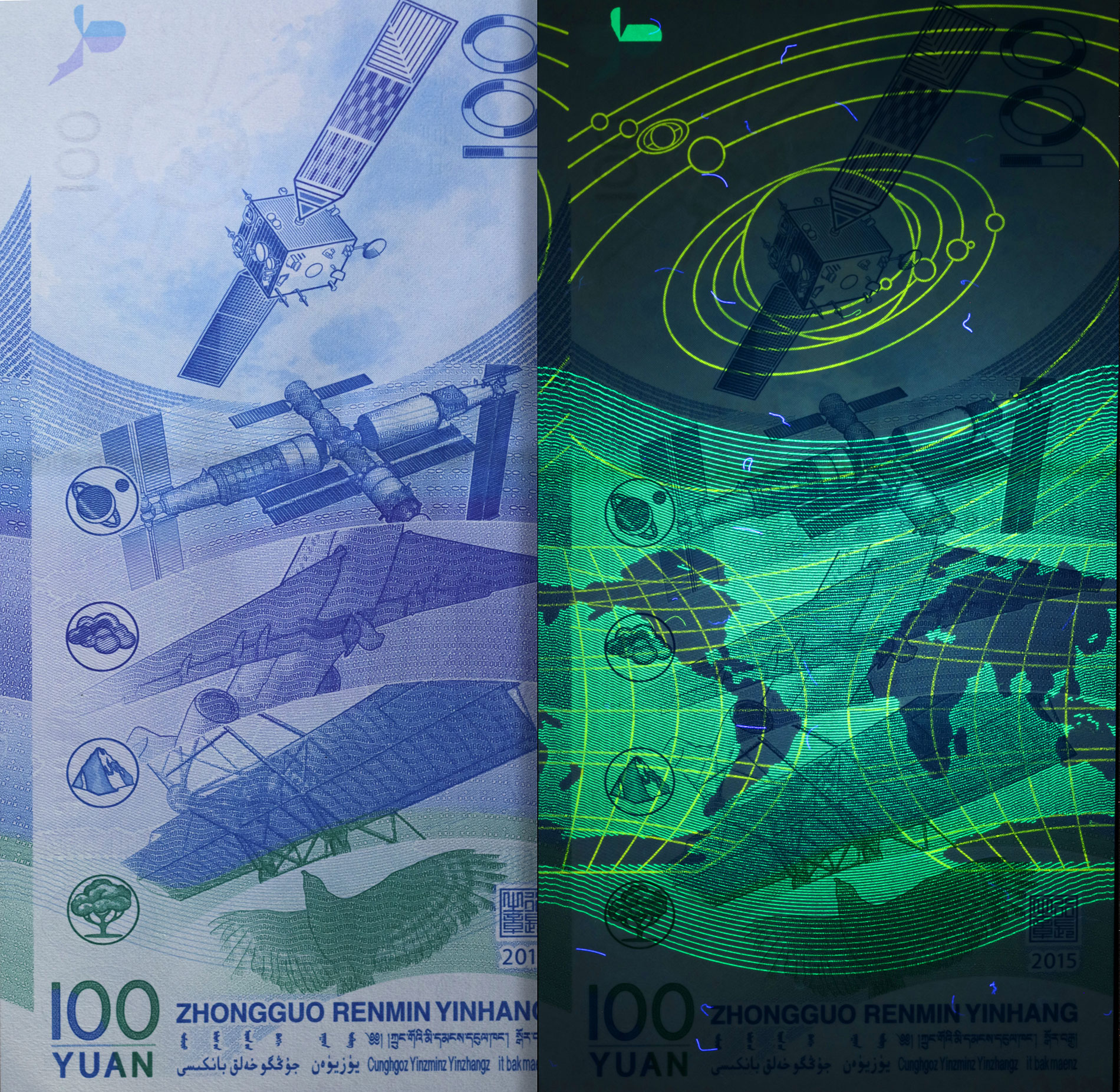
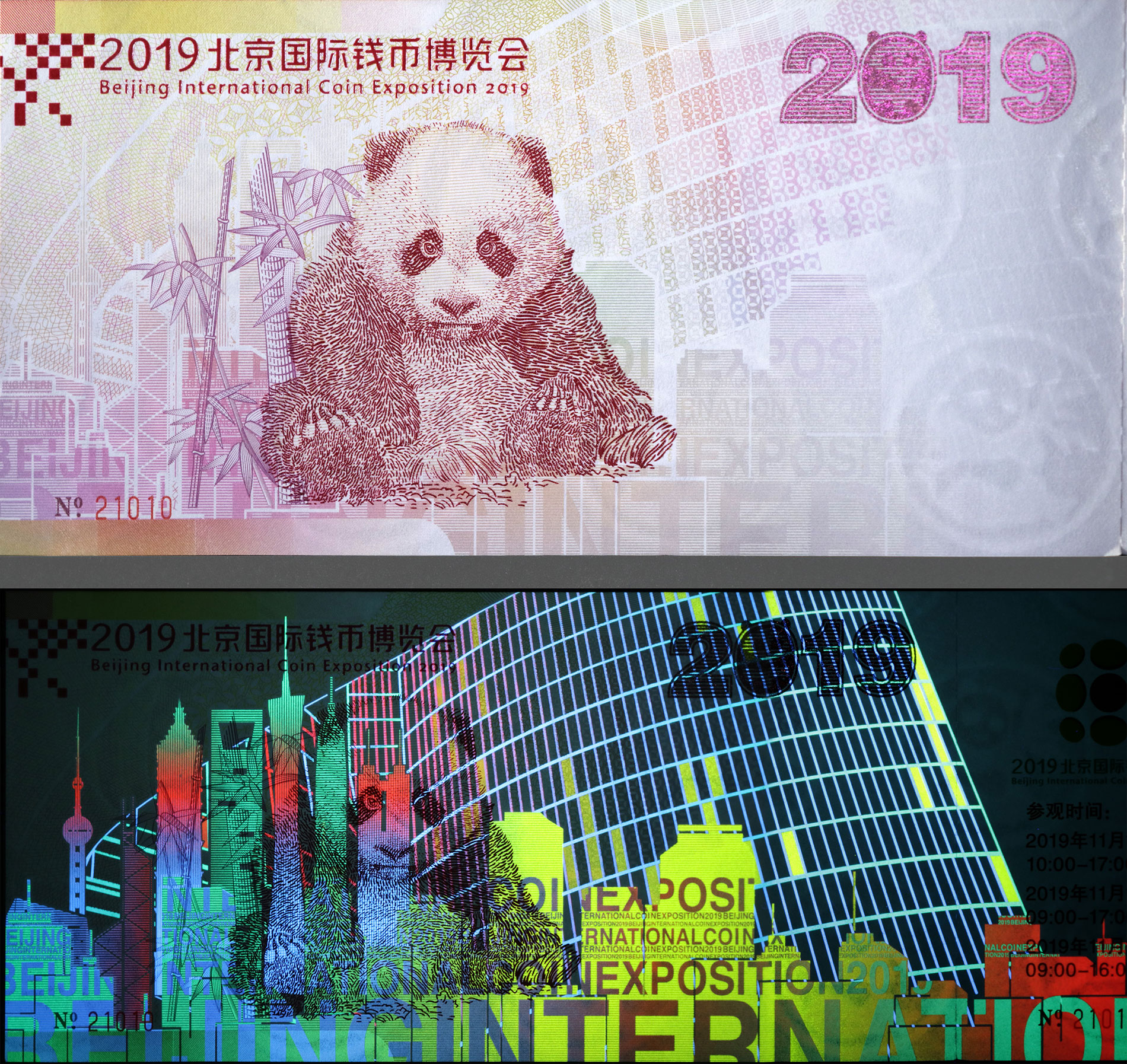
In the past, I have told quite a few coin dealers that China puts some amazing ultraviolet technology into its banknotes. The usual response is, “Sure, sure, such-and-such country does that, too.” Then I show them photos of the Chinese paper and they say, “Oh no, I’ve never seen anything like that.” The 2015 aeronautics banknote is a good example. Under UV light one side reveals brilliant maps of both the solar system and Earth.
There are many other examples of UV printing on Chinese banknotes, some newer and even more spectacular than the aeronautics one. China does not advertise these developments, so where does a collector get information about them? You could just take line 8 to the Olympic Green subway station. Each year China Banknote Printing & Minting showcases its printing prowess at the Beijing International Coin Exposition. Many coin and banknote designers, as well as mint officials, are available there to talk to the public. Knowledgeable collectors come from far and wide to see, discuss, and buy samples that may not be available any other time. Even the show ticket uses this special printing technology.
The Olympic Green station plaza falls quiet. The concert is over. The singers chat, shake hands, and some congratulate the accordion player whose eyes glisten with joy. A few smile at me, too. My thoughts still on the experience, I walk back to the subway and return to my hotel in under 60 minutes. At the BICE the next day I hear that Mr. E’s car ride to dinner took three hours.


 Copper & Nickel
 Silver Coins
 Gold Coins
 Commemoratives
 Others
 Bullion
 World
 Coin Market
 Auctions
 Coin Collecting
 PCGS News