Stitched into the Sichuan canyon wall like seams on a baseball, the two-lane road is barely wide enough to grip the mountainside. As the bus swerves back and forth the motion sickness bags tucked into the seatbacks no longer amuse me. I stare out the window at a gray, overcast morning. Misty fingers wrap around bamboo trees that cling to the steep slopes. Far below on the canyon floor, a stream tumbles between boulders. I once read that roads and rivers tend to follow earthquake fault lines because the fractured rock is weaker there. Sichuan is famous for its temblors, but hopefully, the Earth will slumber this day.
Once out of the canyon, the bus chugs into a village square, and all the riders exit. At one end of this plaza is a trailhead. This path should lead all the way to Mount Emei’s (pronounced Eh-may) summit, one of the four sacred Buddhist mountains in China. There aren’t any signs in English, but it looks right. The time is already past noon so hiking to the summit is out of the question. The ancient Wannian (Wah-nee-en) Temple, though, should be reachable and that becomes my goal.
Near the entrance are several vendors hawking bamboo walking sticks. According to the internet, these are highly advised to fend off packs of monkeys that can attack hikers for their food. The bamboo sellers strongly encourage my business. For two Yuan, I select a sturdy shaft, and everyone smiles.
The trail begins with a paved stairway that leads steeply up through a forest of tall, white-barked trees. Ahead of me are five backpackers; I try to keep them in sight as my breath forms clouds in the frigid air. After a half-hour of serious huffing and puffing the path levels off and runs through a hamlet. Among its handful of buildings is an open-air teahouse with many empty tables. Only one is occupied – by the quintet of hikers who started ahead of me. Vapor rises in columns from their tea-filled mugs. The group motions to me to sit down and join them, which I happily do. We cannot really speak one another’s language, but the mood is festive and they are as curious about me as I am of them.
It must have been in just such a Sichuan hamlet that another foreigner arrived in 1869. The villagers invited him and his guide to sit down and drink with them, too. That traveler’s name was Père Armand David, Father David, a French priest and probably the first European these villagers had ever seen. His life was dedicated to two causes, his faith and the natural world, particularly in China. He once wrote, “…It was the desire to honor life, the diversity of life, that drove me — to observe and describe.”
Fascinated by nature since childhood, the father was a remarkably keen observer of plants and animals and was the first westerner to take notice of hundreds of species in China. These ranged from a Chinese wild peach to several famous faunas: in 1866, he found both the gerbil and a rare species of deer. A year later, he informed the world about a golden stump-tailed macaque, or monkey, from East-Central China.
The deer had been extinct in the wild for centuries, but one herd survived inside the Nanyuang Royal Hunting Garden in Nan Haizi, an imperial sanctuary. The area was absolutely out of bounds to visitors, but the determined padre convinced the guards to allow him to peek. One look confirmed that this animal was indeed unknown to western science. Their Chinese name was “milu,” or “the four unlikes.” With small ears, a mane, and cow-like hooves they resembled a deer, a donkey, a camel, and a cow all cobbled together. By the time Père David saw them no one could recall their history — biologists theorize that they originally inhabited swampy areas — but now existed only due to the emperor’s protection.
When news of the discovery got out, it was arranged (perhaps legally, perhaps not) for some to be sent to Europe, including England. That turned out well. By 1900, a combination of floods, rebellion, and foreign soldiers wiped out the last of “Père David’s Deer” in China. A breeding program in England was a success, though. In 1985, 20 “Père David’s Deer” returned to China – to the very same area where they had been discovered. More arrived later and were sent to other reserves. Today, thousands roam at least 80 locations inside their homeland.
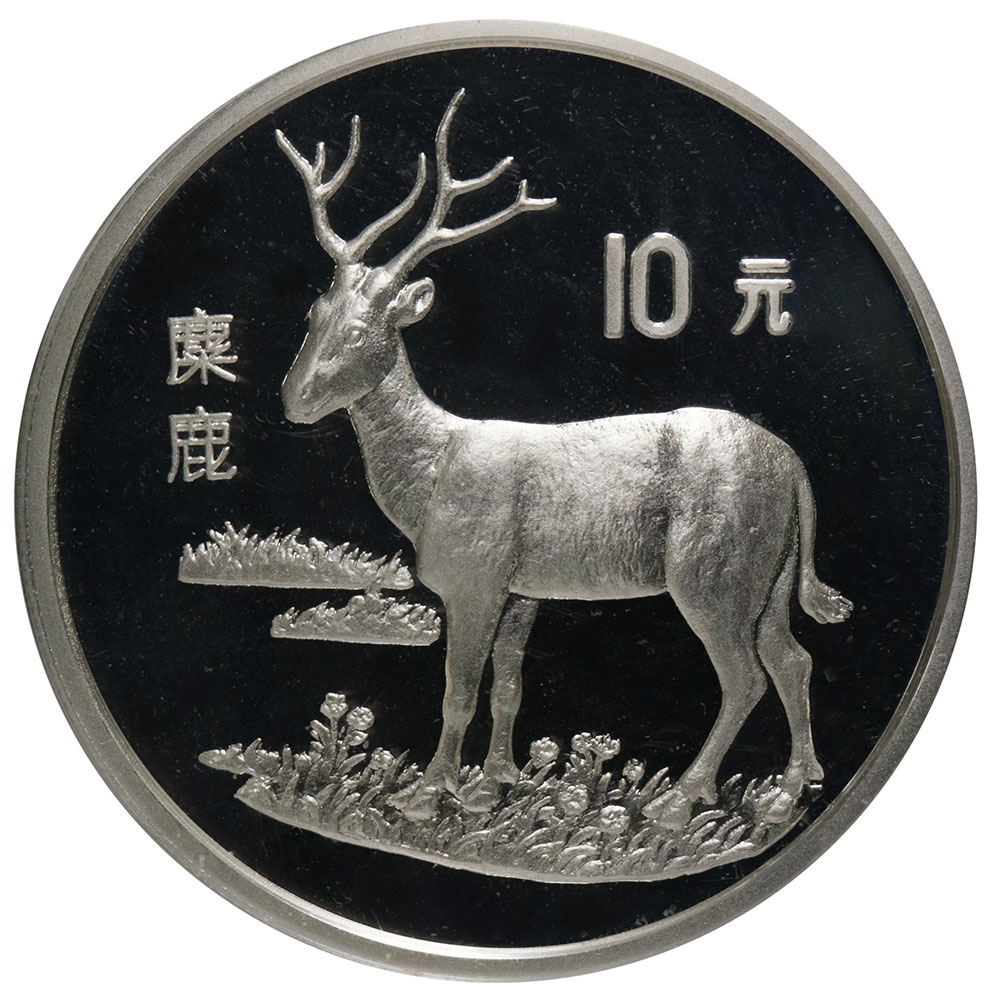
The survival story of these extraordinary animals — and others — in China is reflected in numismatics. On August 12, 1988, to mark the 10th anniversary of a friendship treaty with Japan, China issued the first in a series of endangered Chinese wildlife coins. By 1997, five groups were minted. They all feature the National Emblem of China on one side and an animal on the reverse. A single eight-gram .916-fine gold coin and two .925-pure silver coins make up each year’s group for 1988, 1989, 1992, 1994, and 1997. Additionally, the series includes one silver 1993 five-ounce and one gold 1997 five-ounce coin.
The fourth group of “Endangered Wildlife” coins is from 1994. In it are two coins that display animals discovered by the French naturalist priest. One is the Père David Deer — which bears his name even today. Its image graces the reverse of a 27-gram silver proof coin of which 15,000 were minted. These coins were designed and struck at the Shenyang Mint; Zhang Wenjing designed and Li Chaoxhuan engraved them. The other coin has its own story.
In 1869, with three important fauna discoveries to his credit, Père David was still in search of something to astonish the world. He took his quest to Sichuan. Much like me a century and a half later, he and his guide Jean Lee found themselves drinking with friendly strangers in the mountains. According to the priest (translated by Molly Patterson), “we ate in the open air with our coats bundled around us, for it was still early spring and rather cold. Of course, there was liquor to warm us up… I grew sleepy and warm. I took too much. At last, they invited me to take a rest in the house.”
“Two or three hours later when I awoke… I looked about me… And was confronted by a giant pelt of black and white fur nearly covering the wall behind me… Out in the courtyard, the men, still drinking, shouted their welcome… In my awkward Chinese, and with a series of gestures, I implored the master of the house to come into the room and explain to me what was tacked to the wall. The whole group, seven or eight men altogether, plus myself and Jean Lee, crowded into the tiny room and exclaimed over the skin, for the men were excited, too, seeing it with fresh eyes, and realizing that I had never encountered such an animal before. And at last, the thing was given a name for me to call it by: chu hsiung, the bamboo bear, which was not the scientific name I later assigned it, but the name by which I sometimes remember it all these years later.”
The Bamboo Bear. This is how the giant panda was first known to the western world. Could Père David have imagined that his discovery would one day be, possibly, the world’s most beloved animal, as well as a national treasure of China?
The first confirmed reference to an animal (a “white bear”) that was probably a giant panda, occurs during the T’ang Dynasty in 621 AD. Two living “white bears” are also listed as gifts to the emperor of Japan 64 years later. This is quite astonishing, if the white bears were truly pandas, as even with modern methods they are difficult to move safely. Some have suggested that the “white bears” may have been some other kind of bear, even polar bears. In any case, written references to white bears are few and far between. In 1597, when an exhaustive Chinese encyclopedia of animals with medicinal properties (which was essentially all animals) was compiled, there was no mention of “white bears” in it. Nor do “white bears” appear in art or literature. One expert wrote, “this species was never sufficiently well-known to play any part in Chinese folklore. I have never seen any representation of it in Chinese painting or in bronzes or jades.”
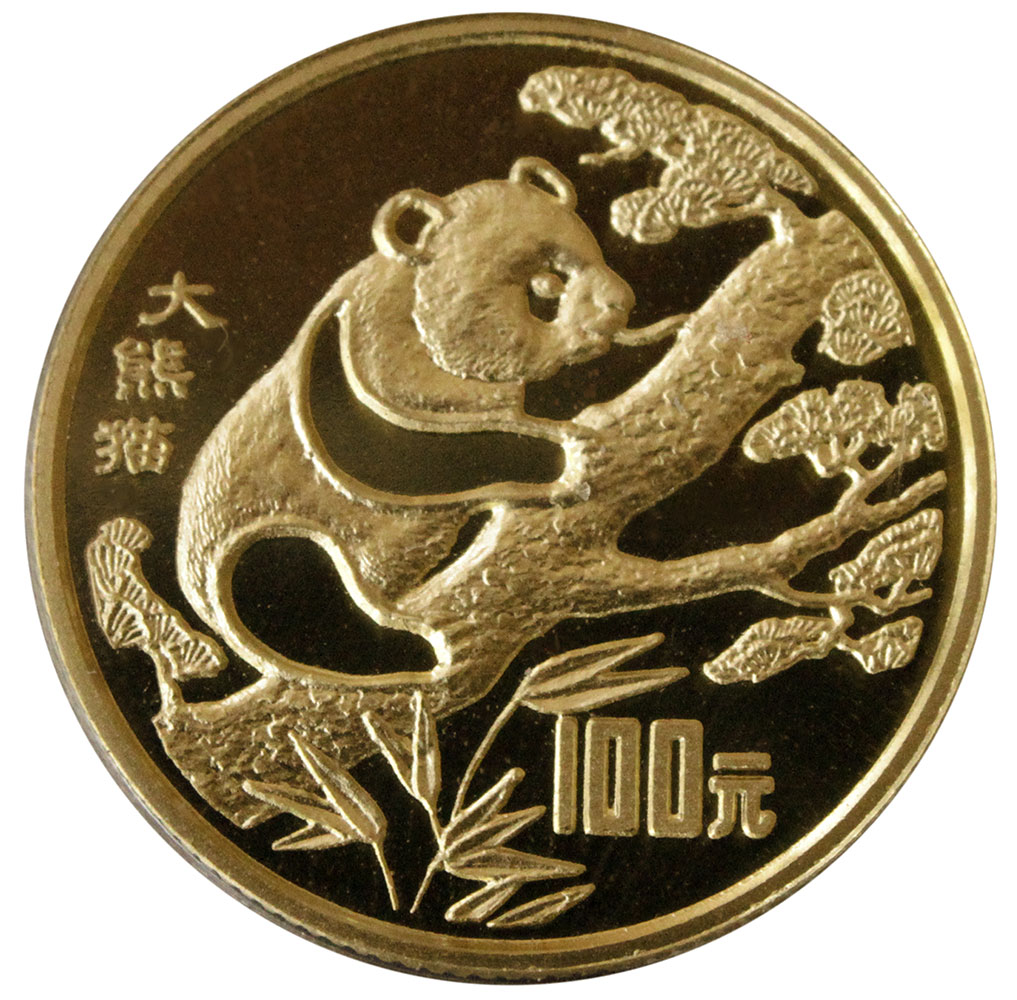
So, unlike other celebrated animals, the giant panda was largely unknown until that day in 1869 when Père David drank a little too much and woke up staring at a black-and-white pelt. We should also remind ourselves that, despite all their popularity, pandas themselves are still rare — even here in their home range in Sichuan. So, it seems fitting for a giant panda to be the second of Père David’s discoveries to appear in the 1994 “Endangered Wildlife” coins group. An eight-gram .916 fine gold proof shows a giant panda cub clambering up a tree. Its mintage is just 5,000, but that’s still far more than the number of pandas in the world. Like the other coins in this group it was designed and struck in Liaoning Province at China’s oldest operating mint, the Shenyang Mint. The designer and engraver is Yan Jingkui.
A couple of hours after we finish tea, my new friends and I arrive at our destination: the Wannian Temple. The final approach is up a long, steep set of stairs. As I plod upward, I think that this would be a good position to defend. Finally, at the top, a 10 yuan banknote buys me an entry ticket.
The Wannian Temple was established during the Jin dynasty (266–420 AD). The gardens inside its walls are an island of well-tended serenity. Fruit tree branches brim with blossoms and cream-colored prayer cards. A flock of doves flutters toward the main temple building, the “Beamless Hall.” Waist-high statues of elephants line a center walkway that leads to it.
At the Beamless Hall’s core glitters a large gold idol of the Bodhisattva Puxian seated on an elephant. This dates from 980 A.D. A Bodhisattva, or potential Buddha, is a person who sacrifices nirvana for themselves so they may bring healing and salvation to the people. Emei Mountain is dedicated to Puxian, the Bodhisattva of Benevolence. One tale tells of how many lives were saved when Puxian calmed a raging elephant by stroking its forehead. This idol places him atop a six-tusked pachyderm. Outside, on the temple steps rows of pilgrims in saffron and maroon robes, men and women who arrive here on foot from far-off places, bow and pray.
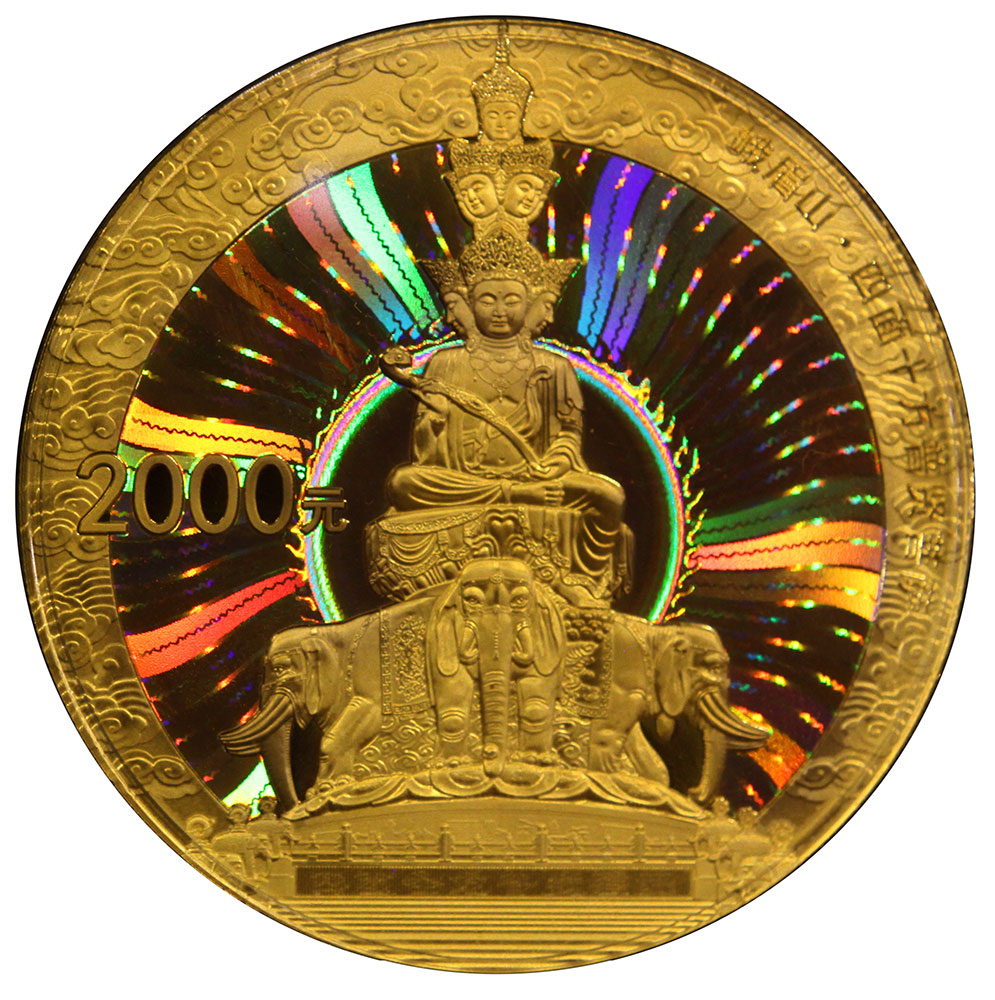
The Bodhisattva Puxian appears on many Mt. Emei coins and medals. Among the most spectacular is a 2014 2,000 Yuan five-ounce gold coin. On it, Puxian sits astride a trio of elephants and is surrounded by a brilliant rainbow hologram, a view of the statue of Puxian on Mt. Emei’s summit. It is a product of the Shenyang Mint with outstanding design and engraving work by Chang Huan and Liao Bo. The official mintage of this 60-millimeter diameter coin is 2,000, but the Standard Catalog of Gold & Silver Coins of China lists only 1,400 as actually struck.
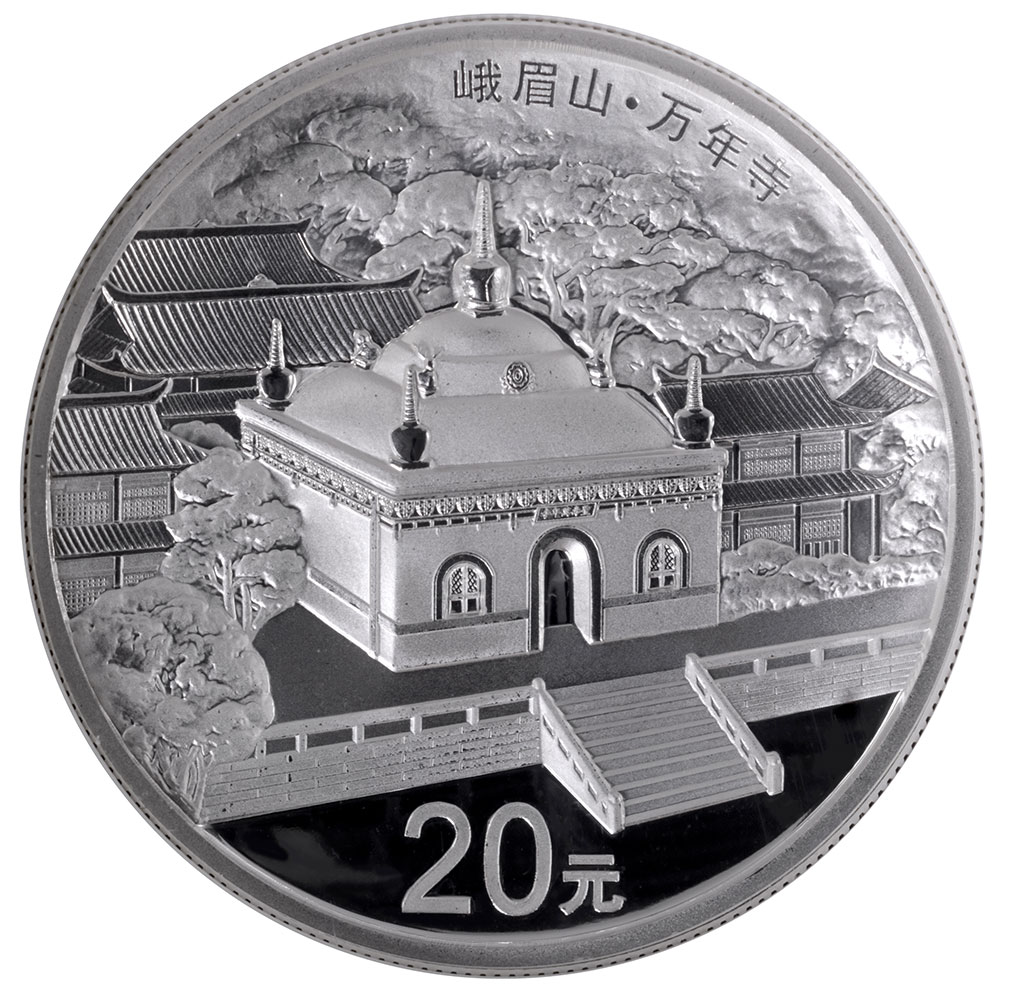
The Wannian Temple has a modern commemorative silver coin of its own, too: a two-ounce .999 silver piece that is 40 millimeters in diameter. It was struck at the Shanghai Mint in 2014 with an authorized mintage of 60,000. However, the standard catalog gives the actual mintage as 42,000. The coin shows a bird’s-eye view of the Beamless Hall and the grounds.
A glance at my watch reminds me that the last bus of the day down the mountain will leave without me if I don’t get going. As the afternoon light fades I fairly leap from step to step down the path, the bamboo walking stick proving its worth with each stride. Though I encountered no monkeys, or bamboo bears, this day, that stick was a welcome addition. As I near the village, I try to imagine how I can take it home with me. I conclude that I can’t – it’s too large. Near the gate, I stop and carefully lean it against a tree to wait for another hiker to use.


 Copper & Nickel
 Silver Coins
 Gold Coins
 Commemoratives
 Others
 Bullion
 World
World
 Coin Market
 Auctions
 Coin Collecting
 PCGS News