


“Look up!” my friend Min exclaims and points.
I lift my head to the lamppost. A pair of glass globes is mounted right below the streetlamps. Floating inside one is a bright red Chinese knot. Inside the other, a sizzling hot pink hummingbird beats its wings. The unreal bird hovers for a few moments. Suddenly, it expands and transforms into a red rose, and a few seconds later it morphs into a Chinese lantern. A couple of other pedestrians on Dadong Road in Shenyang notice us staring. They, too, look up at the holographic projections.
Although fairly fascinated by this municipal decoration, neither Min nor I want to linger for too long. It’s an early March evening, the date of the vernal equinox, when days and nights are almost equal everywhere on Earth. This March, the wide Hun River that runs through the city is still frozen solid, and the night air is not much warmer than the river.
If you were in the mood to follow the trail of pink hummingbirds down Dadong Road, it will lead you to downtown Shenyang. I decide to come back this way in the daylight. As I do the next morning, a quartet of high school age boys walk alongside me. They chatter about whatever it is that high school aged boys discuss; probably studies, as they sound serious.
All four wear identical outfits; white shirts and black nylon pants. Whenever I have asked young people in China if they like wearing school uniforms they answer, “No.” but, they admit the uniforms serve a purpose. One is that it tamps down fashion competition between students. For another, it makes it much easier for teachers to keep track of their pupils on field trips.
The students and I reach an intersection with a traffic light. Here, they turn while I continue straight on. On one corner there is a fruit and vegetable market, in front of which are bins loaded with red apples. Diagonally across the street from the market stands an office building. On each side of it are the high walls that surround the Shenyang Mint compound. The main entrance is just a short stroll further down the block.
Here stands an imposing three-arched gate almost as fantastic as the pink hummingbird. Built in 2016, this gate duplicates the 1896 portal that led into the mint. The current version is painted in royal blue and crimson red hues with gold accents. In 1896, China was still ruled by the Qing Dynasty, and Shenyang was called Mukden, a word rooted in local history and language. The province was named Fengtian, or sometimes Mukden, Province instead of Liaoning, and the mint company was called the Fengtian Machinery Bureau. Its first assignment was to produce small denomination coins.
The architectural style of the 2016 gate recalls this past. It wasn’t the only thing. Being a coin company, the mint created several interesting numismatic items for its 120th anniversary celebration. By far the best known are two commemorative Panda coins. The words, “120th Anniversary of Shenyang Mint Co., Ltd.” form a circle around the standard 2016 Panda coin image. There is a gold 100 yuan commemorative that weighs eight grams, with 10,000 pieces minted. The other is a 10 yuan silver Panda that weighs 30 grams. Both coins are legal tender in China. Every employee of the mint received a gift of one of the silver coins. The rest of the 30,000 silver Pandas that were struck were released to the public. As far as I could determine, the coins that the employees received are identical to the rest of the mintage. Move on folks, no varieties to see here!

Interesting, but much less well-known, are a pair of 120th anniversary medals. One is semi-rectangular, made of brass, and notable for the red and green glazes on one side. The image on this side is constructed around the number 120. The other face presents the history of the mint as a page in a book alongside representations of the mint’s main office building and the new gate. This theme continues onto a matching wood frame that the medal fits into. Really, the medal is incomplete without this intricately carved frame. 2,000 were minted.
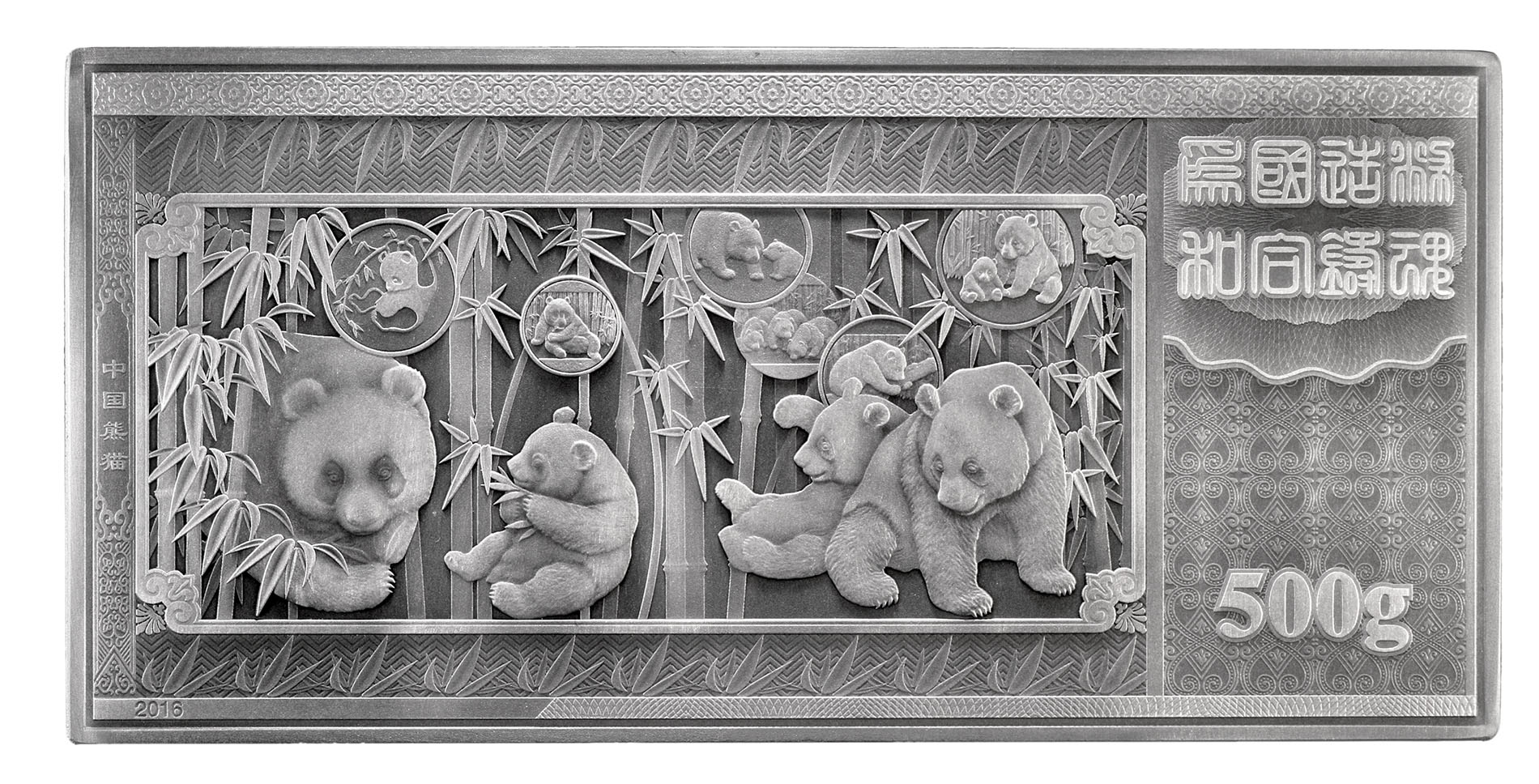
A second 120th anniversary release may intrigue Panda collectors as it is not only beautiful, but also exists in two varieties. This is a 500-gram silver rectangular ingot. Its design is the work of Ms. Chang Huan, who headed the Shenyang Mint art department at that time. The design on this bar resembles a banknote with many finely engraved patterns. Like a banknote, there is a central panel. Within this panel is a bamboo forest. Visible through the forest are six years of Panda coins: 1985, 2011 through 2013, 2015, and 2016. Displaying the 1985 is significant, as this was the first Panda coin designed by a Shenyang Mint artist, Mr. Wang Fu De.

Additionally, there are three groups of Pandas with poses taken from other coin years: 2003, 2006, and 2010. The year 2010 opens the decade, 2003 and 2006 represent Shenyang Mint designs, and the 2006 emission comes from the hand of Chang Huan herself.
The bar mintage is listed as 1,000, but almost none were exported. This was a numismatic art project, not a bullion bar, and the new issue price was far above its silver value. There was initial interest among foreign coin dealers — until I told them the price. Accustomed to bars as bullion items, they were shocked at the cost and told me these were unsellable.
There are two varieties of the silver bar. This came about because the Shenyang Mint struck a handful of samples to display to the news media at the anniversary celebration. These have a distinctive, lovely matte luster. The final version for public sales is brighter and more polished. My estimate for the number of samples that were sold is five to 10, at most.
The new Shenyang Mint gate in Qing Dynasty architectural style is part of the reverse designs of both medals. The two 120th anniversary medals seem to be its only presence on numismatic items. Facing Dadong Road, the gate is a reminder to passersby that this city and region played an important role in China’s past.
Meanwhile, far from the Shenyang Mint in place and time, events occurred that would shape its future.
…As day fades into night a line of camels placidly paces through the city gates of ancient Bianjing. From the opposite direction a horse-drawn cart approaches as the city’s famous nightlife awakens. These are scenes from the semi-documentary scroll painting Along the River During the Qing Ming Festival that depicts life in the Song Dynasty a thousand years ago.


In Bianjing’s clubs and taverns people gather to drink, play cards, and tell stories. This city on the Silk Road, the capital of the Song Dynasty, far from Liaoning Province, is nonetheless connected to Shenyang’s future. In this place, culture and information trade back and forth among travelers from far-flung lands. Music fills the rooms and drinking establishments vie to hire popular musicians and dancers. Arts and cultural pursuits at all social levels blossom to an extent that few societies had ever experienced. The Song Dynasty is considered one of the high-water marks of Chinese cultural development. Moreover, Bianjing was the world’s largest city during the medieval era with around 600,000 to 700,000 inhabitants. At that time, Paris was Europe’s largest metropolis with 200,000 residents, while London was home to just 80,000.
During Song times, a style of poetry called ci that was sung to music rose in favor. Not only male poets gained followings; the ci poetry of more than a hundred women has been preserved. By far the most celebrated of these poets was Li Qingzhao, whose evocative work is still studied in Chinese schools for lines like this: “Still is the swing, quiet the street. The pear blossoms bathe in the radiance of the moon.”
Li lived from 1084 to around 1155. This includes the fateful year of 1127, when the Song Empire was overrun by a northern people with nomadic roots called the Jurchen. While the Song Dynasty ruled over much of China, the Northeast always remained separate. It was the territory of a fierce, smaller empire called the Liao Dynasty that the Songs could never conquer.


In 1125, the Liao Dynasty was overthrown by a combined force of the Jurchens and a native Northeastern ethnic group, the Bohai (whose name lingers in the Bohai Sea). After this conquest the Jurchens, or Jin Dynasty, resumed their long running feud with the Song empire. In 1127, for complex and disputed reasons, the Song capital in Bianjing fell to them. The capture and sacking of Bianjing, called by some the Catastrophe of Jingkang, delivered a tremendous shock to Chinese culture.
Not everyone calls this event a catastrophe, though. I once mentioned it to a friend in America, who responded, “The Jurchen are my ancestors. I do not think it was a disaster.” Coin collectors may be grateful to the Jurchin, too. The Jin Dynasty introduced silver as legal tender to China. They also synthesized architectural styles from the Song and Liao Dynasties with their own knowledge to advance the field.
The fall of the Northern Song Dynasty was a terrible blow to Li Qingzhao and the arts communities that flourished under the previous order. One thing leads to another, though, and a century later, the Jurchens were overthrown by the Mongols, who in turn succumbed to the Ming Dynasty. Centuries later, in 1616, the descendants of the Jurchen (renamed the Manchus) regrouped and reconquered China’s northeast, or Manchuria, and established a new dynasty with a capital in Mukden, today’s Shenyang. At first, it was known as the Later Jin, or Chin Dynasty. In 1635, that was changed to Qing and so began the Qing Dynasty that would rule China until 1911.
The Qing government built a palace that is a straight 30-minute walk from the gate of the Shenyang Mint. On this chilly March morning, the route down Dadong Road takes me past a giant tilted teapot. This is the centerpiece of a fountain that advertises the city’s tea market. Farther on, I pass a fine sculpture park that was installed in 2020. A few hundred meters from that, Dadong Lu meets a broad intersection with a traffic light.
On the far side of this crossing stands another large Qing era design gate. From this point on the road narrows, the buildings look older, and the street name changes to Shenyang Lu (road). Very soon the outer walls of the palace come into view. This is the original Forbidden City of the Qing Empire. It was completed in 1636 and is the only royal palace in China that still exists outside of Beijing. While it is very large, it covers only 1/12th the area as the palace complex in Beijing. Incidentally, everyone I have met in Shenyang calls this the Imperial Palace, not the Forbidden City.
The Beijing Forbidden City is the subject of two sets of coins: 10 coins issued in 1997 and seven coins released in 2020. Despite being a UNESCO World Heritage site no coins yet exist for the Imperial Palace in Shenyang. For numismatists, the city’s mint fills that gap slightly with two medals. Both show Dazheng Hall, the central place for grand ceremonies. One undated medal is gold and silver-plated and features a rose on the opposite side. The second dates from 2013 and was minted in three versions: silver, silver-plated, and bimetallic plated. The silver variety is 40 millimeters in diameter and contains one ounce of .999-pure metal.
In front of Dazheng Hall is a plaza as big as a football field. Near its base are two hulking, fierce lion statues. A pair of gold dragons encircle the two red columns at the Hall’s entryway. On this morning, I watch lines of schoolchildren march by the lions and up the stairs past the dragons, each student sporting a sweatsuit in their school colors. Their joyful chatter wafts through the plaza and takes the chill off the air, and I think to myself, “Something like this could never have happened here 128 years ago when this city was forbidden, but today is just a public-school field trip.” And as they reflect the morning sun, the school colors shine brighter than the dragons.


 Copper & Nickel
 Silver Coins
 Gold Coins
 Commemoratives
 Others
 Bullion
 World
 Coin Market
 Auctions
 Coin Collecting
 PCGS News