Surrounded by the smaller children the boy propped himself up in the middle of the sampan. Cloaked by the night the boat slid quietly down the river. The boy did not row because, although he was 12 years old, he was a visitor and unfamiliar with the watercourse. Four of the older boys at a time took turns at the oars.
To bob across an unlit body of water by night, with sight reduced to irrelevance in the blackness, all our other senses leap to maximum keenness. In the Village Opera, by Chinese short story writer Lu Xun (translated by Julie Lovell), the boy recalls, “Fresh, vegetable scents — of beans and waterweed — mingled with the mist rising off the river, hazily enveloping the moon.”
The tale is set in 1912, or 10 years before it was written. The destination of the nighttime journey is a larger village where an opera is being staged outdoors. The much-anticipated performance would be the highlight of a city boy’s holiday visit to his country relatives.
As the boat arrives, “My eyes were drawn first to the stage, looming out of an empty common just beyond the village proper […] as we hurriedly moored, we saw a spear-wielding man with a long, black beard and four banners stuck to his back, fighting with a troupe of bare-chested men […] succeeded by a woman who began shrilling an aria.”
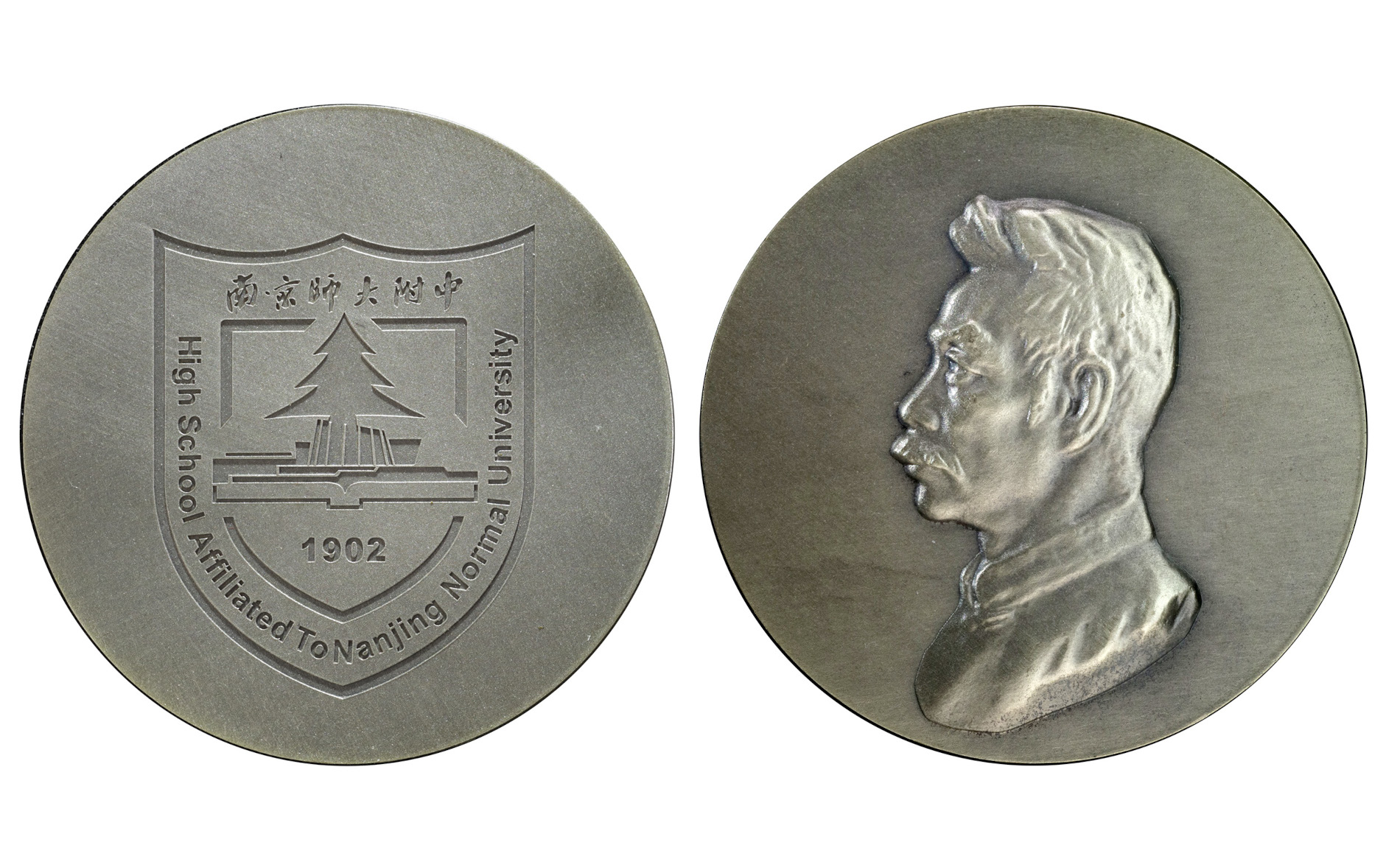
The writer of Village Opera was born in Shaoxing city, Zhejiang Province, China, in 1881. It was during the closing years of imperial rule, the Guangxu Reign (1875-1908) of the Qing Dynasty. His parents named him Zhou Shuren; the pen name Lu Xun came decades later. Several medals mark this birth year. For instance, there are both silver and brass versions of this 40-millimeter-diameter design. They were struck at the Shanghai Mint in 1981 for the 100th anniversary of Lu Xun’s birth. The brass medal’s mintage is recorded as 2,000.

In imperial times the scholarship system conferred status and government positions to the relatively few who passed the examination. Zhou Shuren was born into a family of distinguished scholars. However, when he was 13 years old, his revered grandfather was arrested as part of a civil service examination scandal. At first both Zhou Shuren and his father hid in the countryside. Under Qing Dynasty law the relatives of an arrested person could also be imprisoned.
By the time the pair returned home to Shaoxing the father — also a recognized scholar — had turned to drink and fell seriously ill. As the oldest able-bodied male, the family often sent Zhou Shuren to pawnshops to sell off heirlooms. His treatment by the pawnbrokers would never be forgotten. “Anyone who has come down in the world will, in the process, see the true face of society,” Lu Xun wrote later.
Shaoxing has deep roots in Chinese history; almost 3,000 years ago it was already a state capital. Today, it is an hour away by train from Shanghai, but in 1881 this was a more arduous journey. Socially and technologically, Zhou Shuren‘s Shaoxing was much like it had been for generations. Money meant round cash coins with square holes in the center. These were cast in molds much as in ancient times. Chinese businesses needed something else, though: machine-struck coins that would be acceptable in international trade. In 1887, the government agreed and the Kwangtung (Guangdong, or Canton) Mint was authorized and outfitted to produce coinage with a dragon design. Other mints in cities like Nanjing, Shenyang, and Chengdu soon followed. Lu Xun grew up familiar with both forms of money.
Many parts of society were also transformed in this era; music, for instance. Until the late 19th century sound had never been recorded – not once. When a performance ended it was gone… That’s all folks. Then, in 1877, the first sound recording was made. It wasn’t high fidelity, but in all of human history nothing like this had ever existed before. Within a year, China’s first envoy to England, Guo Songtao, saw a sound machine at an exhibition in what is now the Victoria and Albert museum in London. He was quite enthusiastic about the device, but for many years it did not become popular in China. Too fragile and too poor in quality was the consensus.
Over time the gramophone’s sound quality improved as did its popularity. In 1901, Shanghai was the site of the world’s first stereo recording — of an opera. Nonetheless, for people like the boy in a Village Opera, recorded sounds were not yet a part of their world. Sound players were a great luxury and the outlook for most of China’s population was bleak. For example, in the Village Opera story, while the boy loves to get away from the city and his studies, he recognizes that none of the children (and probably none of the adults) in his ancestral village can read, or write.
Already as a young man, Zhou Shuren realized that stale thinking shackled his country as much as its political system did. So, in 1902, he broke with his own family’s customs to study scientific medicine in Japan, courtesy of a Chinese government scholarship. In Asia, Japan was the first to adopt western technology and many in China applauded.
As can happen, events did not follow Zhou Shuren’s plans. Between 1904 and 1905, while he studied medicine in Sendai, a war broke out between Japan and Russia. The battle was over control of Korea and Northern China. Japan won, the first victory for an Asian nation over a Western power.
A year later, Zhou Shuren attended a biology lecture. After the regular content the Japanese professor gave the class a bonus: war photos. One of the images showed an alleged Chinese scout for the Russians as he was about to be beheaded by Japanese soldiers. The Chinese students in the class seemed unmoved. Years later Lu Xun described that moment, “Every face was utterly, stupidly blank […] if (a country’s) people were intellectually feeble, they would never become anything other than cannon fodder […] the first task was to change their spirit; and I decided that literature and the arts were the best means to this end.”
Zhou Shuren abandoned medicine, but the scholarship continued for three more years. So, he remained in Japan to study and write. In Tokyo, he tried to establish a literary journal called “Vita Novae” (New Life). He also published articles on the history of science and philosophy. Two volumes of short stories that he and his younger brother wrote were published.
In 1909, short on funds, he returned to Shaoxing to work as a teacher and school administrator. It was neither a happy nor a prosperous time for the young man.
There is an old song that goes, in part, “To turn, turn will be our delight, Till by turning, turning we come around right.” In 1911, China turned and so did Zhou Shuren’s fortunes. The Xinhai Revolution ended imperial rule and he was soon employed by the new National Ministry of Education. In this position he moved first to Nanjing and then Beijing.
His duties for the Ministry included supervising the restoration of the Jingshi Library (now the National Library) and the preparation of the History Museum. During this time, he became interested in the role of numismatics in China’s past. In Beijing’s Liulichang district he sought out ancient coins and eventually cataloged more than 1,300 types. The heart of this district is still filled with art galleries, bookstores, and a coin shop that sells modern Chinese coins.

During the Southern Song Dynasty, the writer Hong Zun published a study of ancient coins from the pre-Qin to the Five Dynasties and Ten Kingdoms. Lu Xun used his own research to add 700 years of numismatic history to this work. As part of this effort he also compiled and organized the first comprehensive catalog of Song Dynasty coins. This was completed in 1913.
The revolutionary literary journal New Youth solicited and published his story, Diary of A Madman, in 1918. No Chinese author had ever satirized traditional Chinese morality through everyday expressions like this. “Diary” was also the first time the pen name “Lu Xun” was used.
Gongmenkouertiao Road in Beijing is a small, quiet street today. The buildings on it may even date back to the Qing Dynasty. At the far end a large gate with red columns opens to the Lu Xun Museum. Inside is a garden and several Lu Xunrelated sculptures. Nearby is the small single-story flat that Lu Xun lived in at one time. From the outside the museum does not look grand, but, like a good book, there is more to it than meets the eye. Most of the exhibits are below ground level. It is a popular field trip destination for elementary school students who pore over the displays with their teachers.
The first room is a gallery of Lu Xun photos. Downstairs, other galleries trace the author’s development. Lu Xun was not only a great writer, but also a talented artist. Books that he both wrote and illustrated are exhibited along the walls. One case contains a Dragon and Phoenix Pattern Dollar coin. Lu Xun, together with two colleagues, designed this, but it was never approved for production.
After 1918, Lu Xun was famous. In December of 1919, he, his younger brother, and their families moved to a house in the Xizhimen district, northwest of the Forbidden City. This home attracted many guests, including Mao Zedong in April 1920. After a fall out with his brother, Lu Xun moved into the home on Gongmenkouertiao Road in 1924. There, he stayed active as a teacher, political author, and published two journals of writing by young Chinese writers.
On March 18, 1926, soldiers killed 46 people and injured 200 at a peaceful protest in Beijing. Two of Lu Xun’s own students were among the dead. Lu Xun called it, “The blackest day since the founding of the Republic.” An arrest order was reportedly issued for him soon afterward. Perhaps tipped off, he quietly left the city.
This time period was also when he first showed signs of tuberculosis. After Beijing, Lu Xun spent the following years in Xiamen, Guangdong, and Shanghai while he continued to teach, study, and write – especially about politics – until his passing in 1936.
One of Lu Xun’s best-known short stories is, The Real Story of Ah-Q. This satire skewers every level of traditional Chinese society. The tale follows the adventures of, basically, the village idiot who subsists on day jobs and mucks his way through frequent humiliations. Through it all, Ah-Q deludes himself into believing things are going his way.
One day he clumsily proposes to a maid and is thereafter shunned by everyone. Reduced to poverty he leaves the village only to return newly prosperous months later. For a short while the mystery of his good fortune earns him respect, but it doesn’t last. When rumors of a revolt against the government reach the town, he fancies himself a rebel who will overturn the social order. It’s all a fantasy, as he never joins anything, but his talk has real consequences.
At the end of the film Casablanca, police captain Renault covers up a crime with the order, “Round up the usual suspects.” In like fashion, Ah-Q is arrested for a major robbery he was not part of. The innocent and witless Ah-Q is then paraded around town guarded by soldiers in the back of a cart as an example to others. Only then does it even occur to him what his fate will be. Ever the fool, he comes to terms with his own execution as just the sort of thing that happens sometimes in life.
One of the finest medals to honor Lu Xun illustrates characters from The Real Story of Ah-Q, along with other stories. Struck at the Shanghai Mint in 1994, it is the work of master designer Chen Jian who not only designed the first Panda and many other coins, but is also a native of Shaoxing like Lu Xun. It began in 1988 when Mr. Chen graduated from East China Normal University. For his final project he carved a portrait of Lu Xun for a copper plaque. Only 10 of these were cast.
This image became the basis for the 1994 medal that merges Lu Xun’s portrait and calligraphy on the obverse. The reverse side is filled with figures like Ah-Q and Kong Yiji, the sad-sack character of another famous short story. Hints of Shaoxing help weave the pieces of the author’s life together.

When he passed away Lu Xun was eulogized in newspapers as “The Soul of the Nation.” Mao Zedong said of him, “Lu Xun’s bones are the hardest. He has no servility and charming bones.” It is said that as long as someone is remembered they are not truly dead. Lu Xun himself wrote, “If the deceased is not buried in the heart of a living person, he will surely die.”
Lu Xun remains alive in the minds of readers around the world, in the minds of the children who visit his museum, as well as in the collections of numismatists. Just before the museum exit there is a gift shop. In one showcase is a pin with the logo of Peking University on it. This logo was designed in 1917 by Lu Xun and the school continues to use it, a perfect exonumia souvenir of a writer who saw the true face of society.


 Copper & Nickel
 Silver Coins
 Gold Coins
 Commemoratives
 Others
 Bullion
 World
 Coin Market
 Auctions
 Coin Collecting
 PCGS News