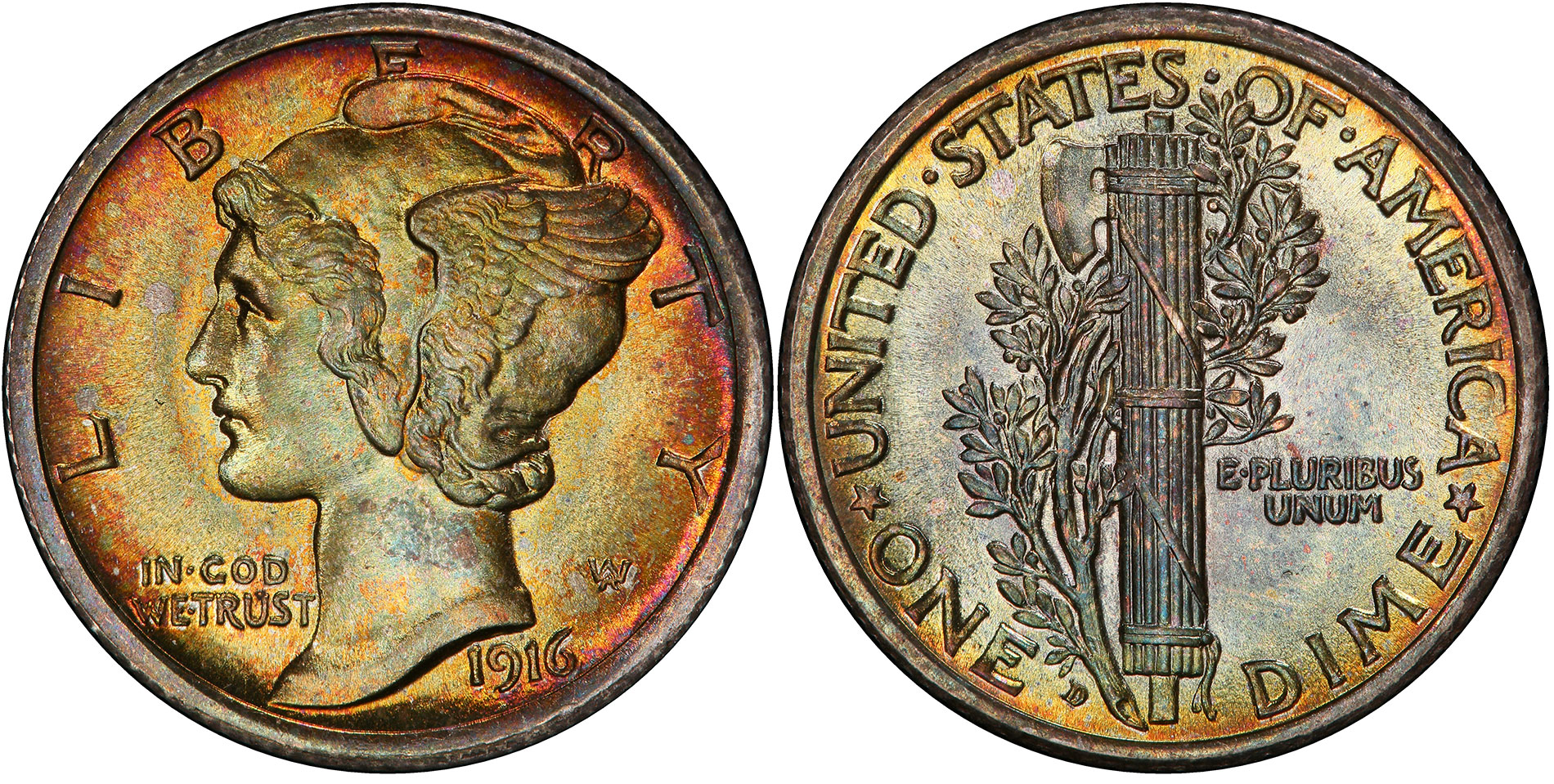
Many who are just starting to collect Mercury Dimes may wonder what the term “Full Bands” means. It’s not necessarily a phrase that jumps off the page with an obvious meaning. Bands? What are the bands? And why does it matter if they are “Full”? Sometimes this special grading designation is even less obvious because it’s presented only with the abbreviation “FB.” As Mercury Dime collectors can well attest, Full Bands – or FB – is of great importance to collecting these classic coins that were designed by Adolph A. Weinman and minted from 1916 through 1945.
The Importance of Full Bands
The bands on a Mercury Dime are found within the fasces design element, serving as the main reverse device that resembles a bundle of sticks and an axe wrapped within vines of olive leaves. Binding all these elements together are the bands, which are shown as three sets of twin belts. The Full Bands designation is granted to Mercury Dimes in which the central (middle) set of bands shows a complete split in the middle.
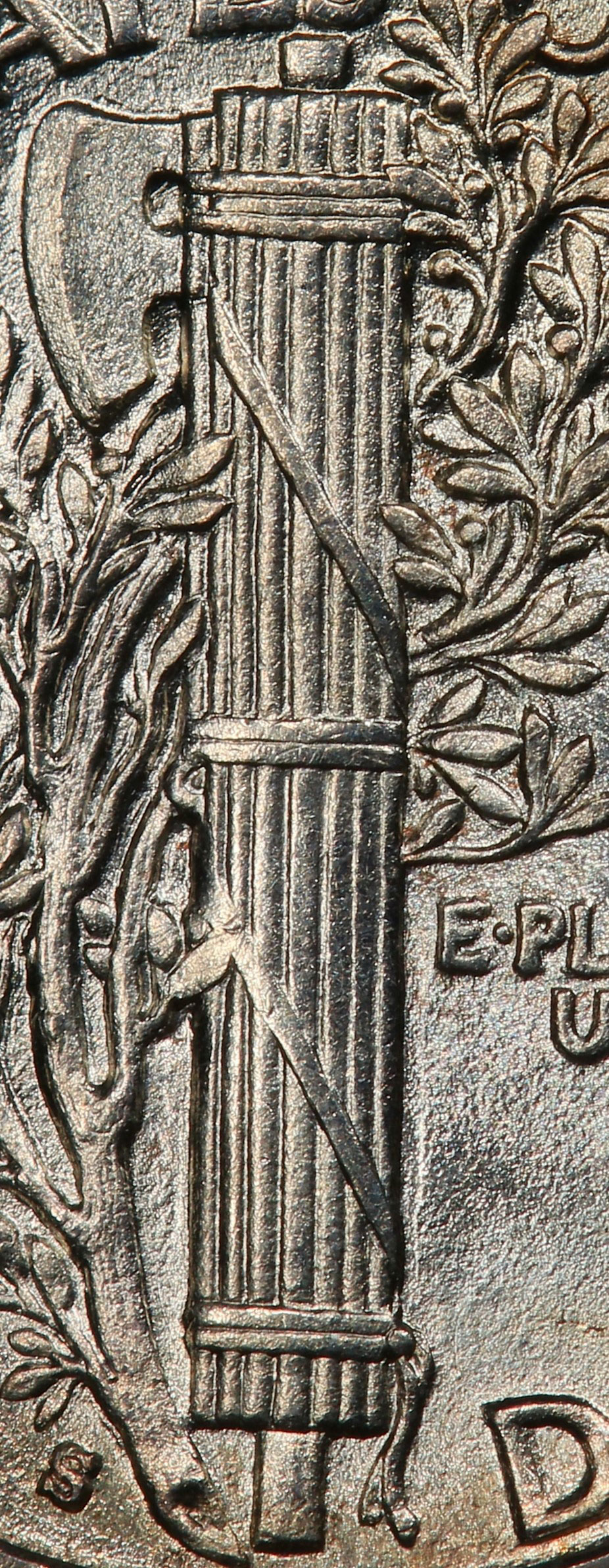
Why is this worth noting? The Full Bands detail is indicative of a sharp strike, which on many Mercury Dimes is quite scarce and is often highly rare. This is especially true with early branch mint strikes, though there are plenty of later dates from Philadelphia that are all but elusive with Full Bands details, such as the 1945 Philadelphia Mercury Dime with Full Bands. And because a Mercury Dime possessing these complete details are generally scarce, many collectors are willing to pay a substantial premium for them over examples with characteristically softer strikes.
Qualifying for the Full Bands Designation
For the most part, Full Bands designations are bestowed only to Mercury Dimes that grade MS60 or better and exhibit a complete separation of the central crossband on the reverse of the coin. However, there are exceptions made for the rare 1916-D Mercury Dime as well as the 1942/1 and 1942/1-D overdates, which can receive a Full Bands designation on a qualifying coin grading as low as AU50. In all cases, there must be no interruption of the separation of the subject crossbands, including marks, gouges, nicks, or other surface imperfections.
While the definition of a Full Bands Mercury Dime essentially calls for surficial perfection in the areas of the crossbands, this does not suggest that only flawless specimens are capable of achieving the coveted Full Bands designation. Again, a Mercury Dime can technically earn a Full Bands designation in a grade as “low” as MS60, and a great many Mercury Dimes in the MS62 and MS63 are graded as “FB.”
A Word of Caution About Buying Full Bands Mercury Dimes
The Full Bands designation is dependent on the appearance of a full, sharp recessed line through the crossbands on the fasces. Thus, there is the potential of unscrupulous individuals taking a sharp implement, such as a pen knife, and cutting across the bands to imitate the appearance of Full Bands detail. While this nefarious alteration may be imperceptible to a typical buyer, a coin-grading professional can easily spot pieces with fake “Full Bands” details.
Unfortunately, these fake “Full Bands” Mercury Dimes are commonly encountered on the marketplace posing as the real deal. It is therefore prudent for someone buying Full Bands Mercury Dimes to only purchase specimens that have been encapsulated by PCGS to ensure the Full Bands specimens they wish to buy are 100% authentic and accurately graded.


 Copper & Nickel
 Silver Coins
 Gold Coins
 Commemoratives
 Others
 Bullion
 World
World
 Coin Market
 Auctions
 Coin Collecting
 PCGS News