The first "nickels" were actually the "nickel cents" first struck for circulation in 1857. (Yes, there are some dated 1856, but the law authorizing the Flying Eagle cent, as it is now commonly called, was not passed until early 1857.) These cents were composed of 88% copper and 12% nickel, struck in 1857 and 1858 for the Flying Eagle series and 1859 through 1864 for the Indian Head series (commonly called Copper-Nickel cents). The term "nickel" for five-cent coinage probably came into use sometime during the nineteenth century, but it was the early twentieth century before it became part of the common vernacular. My father (1896-1983) remembered the destitute population during the Great Depression begging for nickels on street corners (or apples, bread, etc. - anything that could be consumed as food or spent to buy something to fill the void in their stomachs). However, the first "nickels" besides the "nickel cents" were the Three Cent nickels, first struck in 1865 and discontinued in 1889. Actually, even calling these coins "nickels" is a misnomer, as they contained only 25% nickel; the remainder was copper. This is the first in a series of articles on nickels, which will encompass the Three Cent nickel series, Shield nickel series, Liberty Head (commonly called "V") nickel series, and Indian Head (commonly called Buffalo) nickel series.
When James Longacre designed the Three Cent nickel, he did not know that nearly a hundred and fifty years later numismatists would be analyzing his short-lived series date by date, noting the striking characteristics, luster, and other attributes. Collectors have been putting sets of this odd denomination series together for many years, but today, interest is extremely keen for this quaint series. Both Mint State and Proof collections are currently being formed by astute numismatists. Certain Mint State dates have long been known to be rarities (1883-1885, 1887), but with today's condition conscious collectors, some other dates have turned out to be just as elusive as these low mintage dates, especially in MS-66 and higher grades. In fact, more than half the dates in the entire series have never been graded higher than MS-66 by PCGS (June 2001 PCGS Population Report). Although some of these dates are quite available in MS-60 through MS-64, the introduction of certified grading has "unearthed" some true diamonds in higher grades. Although it may be odd to some, the following analysis will first dissect the Mint State coins by date, then the Proof issues by date, which have some rarity surprises themselves.
One other item also should be mentioned for this series. There is often "doubling" seen on the legend, head of Miss Liberty, the wreath, and the Roman numerals. This has variously been attributed to die doubling, worn dies, eroded dies, or other numismatic curiosities of the die and striking process. However, having studied this phenomenon in depth for another of Longacre's series (gold dollars), another conclusion may be more accurate. For Type 1 gold dollars, the extra outlines around the stars turned out to be vestiges of a too-deeply impressed master die, which in turn was transferred to all working hubs, and then to the working dies. Basining of the dies removed these artifacts in many dies, but coins from all five Mints that struck gold dollars have been identified with the exact same artifacts on the same stars. Thus, the likely cause for the Three Cent nickel series "doubling" is the same. The master die, working hubs, and working dies (at least those that were deeply impressed) all had this "doubling" and only those weakly impressed working dies or properly basined dies do not show this effect. Only very close inspection of these small dies (as are the gold dollar dies) would have revealed this phenomenon, so today one can understand why this effect is seen on numerous examples of this series. This situation has no effect on the grading of this series.
The first year, 1865, saw a very large production of circulation strikes for this series; in fact, over twice as many 1865 coins were struck as for any other year of the Three Cent nickel series. They are available in Mint State condition up to the very highest grades, although in MS-67 they are very elusive. Three Cent nickels dated 1865 run the gamut in strike, luster, and eye appeal. They are found fully struck and all the way down to poorly struck (hair curls weak, wreath detail missing, and the Roman numerals with almost no vertical lines present). The luster also ranges from blazing "silver" gray to pale gray, although the most common "problem" with this date (as well as numerous others) is clashing. This series seems to be plagued by more clashed dies than almost any other United States coin series. The reason for this is not known, but perhaps the new alloy caused more jams in the feeding mechanism, or the small planchets may have jammed in the feeding tubes more easily than larger ones. For whatever reason, clashing is very prevalent in the early years of this series. The smaller mintages of the later years, or perhaps better quality control, may have resulted in fewer clashed dies, for after 1878 the "problem" became less prevalent. Clashed dies are not really a "problem" like planchet flaws, lint marks, and the like. They only affect the grade when they become severe and can slightly lessen the eye appeal. In fact, some collectors and dealers (myself included) find them quite interesting. The only other "negative" noted for 1865 coins is the presence of tiny planchet flaws that appear as "chips," often on the face or neck of Miss Liberty. If severe, these affect eye appeal, thus the final grade assigned.
The next date for this issue, 1866, is nearly a duplicate of 1865, relatively speaking, at least in the lower Uncirculated conditions. The same variances in luster, strike, and eye appeal are seen. It is scarcer in all Uncirculated grades and much tougher in MS-66 and higher. Die clashing is just as prevalent and the small planchet flakes noted for 1865 are also seen. This is a common coin except for higher-grade examples, which are rare in MS-66 and above.
The year 1867 seems to be an anomaly as most examples are fairly well struck. Only slight weakness in the hair curls, wreath, and Roman numerals is usually seen. This date, however, is very scarce in MS-66. The luster usually is above average and clashing is not as often seen as in 1865 or 1866. In higher grades it is very scarce, slightly more so than the 1866, and rare in MS-67.
Most 1868 Three Cent nickels are decently struck with good luster. Some weakness in the hair curls, wreath, and especially the lines of the Roman numerals is noted, about the same as in 1867. As with 1867, the higher grades are very difficult and this date is very rare in MS-66 and above, about the same rarity as 1867 except that MS-65 and MS-66 examples are more plentiful.
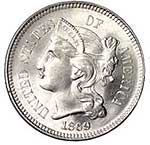
The issue of 1869 starts a run of similar looking and about equal rarity coins. It seems that many coins of this year were struck from dies basined more intensely than those that came before them. Many of this date have fine, parallel die polish. This gives a different look for 1869 Three Cent nickels than the 1865-68 coins. The finely polished fields give a nice contrast to the slightly frosted head, wreath, and Roman numerals. Not all coins of this date are seen with this effect, as some have the subdued satin or frosty luster of the prior years. This issue is very scarce in the higher grades with MS-66 and higher grades very seldom encountered, this being one of the early dates of the series that PCGS has graded a couple of coins in MS-67 grade. Since strike and luster usually are not a problem with this date, eye appeal mainly is diminished by the presence of the ubiquitous planchet chips - these, however, are not present on too many coins. Another "feature" that begins to appear in this year (they are few and far between for prior years, except for Proof issues) is the presence of lint marks. They are threads from the cleaning rags used after the dies were basined or repolished during a striking run. It is perfectly logical that these tiny threads would be virtually unnoticeable on these tiny dies. Lint marks, when severe or in obvious "eye spots" such as the cheek, will affect the grade of a coin similar to the negative effect of planchet flaws. (As previously noted, lint marks are much more prevalent on Proof strikes than on circulation strikes.)
The 1870 Three Cent nickel is almost a carbon copy of the 1869, although there probably are a few less coins seen with die polish. More are seen with satin or slightly frosty luster. However, it is slightly scarcer than the 1869 in the higher grades and is rare in MS-66 or better.
1871 can be characterized as the twin of 1869 and 1870. Many circulation strikes have the frosted devices and fine, parallel die polish seen on numerous 1869 and some 1870 issues. It is also very scarce and is on the same rarity level as the 1868, 1869, and 1870 in grades of MS-66 and higher. It is virtually impossible to find in any grade higher than MS-66, again this is one of the few early dates to have a coin or two graded MS-67. Also, many Proofs of this date have been mistaken for circulation strikes, as numerous Proofs also have fine die polish. About the only way they can be distinguished is to examine the third side of the coin - the edge. If the edge is deeply mirrored, it was likely issued as a Proof, no matter how much "frost" might appear to be lurking in the fields. Overall, this is one of the scarcer dates of the Three Cent nickel series in higher grades.
Very few nineteenth century numismatists cared much about condition. Most dates were available in quantity in Uncirculated condition and collectors probably paid little attention when they picked out examples for their collections. The 1872 issue is one of those dates that may have been available at one time, but today is quite scarce. Some 1872 examples have the fine die polish of the previous three years, but the majority of them are satin to slightly frosty in luster. Slight softness in the hair curls, wreath, and Roman numerals is sometimes noted, but most examples are decently struck. MS-66 coins are very scarce and higher grades are rare, this coin, as previously noted, is in a string of dates with similar rarity (1868-1879).
More fine, parallel die polish is noted for some of the 1873 Closed 3 issues and the difficultly in distinguishing circulation strikes from Proofs is similar to 1871 (Proofs of 1873 only were struck in the Closed 3 format). In fact, the coinage of 1873 is nearly identical in look to the 1871, which is nearly the twin of the 1869 and 1870 (although there probably are more frosty coins from 1869 than from these three years). The rarity is similar in the higher Mint State grades and is seldom encountered in MS-66 and is rare in MS-67. Luster and strike, therefore, are quite good, although there seems to be a reoccurrence of that bugaboo seen for some years - the small pre-striking planchet flakes or chips.
There is only recent Population data for the 1873 Open 3 Three Cent nickel. While it is similar to the Closed 3 coinage in appearance, there seems to be fewer prooflike examples and more frosty coins. The data is sketchy, but it appears that the Open 3 coins are scarcer than their Closed 3 counterparts. Certainly, in the higher grades they are more elusive.
The year 1874 is similar to 1873 Closed 3 coinage in strike, luster, fine die polish, and rarity. Again, determining circulation strikes from Proofs is quite difficult. Many coins of this date have been misidentified, Proofs called Mint State and Mint State coins called Proofs. Sometimes the only clue will be the third side, the edge on Proofs will be deeply mirrored. Some numismatists are confused by the beveled edges, usually seen on circulation strikes, but very common on Proof issues of this year. (Most Proof 1889 Liberty Head nickels have beveled edges, so this is not that unusual.) 1874 Three Cent nickels are quite scarce in MS-66 and very rare in MS-67, about the same as the rest of the 1868-1879 group.
As with 1874, the 1875 circulation coins are usually seen with fine die polish. Of course, many Proofs have similar-looking die polish. The same methodology is necessary to determine the correct designation status, although this is probably the most difficult year to determine Proof/Mint State status prior to the low mintage issues of the 1880's. This date is just as available in MS-65 as prior years, although in MS-66 it is slightly more often seen - PCGS has still not graded a specimen MS-67 (June 2001 PCGS Population Report). Strike is above average with slight weakness occasionally noted with luster also usually above average.
The 1876 Three Cent nickel is the last of the rare issues in Mint State from the 1870s. There are fewer of the fine die polish coins seen than for the previous years with satin and frosty coins about as often seen. In the higher grades, however, it is very difficult to find. Strike, again, is not a problem with most coins well struck and slight weakness only occasionally noted.
Although 1877 and 1878 Three Cent nickels have been reported in Mint State, these coins were obviously all struck as Proofs. Turning them on edge, one notes the deeply mirrored third side seen on Proofs. The fact that some slight frost in the fields is a result of the difficulty in striking nickel coinage and the likelihood that some coins were struck only once. Most silver and gold Proofs are struck at least twice, but the copper and nickel Proofs obviously were not as carefully struck.
When circulation strikes resumed in 1879, the quality was dramatically improved and the quantity struck reduced. Since the dies struck fewer coins, most Mint State 1879 Three Cent nickels are well struck with prooflike, semi-prooflike, satin, or occasionally, frosty surfaces. In fact, this is one of the more common issues in MS-66 for the entire series (third most graded in that grade per the June 2001 PCGS Population Report). It appears that collectors saved the issues of 1879-1889 like they did for the low mintage quarters, half dollars, gold dollars, and so on. This was a time after the Panic of 1873, so specie was hoarded by much of the populace. Interestingly, the small mintages also were the result of a drop in demand for specie because of the slow economy. What little was issued was bound to be gobbled up by the first hoarder or collector that obtained any of this "real" money.
The 1880 Three Cent nickel is easily available in Mint State. It is similar to 1879; in fact it is even more available in high-grade condition, although there were only 21,000 struck versus 38,000 for the 1879 (evidence that hoarding was becoming more active). The only problem is determining which coins are circulation strikes and which coins are Proof strikes. It appears that some of the dies for the Proofs were used for some of the circulation strikes. The 1880 Three Cent nickel, as well as many of the dates to follow, is a nightmare to designate. The third side, the edge, is even inconclusive in some instances. One will find coins that are somewhat prooflike on the edge, but not totally convincing as either Proofs or circulation strikes. For this reason, some Proofs are probably labeled as Mint State and vice versa. 1880 coins are ranked second most populous in MS-66 and most populous in MS-67 in the June 2001 PCGS Population report.
In 1881, one finds the most available date of the 1880s in all Mint State grades as well as the highest mintage date of the decade, the only coin with over a million made - in fact the only one with more than 40,000 struck! However, it is surprisingly difficult to find in MS-66 and higher grades, more in line with the years 1868 through 1876 than 1879 and 1880. There is no difficultly in determining designation, as most 1881 coins are satin or frosty in luster. Prooflike coins are less seldom seen. Most coins are well struck with only slight weakness noted on the hair curls and the lines of the Roman numerals.
The 1882 is seen in the lower Mint State grades about as often as 1880, but is more akin to the 1868 through 1876 group in MS-66, although it is seldom seen finer with only a couple of coins graded MS-67. The luster varies from satin to frosty to prooflike, with some difficulty in determining the designation of the latter. Strike is excellent with little weakness noted.
Starting with 1883, one starts a run of dates that are rare! With only 4,000 circulation strikes (contrasting with the highest number of Proofs struck for the series - 6,609), this issue is very tough in all Mint State grades. However, when it is found, the grade is likely to be MS-63 or better. Obviously, with such a scant mintage, most coins are prooflike or semi-prooflike. Finding fully frosty examples is almost a totally futile task. Only a few coins have been graded Mint State (17 per the June 2001 PCGS Population Report) making it one of the keys of the series.
The coins of 1884 are even more difficult to locate than the 1883. With a circulation mintage of 1,700 coins this is to be expected and, not surprisingly, there are fewer Mint State coins graded for this date than for any other date of the series! In fact, high-grade examples have traded in the low five-figures! Determining the correct designation is extremely frustrating as Mint State examples are almost always similar to Proofs. The edge is about the only arbiter that one can rationally use to determine whether an example is Mint State or Proof. A very rare coin in all Mint State grades, the discriminating collector can expect to pay handsomely for an example that satisfies.
It does not get easier for 1885. Well-struck, prooflike coins are the norm with the mintage of this date the lowest for the entire series, a scant 1,000 circulation strikes made. Determining whether they are Proofs or circulation strikes is the problem. Since most examples, Proofs and circulation strikes, are high grade, one must use all available tools to determine designation. True Mint State coins are among the most rare of all Three Cent nickels with a Mint State rarity only slightly less than the 1883 or 1884. Again, open the pocketbook for this date in all Mint State grades. Occasionally, circulation strikes of this date have weak denticles.
The coinage of 1886 is a Proof-only issue that is like the 1877 and 1878. It is found with even more frost in the fields that has led many a respected numismatist to declare: "I have found a Mint State 1886!" Not!
For some reason, there are quite a few 1887 examples seen with satin or frosty luster. This date is much more available than the 1883-1885 run and usually much easier to designate. In fact, many of the Mint State coins of this year have slight weakness in the hair curls, wreath, and lines of the Roman numerals. The periphery also is often found with weakness, not only on the denticles, but sometimes also the rim. This date is quite scarce but it is more akin to the 1879 in rarity than the 1883 through 1885 group. It is found in MS-65 with some frequency, although above that grade it is rare.
The 1887 circulation issue is reportedly also found as an overdate. The 1887/6 in Mint State is the rarity for the Three Cent nickel series. In fact, it is so rare that is may not really exist. The author has never seen an unequivocal example of this coin. (PCGS has not graded an example in any grade in over fifteen years of grading.) It reportedly is from a different die than the Proof 1887/6, which, of course, definitely exists. Breen only mentions the circulation strike overdate and does not provide a picture - to me a telling fact - although he notes the different die details. (The author invites any correspondence about the existence of this "rarity.")
1888 is one of the "common" dates in high grade for this series, ranking as the most common in MS-66 and the second most common in MS-67 per the June 2001 PCGS population Report. Finding frosty, well-struck examples is not difficult and the pricing reflects this fact, although it does sell for a slight "rare-date syndrome" premium. This is due to its association with other low mintage coins of the era. One will have little difficulty in obtaining a superb specimen for his or her collection as this coin has the third highest mintage of the 1879 through 1889 group.
The last year of this fantastic series, 1889, is the virtual twin of 1888, although with half the mintage, it is much tougher in MS-65 and higher grades. Well-struck, frosty examples are found with ease and are priced accordingly, with the slight "rare-date syndrome" premium.
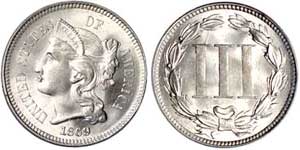
1869 Three Cent Nickel


 Copper & Nickel
 Silver Coins
 Gold Coins
 Commemoratives
 Others
 Bullion
 World
World
 Coin Market
 Auctions
 Coin Collecting
 PCGS News