Abe Kosoff: Dean of Numismatics
Q. David Bowers
At the Numismatic Association of Southern California convention held in Los Angeles from January 30 through February 2, 1963, Abe Kosoff conducted a sale featuring the collection of Lee G. Lahrman and other consignments. Included were Proof half cents and large cents, an outstanding offering of half dollars, pattern coins in various categories, and other pieces.
Around the same time Abe Kosoff's annual prediction appeared in the Numismatic Scrapbook Magazine:
"Coins will continue to go higher in 1963. The economy is geared to spending as long as the Cold War continues, and that situation seems to be here to stay-at least for this generation."
Sold in New York City at the Park-Sheraton Hotel in two sessions, the first of which took place on the evening of April 30, 1963, was the collection of Jacques D. Sweyd plus other consignments. The offering consisted primarily of United States coins in various series and gold coins of the world. In keeping with tradition, Lot No.1 was an1856 Flying Eagle cent, Extremely Fine, which fetched $1,500, reflective of the rapidly expanding coin market. A 1793 half cent, Gilbert-4, the coin used to illustrate the Gilbert book, Very Fine-35, was listed as Lot 56 and fetched $775. Lot 121, a Proof 1841 large cent, Newcomb-I, Proof, a piece which was offered in at least two earlier Kosoff auctions, crossed the block at $490, while a set of Proof two-cent pieces from 1864 through 1873, one of each date, plus an Uncirculated 1864 Small Motto, fetched $1,250, and a set of Proof nickel three-cent pieces from 1865 through 1889 commanded $1,600. An 1833 Russian platinum 12 rubles, Proof with a bruised edge, fetched $1,025, while an 1848 Dutch 20 guilders, lettered edge, Proof, brought $675 and a Dutch 1892 10 guilders, one of only 61 pieces believed to have been struck, sold for $700.
The interest in American gold coins was on an upward march, and Proof double eagles of 1890 and 1892 sold for $2,350 each while a 1901 in the same state brought $2,050. A complete set of commemorative gold dollars and quarter eagles, 11 pieces, described as Uncirculated, sold for $2,200, while a complete set of five Panama-Pacific commemorative coins, very rare and estimated at $10,000, didn't quite make it this time around but sold for a very respectable $8,750.
The interest in American gold coins was on an upward march, and Proof double eagles of 1890 and 1892 sold for $2,350 each while a 1901 in the same state brought $2,050. A complete set of commemorative gold dollars and quarter eagles, 11 pieces, described as Uncirculated, sold for $2,200, while a complete set of five Panama-Pacific commemorative coins, very rare and estimated at $10,000, didn't quite make it this time around but sold for a very respectable $8,750.
Lot 843 was described as follows: "1916 Standing Liberty quarter, Uncirculated. We do not particularly like to use the term 'cabinet friction' but that best describes the high spot on the eagle's wing." The coin sold for $710.
In New grade, examples of the $1, $2, and $5 "Educational" notes of 1896 fetched $47.50, $160, and $325 respectively. Little did the cataloguer dream that within two decades the same set would bring over $10,000 in the coin market peak of 1979-1980!
In 1962 and 1963 there was great concern in the numismatic hobby about the proliferation of counterfeits, copies, and replicas. Some of these were made to deliberately deceive collectors while others were created as souvenirs. "1776 Continental dollars," "1856 Blake & Co. $20 pieces," and a host of other items surfaced to plague coin dealers, who continually received telephone calls from people who believe they had varieties worth a great fortune.
Abe Kosoff encouraged the Professional Numismatists Guild to set up a study committee on the subject of forgeries. This was done, and the committee announced its intentions to work with a comparable committee of the International Association of Professional Numismatists.
From time to time, Abe Kosoff issued news releases and consented to interviews on the perplexing problems of counterfeits. For example, the June 7, 1963 issue of Coin World, excerpted herewith, told of a situation:
"If Mr. Bob Siegel chooses to flood the field of classical numismatics with coin reproductions, then it is up to us to inform the collector that this is the road from which there is no return! We must urge our government officials of every level that this practice must be controlled, that the machine which is responsible for the production of the dies must be licensed and registered."
These were the words of Abe Kosoff following -a May 15, 1963 declaration by Robert Siegel, of Coin Reproductions, New York City, who stated, according to Coin World, "that the firm would manufacture and market unlimited numbers of un-marked coin replicas-a reversal of its earlier policy."
The article went on to say that Mr. Siegel had indicated that replicas of 3,000 Roman and Greek coins plus 1,000 coins of "later years" would be manufactured in unlimited quantities. "The coin copies have been labeled 'deceptive' and 'excellent reproductions.' Coin World has refused to advertise them without proper marking; the PNG has been joined by the IAPN in objecting to the copies. The British Museum, at one time credited with furnishing the New York firm with assistance, denied any association with the manufacture of such spurious articles," the article noted.
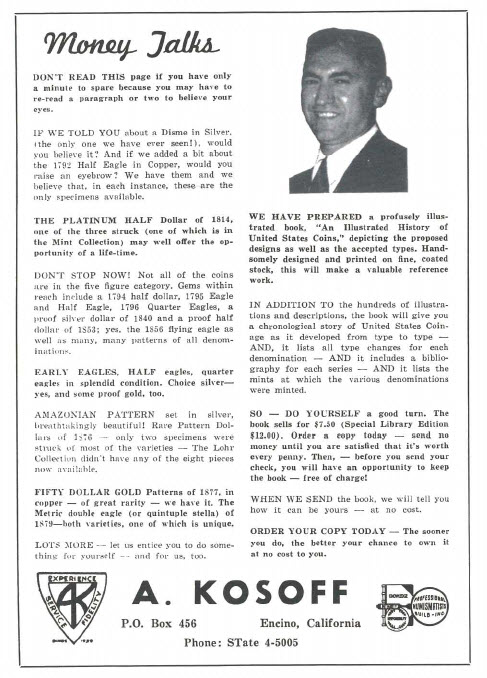
Many of the pieces in this May 1963 advertisement in "The Numismatic Scrapbook Magazine" were from the Dr. J. Hewitt Judd collection, a group of coins that was marketed over a period of years.