Abe Kosoff: Dean of Numismatics
Q. David Bowers
"Alex Shuford of Hickory, North Carolina had been building an extraordinary collection of United States coins and paper money, and I wanted to get this little prize for him. I persuaded the owner to part with it ($18,500 helped), and Shuford owned it for $20,000. Now I have it again as I complete the catalogue of the Alex Shuford Collection preparatory to placing it on sale by auction.
"I have had the Shuford Collection in my vault for a lengthy period of time. The sale had been first scheduled for the spring of 1967, but market conditions were not favorable, and I advised Shuford that I recommended a postponement, possibly for six months or even a year-depending on how things would go. It was difficult for him not to follow this advice, Shuford pointed out, since my own commissions would not be realized until the collection had been sold. We waited.
"The waiting period gave me time to think. Normally, a collection of this kind should realize a handsome profit for its owner. In this instance, Shuford, an extremely busy man with a trust in his then-numismatic-advisor, acquired many coins which, in my opinion, did not measure up condition-wise. Fortunately, the collection was still a very unusual one and contained a number of gem coins and many rarities. Preparing the catalogue was a thrill, despite the necessity in many instances of downgrading coins which were acquired as Uncirculated to levels as low as Very Fine, a procedure which could have been very distasteful."
The Shuford catalogue was prepared, and advertisements were placed. Response was over-whelming, and 2,000 extra catalogues had to be ordered from the Sidney Printing and Publishing Co. (later known as the Amos Press) in Ohio. Even so, he ran out of catalogues and had scarcely an extra by the sale date.
After the results of the mail bids were added up (there was no public gallery or floor participation), it was announced that a bid of $18,000 captured the 1841 quarter eagle, while it took $3,125 to buy an 1932 double eagle and $2,750 to capture an 1854-O coin of the same denomination.
A pair of 1883 and 1884 Proof double eagles were bid to $7,600 each, while an 1870-CC double eagle brought $8,235, according to an auction report. Selling for $4,600, a new record price, was a 1933 $10 piece, while a 1920-S of the same denomination brought $2,500 and a 1930-S sold for $3,500.
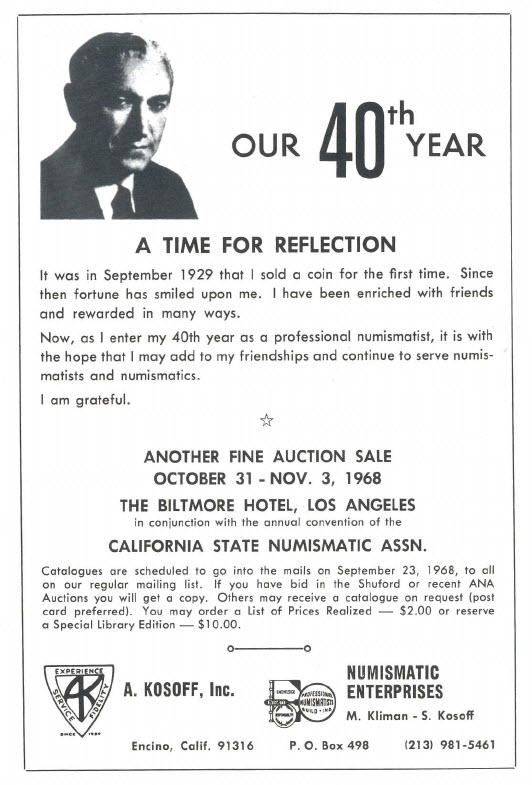
The beginning of Abe Kosoff's 40th year in numismatics furnished a time for reflection, as observed in this advertisement in the September 1968 issue of "The Numismatist."
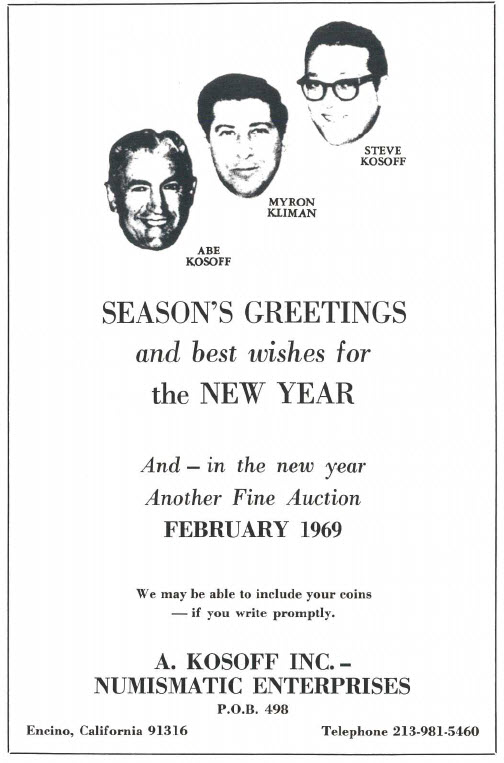
Greetings and best wishes from A. Kosoff, Inc. and Numismatic Enterprises. ("The Numismatist," December 1968)