Walter Breen's Encyclopedia of Early United States Cents
Walter Breen
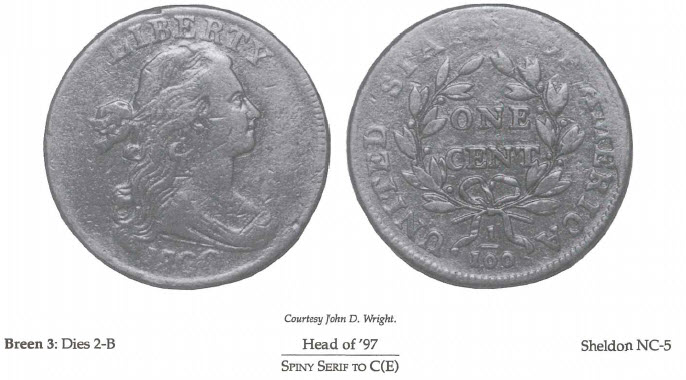
Obverse 2.
Reverse B. Spiny serif to C(E). Short fraction bar to the left, not extending above the final 0, similar to several 1798 reverses, but unlike most later 1800 reverses. The berry below E(D) is caught between leaves, its stem parallel to the leaf edge above. All berries have stems, those nearest F and (N)E are shortest, the three on the inner left longest. Left base of E(D) is short and left base of E(S) is almost gone.
Edge: unidentified.
Die states: The only one I have seen has a rim break on F AME. TES 0 are weak.
Equivalents: Sheldon NC-S. EAC 1. Encyclopedia 1735.
Rarity 8. Three examples are currently known. Remarks: Discovered by Dr. Stanley Q. West. (Penny-Wise,no.8,9/15/1968,p.168;no.16,1/15/1970,p.28.)
The spiny serif to C(E) is as on numbers 13-16 and 1798 numbers 22, 32, 34-36. It represents a chip on the hub, repaired by hand on some working dies.
Condition Census:
VG-10 Purchased unattributed from an old Philadelphia collection in 1965 by Dr. Stanley Q. West and from him in 11/1965 to Dr. William H. Sheldon, 4/19/1972 • R. E. Naftzger, Jr., 2/23/1992 •Eric Streiner, 8/13/1992. Robinson S. Brown, Jr. • Superior Stamp & Coin Co. 1/1996: 262 $22,000 • Daniel W. Holmes, Jr. Obverse and reverse illustrated in Noyes. The discovery coin for the variety.
VG-10 Sharpness of VF-25 but nicked, cleaned, and recolored. Discovered in a group of 50 large cents kept by the Arthur Rexford Willis, Sr. family that came from a safe found in the woods around 1945 after it had been tossed out of an old shipyard in New Bern, N.C. sometime in the 1930s, the 50 large cents being given in 1965 to William S. Willis. He sold them in March 1996 for $50 to William Sherwood Henderson who identified the first example he looked at as 1800/1798 NC-5 • Early American Coppers 5/1996: 154 $17,000 • Thomas D. Reynolds.
AG-3 Purchased unattributed in 8/1995 by a confidential source.
No other examples have been reported.
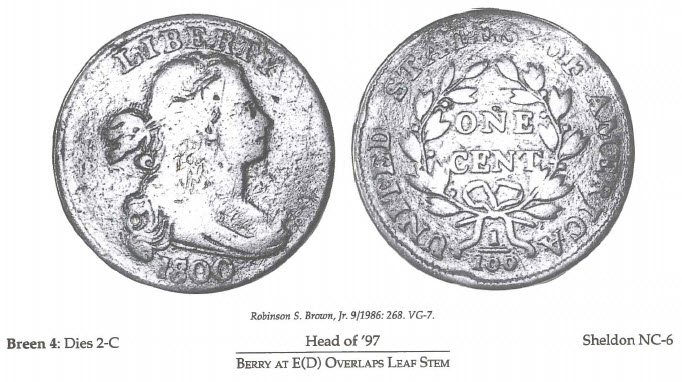
Obverse 2.
Reverse C. Long heavy fraction bar. Berry left of the bow has a long vertical stem, the berry right of (N)T is virtually stemless, and the berries below M and R have long stems, especially at M. Berry below E(D) joins the point of a leaf and overlaps the stem of adjacent leaves. C(E) is normal, as are the bases of ES and F.
Edge: Plain edge (PE).
Die states: The only ones seen sharp enough to show them have faint double clash marks below the chin. Possible die failure at TES from axial die misalignment: weak at right obverse and upper right reverse.
Equivalents: McGirk 1C(?). Sheldon NC-6. EAC 2.
Encyclopedia 1735.
High Rarity 6. Nearly Rarity-7. Thirteen examples are known.
Remarks: If the Hines coin is traceable to Dr. S. T. Millard, then the discoverer is Dr. Charles E. McGirk, and the McGirk number is confirmed. His description calls for this obverse and reverse to differ from numbers 2 or 5 but is otherwise unidentified. He described no die breaks: this rules out number 3. His discovery coin was in the Dr. Millard collection. (A.. Gies, Stack's January 1942: 244, "Mc[Girk] 1-C. (R-11.) Very fine, light steel. Has a few defects. Very rare.") As late as December 1971 this variety was still controversial.