The Norweb Collection - An American Legacy
Michael Hodder and Q. David Bowers
New Netherlands' owner was Charles Wormser, who had taken over the company from his father Moritz. Charles was gracious and affable, and his important and wealthy clients felt at ease with his correct manners. John Ford, his associate, was dynamic and hard-driving, had an excellent command of the subtleties of United States numismatics, and wrote well. Numismatic research was in the hands of Walter Breen, whose genius, together with the work of John Ford, can be seen in the company's auction catalogues of the time. Together, the three created a first class business team; many believe that the scholarship evident in the company's catalogues, fixed price lists, and numismatic publications set a new high standard.
Mrs. Norweb's introduction to New Netherlands in 1952 was the beginning of a decade-long relationship that spanned the period in which the Norweb family was most active in the hobby. While Ambassador and Mrs. Norweb patronized other companies and professionals, particularly B. Max Mehl (until his death in 1957), the late Richard Picker, and Paul and Art Kagin, the relationship with New Netherlands, and John J. Ford, Jr. in particular, was the most significant one for the future shape of the Norweb Collection itself.
We should note here that this study of the personalities, history, and contents of the Holden-Norweb Collection is concerned almost exclusively with the United States coins and medals acquired by the family over nearly eighty years. The Norweb Collection was not confined to United States coins, however, and some references to the family's interest in foreign numismatics can be found throughout this book. Close personal relationships were formed with several noted professionals over seas. Most prominent were the late Leonard Forrer, Fred Baldwir ("Uncle Fred"), and Douglas Liddell of Spink & Son, Ltd. Another book entirely would be required to do justice to the importance of the Norweb holdings of foreign coins. Here we car only touch upon some isolated aspects of their interests in non US. coinages.
The Norwebs and New Netherlands
As noted, Mrs. Norweb first met John Ford at the ANA Convention in August 1952. He must have impressed her favorably as by the fall of that year she was buying colonial coins in large numbers from New Netherlands. She was also filling in gaps ii other series with coins purchased from the company. The yea previously, in April 1951, New Netherlands was recommender to Jane Allen Brand as a trustworthy outlet for her share of the Virgil M. Brand Collection. The recommendation had com from Leonard Forrer the younger, who had handled Jane Allen Brand's coins previously but had, by early 1951, gotten into some difficulties with Mrs. Brand. Leonard Forrer was an excellent numismatist, but his business practices were of the old school ail! mundane matters like inventory control and accounting were not his strengths. When Jane Allen Brand decided to take he business away from Forrer she asked him for the name of a:
American company she could have faith in. Charles Wormse was about to be married to Forrer's old secretary, Pat Wolft Murray (a direct descendant of General Wolfe of Quebec), s New Netherlands Coin Company immediately came to Forrer mind.
Early in 1952 Jane Allen Brand began giving New Netherland coins from the Brand estate for sale, at a commission of 15% Included were some of the most outstanding rarities in the U.S.colonial field. Starting in 1953 the bulk of these went to Mr: Norweb. Mrs. Norweb always had first choice of anything new acquired for sale by New Netherlands, so when exceptional piece came their way, Mrs. Norweb was always informed first and WE given first refusal.
Ambassador Norweb's primary interests were in the areas ( Latin American coins and proclamation medals, while Mrs. No web's were in United States and English coins. They both share an interest in Canadian coins. These other, non-US. numismatic pursuits manifested themselves early in 1953, at least to professionals in the business. Of course, it will be remembered ths Albert Holden purchased medieval English silver coins from Tor Elder before 1913; and R. Henry Norweb, Sr. started collectin Latin American coins and medals in the 1930s, while he was stationed in South American countries. Purchases in these field had always been private ones. However, starting in 1953 the No webs began buying actively in these fields, through New Netherlands and at other companies' auctions.
In late 1952 the Brock-University of Pennsylvania Collectio came on the market. Wayte Raymond, who had been contacted by the university, recommended New Netherlands as an appropriate vendor for the university's holdings. At the time, the university's "numismatic advisor" was Philip H. Ward, a loc: stamp dealer and entrepreneur who had acquired the unfortunate nickname of "Piggy" John Ford traveled to Philadelphia to look over the Brock Collection, which included United States and foreign coins, many from the great Parmelee Collection sale and other auctions of the 1890s. Ward asked for Ford's advice on the US. section, and using the knowledge he gained, took as his fee from the university many of the choice and rare colonial coins in the Brock Collection. These later reappeared on the market in 1956 through 1958, with some pieces being sold through Harry Forman, a Philadelphia dealer.
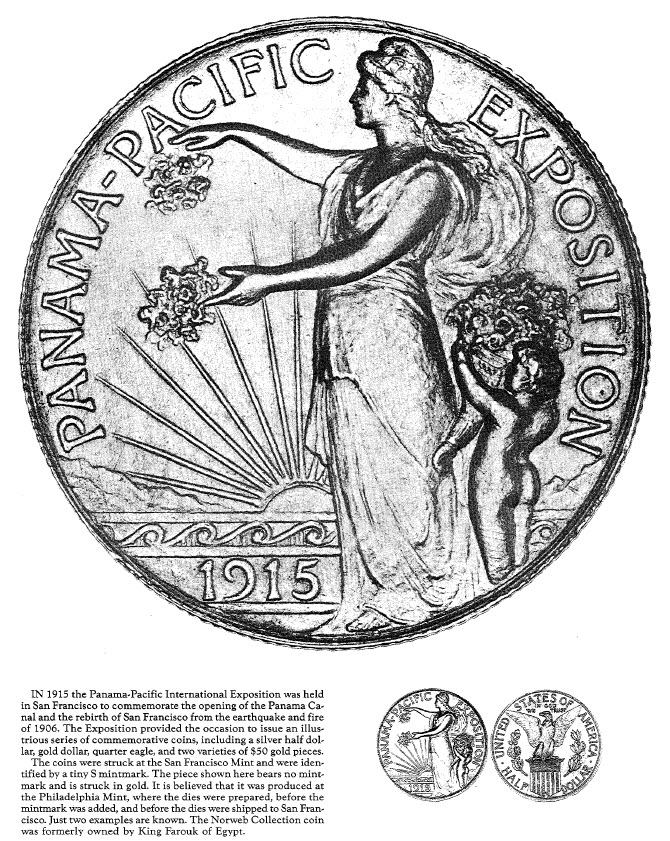
Gold 1915 Panama-Pacific Half Dollar