The Norweb Collection - An American Legacy
Michael Hodder and Q. David Bowers
The Mougey Collection Sale (1910)
The second source of information we can use to get a feeling for Emery May's involvement with her father's coin collection in this early period consists of the few remaining auction catalogues of sales Albert Holden bid in before his death in 1913. As we have mentioned elsewhere, very few were preserved after his death; Albert's original library of catalogues must have been quite extensive, given his known participation in many important sales, whose catalogues are not to be found in the Norweb library today.
One surviving catalogue in particular, of the sale of the Peter Mougey Collection in September 1910, is very instructive. Catalogued by Thomas Elder, one of Albert Holden's favorite dealers; and auctioned by Daniel Kennedy, who had held the American Numismatic Association convention sale earlier that year; the Mougey Sale was a major numismatic event of the period.
Peter Mougey's collection included outstanding half cents and large cents, which Elder described as being the finest ever assembled. It contained one of the finest collections of half dimes known, featuring an 1802; gold coins from quarter eagles through eagles; the finest collection of half dollars ever offered for sale up to that time; and gold and silver proof sets from 1842 to 1906. Individual rarities were too numerous to mention here. Suffice it to say, however, that the Mougey Sale brought Albert Holden out as a major buyer, and the reconstructed inventory of his collection shows he was successful with some of his bids.
Thomas Elder produced two versions of the Mougey Sale catalogue. One contained plates, and was meant to be a reference catalogue, to be kept in a collector's library for future study. The other version contained no plates, only the descriptions of the individual lots being sold. This was meant as a working copy, to be marked and annotated by bidders with any notes they wanted to include, like maximum bid amounts, notes about rarity or pedigree, and so forth. Albert Holden's plated copy of the Mougey sale was lost after his death, but his working copy survives and is filled with notes in his own handwriting. It also contains numerous comments in Emery May's hand.
Judging by the comments, it appears that Albert and his daughter Emery May collaborated on annotating auction catalogues. Albert seems to have given Emery May sale catalogues when they arrived in the mail at his house in Bratenahl, Ohio. Her job was to go through the lot descriptions in the catalogues first, before her father saw them. She would compare the coins being offered with the inventory of her father's collection and note down which pieces were still lacking in their collection. Then she would compare the conditions of coins being offered with the conditions of the ones their collection did contain, to see if there was a chance to upgrade by buying higher grade examples from the auction.
Emery May would also write marginal comments about the lots inthe sale. Sometimes these included notes about the rarity of a particular date; other times,they included remarks about mistakes in catalogue descriptions. Usually, her comments concerned the grades of coins in her father's collection compared to the grades of specimens offered in the auction.
Grading and Pricing
When Albert began collecting coins, in 1907, collectors used the grading system popular at the time, which was purely adjectival. Coins were graded as "Uncirculated", ''About Uncirculated", "Very Fine", and so forth. Distinctions in grades, refinements we might call them, were made by qualifying the adjectival grade with particular comments in the general description of the coin. So, a typical description might read as follows: "1798 dollar. Thirteen stars and Heraldic eagle. Uneven date with pointed 9 and high 8. Uncirculated, sharp, a gem. Plate;' The numerical grading standards which are familiar to all collectors of United States coins today were not created until decades later. Our modern MS-65 and MS-67 grades, equivalent to the above adjectival grade with its qualifiers "sharp, gem", would have made no sense to Albert Holden or his daughter Emery May. Thomas Elder, who actually wrote the description of the 1798 dollar we included above, would not have immediately understood the "precision" our modern, numerical grading system suggests.
There were some scattered, largely barren, attempts at creating a shorthand, numerical grading system for U.S. coins before 1908. Earlier in this book, in the chapter detailing Albert Holden's collecting activities, we alluded to Strobridge's numerical system. Albert seems to have created something very much like Strobridge's system, refining it by adding additional numerical grades. It must have appealed to his scientific nature, as the numbers themselves implied a certain uniformity and general application across different specimens of the same date. For example, a 1798 dollar of the variety described above graded 2, for Uncirculated, would have to be more desirable than another specimen of the same variety graded 3, for About Uncirculated. As we find today, the "scientific precision" implicit in numerical grading does offer the collector some assurance that a coin with a higher number grade is in better condition than one with a lower number grade.
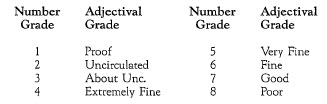
By 1910, when the Peter Mougey Collection was sold, Albert Holden had dropped grading coins adjectivally and was using his numerical system exclusively. Emery May learned the system, and used it in her own comments in the Mougey sale catalogue. We have mentioned the structure of his system earlier, but it is worth repeating here, since he was one of the few collectors of the time who used numerical grades. In his system, the lower the number the better was the grade of a coin, which is directly opposite the modern style. In their grading system, Albert and his daughter Emery May considered Proof to be a grade, and not a method of manufacture, and Proof condition was thought to be the best, so it was given the lowest number, 1. Today, we recognize that the term Proof refers to a coin specially struck from polished dies on a polished planchet, and not a grade in itself (a Proof coin can be Proof-67, Proof-63, Proof-60, and if impaired by handling even Proof-50). The numerical system they used to grade their coins looked like this: