The Norweb Collection - An American Legacy
Michael Hodder and Q. David Bowers
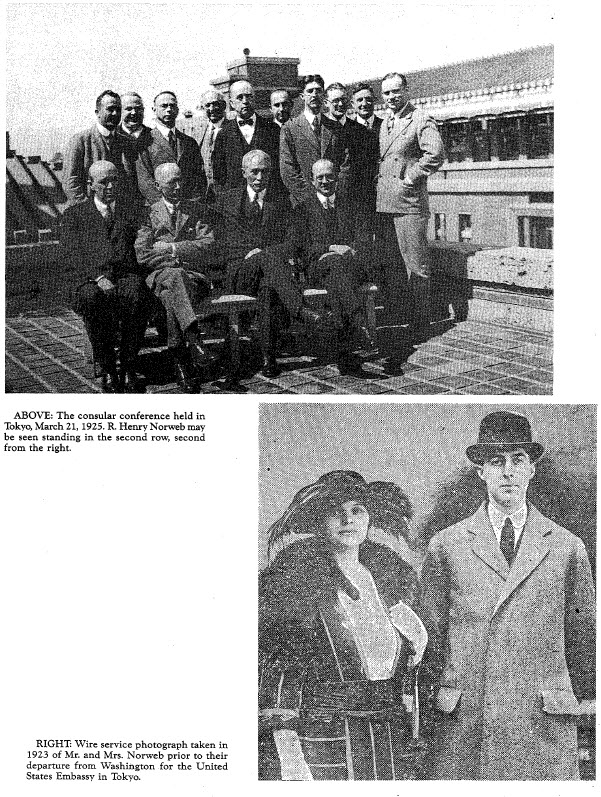
Another observation about Mr. Norweb's career should be emphasized here. He advanced in rank, from third secretary in 1917 to Minister Plenipotentiary in 1936, faster than any of his con-temporaries in the State Department. When President Roosevelt appointed him Minister to Bolivia in 1936, a rank equivalent to ambassadorial status, at forty five years of age Mr. Norweb was then the youngest career diplomat holding ambassadorial rank.
Mr. Norweb retired from the foreign service in 1948. He was then only 53 years old, and while his posting to Portugal three years earlier had been a difficult one, he was still comparatively young and could have looked forward to more years of service with the Department of State. The reasons for his early retirement are not entirely clear. It is certain that both Mr. and Mrs. Norweb enjoyed their new-found free time, and put it to very good use. The Norweb coin collection was largely assembled after 1948, for example.
His retirement may not have been entirely voluntary, however. President Roosevelt appointed Henry Norweb Ambassador to Cuba in March, 1945, shortly before the president's death on April 12. When President Truman assumed the office following Roosevelt's death, Mr. Norweb's appointment was confirmed, and he served in Cuba into 1947. During the 1947-1948 presidential campaign, which pitted President Harry Truman, the Democratic candidate, against Thomas Dewey, the Republican choice, Mr. Norweb appears to have supported Dewey's candidacy. President Truman's election in 1948 coincided with Henry Norweb's retirement from the foreign service. The two events may not be entirely unrelated.
The Azores Bases Treaty (1943-1944)
R. Henry Norweb, Sr. always considered the successful negotiation of the Azores Bases Treaty with Portugal the high point of his diplomatic career. Because of its importance for appreciating Henry Norweb's career, as well as its significance in the history of the Second World War and for today's geopolitics, it is worth spending some time describing the events that surrounded Mr. Norweb's negotiations for basing rights in the Azores Islands.
The Azores are a group of nine small islands lying about 800 miles off the coast of Portugal. From about the middle of the 17th century they have been Portuguese territory. Their location in the Atlantic Ocean makes the island group an important strategic position today. In 1943-1944, their importance to the Allies may have been even greater, particularly in the battle against German U-boats. A glance at any map of the world will immediately show why this was so.
Anti-submarine aircraft armed with bombs, torpedoes, and long-range fuel tanks could patrol most of the middle of the Atlantic Ocean from bases in Bermuda, Newfoundland, and the Azores. Similar patrols, based in England and the Azores, could effectively patrol and interdict German submarines leaving their pens along the western and southern coasts of France. Additionally, the west coast of Africa north of Dakar would also be in range of aircraft operating out of the Azores. Successful anti-submarine measures required that the western leg of the defensive triangle be anchored in the Azores Islands, in 1943-1944 as today.
When the subject of basing rights in the Azores first came up, early in 1943, the military situation facing the Allies put another, different priority on obtaining landing and refueling rights in the islands. Operation Torch, the invasion of North Africa 1942-1943, was facing stiff resistance from the German Afrika Korps in Tunisia. Missing from the invasion's strategic plan was a central refueling and transshipment facility near the African coast that could support the invasion's logistical needs. It should be remembered that in 1943 Europe was in German hands, Pertugal and Spain were formally neutrals but actually leaning towards the Axis powers, and that the support of the regimes in France's African colonies could not be relied upon. Without bases in the Azores Islands, the campaign in North Africa would have to be supported entirely from England and the off-shore invasion fleet, putting the success of the campaign that much more at risk.