The Early Quarter Dollars of the United States
A. W. Browning
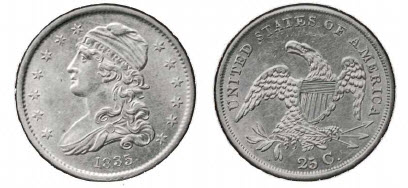
No. 3
Obverse: The same as [Browning] 1 and 2.
Reverse: Similar to [Browning] 2, but value 25 C., low near border, with 5 and C somewhat further apart. The eagle's wing at left does not extend down as far below U, or come as near the border as in [Browning] 2. The eagle has a tongue.
Obverse due here is cracked in two places; through bottom of 3 and 5, extending out in field to right as in No. 2; also from upper edge above upper left star across to top of cap. Reverse die perfect.
Coarse dentils; high 3; extended crack through 35 to right.
Fine dentils; closest 25; plain tongue.
Browning-3; not in Clapp; Duphorne-74; Breen-3928; not in Haseltine.
Rarity-4.
Obverse crack farther extended to right than on B-2.
Very rare in Mint State. The best ones appear to be Davis-Graves:344; Winter:1331; and the Browning, Col. Green example (Plate VII).
In Steve Ivy's Phoenix Sale:711 (6/11-12/82) one was described as obverse B-1, cracked through 5, new reverse: "25 C placed low, 2 higher than 5 C. C in value recut. Period after C. ED in UNITED and second T in STATES repunched. Eagle has a tongue. Die spur juts from serif of N in UNITED. Curved die flaw (initial punch too far right?) below first S in STATES. Coarse dentils." Except for the dentils (which would be true of obverse), the description fits the B-3 on Plate VII. Jules Reiver thinks the coin is B-3; [Breen] had not seen it.
Numerical Condition Census (RWM, Sr. [circa 1992]): 60, 60, 40, 40, 40, 20.
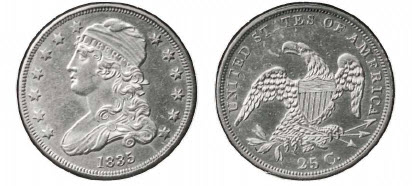
No. 4
Obverse: 5 in date under curl. Left side even with left of curl; upper left star points to spot where end of upper curl meets Liberty band; lower left is same distance from bust as in [Browning] 1-2-3; upper and lower right are slightly nearer bust than in [Browning] 1-2-3, the same die.
Reverse: Similar to [Browning] 3, but in value, 25 C., 2 and 5 are further apart, and the eagle has no tongue.
Obverse die cracked and found in three conditions:
a) From border at left opposite fifth star, extending down, connecting the four stars below and the under front part of bust.
b) Cracked as in (a) and from lower right edge to hair between 5 and lower right star.
c) Cracked as in (a) and (b), but the (b) or second crack extends up over bust to end of chin, and from this point across field to top of third star. Reverse die perfect.
Fine obverse dentils henceforth, except 1837 B-1.
Curl begins over left edge of 5 (hold 5 upright).
Repunching within base of C in 25 C; first S, O, and R high.
Browning-4; not in Clapp; Duphorne-75; included in Breen-3929; not in Haseltine.
Rarity-3.
Die states: I. As Browning's state A.
II. As Browning's state B.
III. As Browning's state C.
IV. Crack rim above eighth star to top of cap and into field. Heavy clash marks both sides. G:608, called "B-4A."
Very rare. Uncirculated.
1. Boyd, WGC:123.
2. J.A. Stack:41. Same? Is either one Browning plate coin?
Others include: JRCS 181. AU. Reiver. EF.
Numerical Condition Census (RWM, Sr.): 60+, 50, 40, 40, 30, 30.