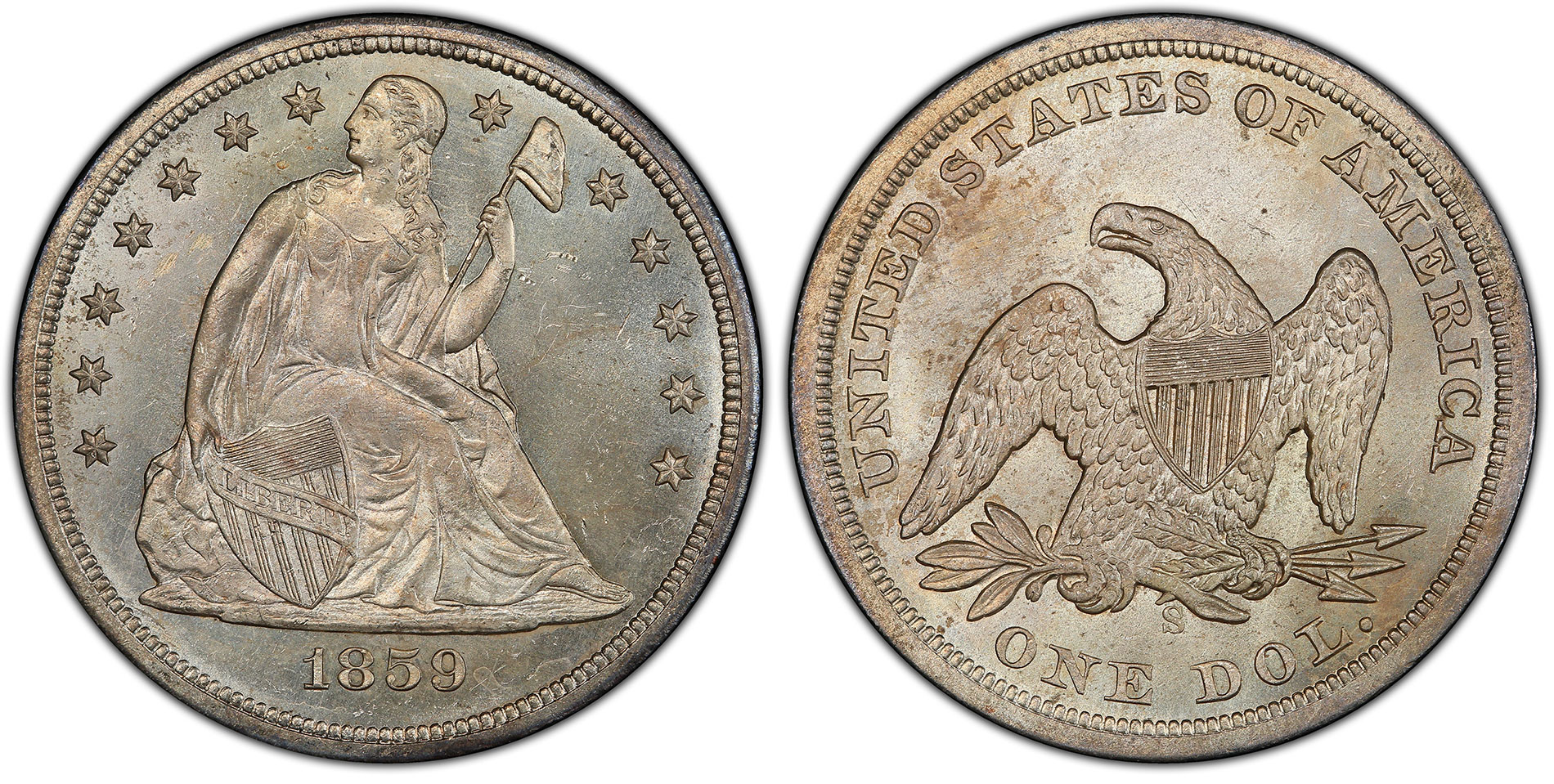
Liberty Seated Dollar, 1859-S $1, PCGS MS64+. Click image to enlarge.
The 1859-S Liberty Seated Dollar is one of the scarcer issues in its series, with a mintage of only 20,000 pieces. It also marks the first year of silver dollar production for the San Francisco Mint, which officially came online in 1854 in the waning years of the California Gold Rush. But the low mintage and first-year “S” mint status of the 1859-S Liberty Seated Dollar isn’t necessarily what makes this coin a notable piece, though those are nevertheless significant attributes. Rather, it’s why this issue was made and where shipments of this particular coin went that stands out about this particular coin.
A Silver Story
In the 1850s, large silver coins were an important trading medium between North America and merchants in Asia – specifically those in China. But even by the mid-19th century that wasn’t a new market phenomenon, especially regarding the use of silver coins from the United States. Untold quantities of early United States silver dollars wound up in trading circles overseas, many of those coins destined for China. This is one reason why relatively few Flowing Hair Dollars and Draped Bust Dollars survive today, with these coins collectively yielding perhaps just 3% of its original mintage for collectors today. Many of these large silver coins were transacted overseas and later melted for their bullion content.
By the 1840s, when the United States Mint had begun minting regular-issue silver dollars again after a decades-long hiatus, other silver coins from around the world had become the darlings of the American-Asian trading circuit. Among these is the Mexico 8 Reales, a hefty silver coin with larger dimensions than the competing Liberty Seated Dollar. With its .903-fine silver composition, weight of 27.07 grams, and 38.9 millimeter diameter, the 8 Reales was purer, heavier, and physically larger than the contemporary United States Liberty Seated Dollar, with its .900 fineness, 26.73-gram weight, and slimmer diameter of 38.1-millimeters. Asian merchants preferred the heavier silver Mexican coin. And Mexico had an advantage in the trade dynamics anyway, with its fruitful silver mines and geographical proximity to the Pacific – a body of water distant from the traditional United States minting hub of the Eastern Seaboard.
The United States silver dollar had already seen increased production during the mid-1850s, following the reduction of silver content in smaller-denomination silver coinage in 1853. The weight reduction in half dimes, dimes, quarters, and half dollars made these coins undesirable for foreign trade, thus more silver dollars were minted to help facilitate payment to international merchants. And with domestic silver supplies still relatively small in an era before the major Western lodes mined in the 1860s and 1870s, much United States silver coinage came from the melting of foreign coins still in U.S. circulation and bullion from silver-rich Mexico.
A Western Coin Struck for the “Far East”
The production of silver dollars further increased throughout the late 1850s as trade between the United States and Asia expanded. And with San Francisco a major trading port between the U.S. and China, United States Mint officials determined it made most sense to strike silver dollars at its relatively new mint in California. Not only did utilizing the San Francisco Mint for striking silver dollars for foreign trade make logistical sense from the standpoint of shipping those coins across the Pacific, but it also eliminated the major security concerns of shipping bulk quantities of valuable silver coins across the sprawling nation from, say, the Philadelphia or New Orleans Mints, to the Pacific shore.
With bullion arrangements made to begin production of dollar coins at the San Francisco Mint, 10 pairs of dies were shipped out West to begin striking 1859-S Liberty Seated Dollars. All 20,000 of these coins were struck for the sole purpose of export overseas to China, marking the largest such shipment of Liberty Seated Dollars from the San Francisco Mint. The only remaining strikings of San Francisco Liberty Seated Dollars were few and small, with the exceedingly rare 1870-S seeing a miniscule mintage of just 15 pieces, only 9,000 examples of the 1872-S, and a mere 700 pieces for the final year of the series, represented by the 1873-S.
In 1873, the United States Mint began striking the Trade Dollar, a coin whose sole purpose was use in foreign trade – most of that in Asia. With its weight of 27.22 grams and silver net weight of .7874 ounces, it was a coin fit for the appetites of Chinese merchants, and they used the coin in quantity, too. The launch of the Trade Dollar in 1873 – along with major changes concerning silver laws that put an effective end to the traditional silver dollar – brought an end to the Liberty Seated Dollar and its role in foreign trade.
Collecting the 1859-S Dollar
The entire shipment of 1859-S Dollars were placed on a ship bound for Asia, yet a rather large share of the 20,000 coins survive today for collectors. PCGS CoinFacts estimates approximately 1,800 examples survive across all grades. The vast majority of these are in circulated condition, with fewer than 40 known in uncirculated grades. None were included in the Mint Cabinet, and even the early numismatists who sought examples of United States coinage by date and mintmark failed to find more than a few specimens in uncirculated grades. Zero grade PCGS MS65 or better.
While 10 die pairs were shipped to the San Francisco Mint for production of the 1859-S Dollar, just two die marriages are known for this issue. So, strike quality becomes a factor in buying the 1859-S Liberty Seated Dollar. The discerning collector will be hard-pressed to find a fully struck example of this coin. The 1859-S usually shows weaknesses in the articulation of the stars and the feathers in the upper regions of the eagle’s left wing.
Collectors today can find examples of the 1859-S Dollars in a wide range of circulated grades. The bulk are found in the Very Fine to Extremely Fine range, in which typical PCGS-grades specimens fetch anywhere from $1,300 to $2,100, according to PCGS CoinFacts. This isn’t at the exclusion of pieces in lower grades, where bargain seekers will locate numerous options. PCGS has graded a few dozen specimens in the G4 to F12, and these range in price from about $500 to $1,000.
Those who wish to make a significant contribution to their PCGS Set Registry goals vie for the tiny handfuls of better-grade examples. As the 1859-S Dollar is a true rarity in Mint State grades, collectors often must suffice for AU specimens. And the 1859-S is a mid-four-figure coin at that grade level, with PCGS AU50 specimens trading for $3,750, PCGS AU55 examples taking $5,250, and AU58s going for $5,750. Most of the uncirculated specimens are graded PCGS MS61 to PCGS MS63, and these take around $10,000 on the low end and upward of $21,000 on the high side. With the finest specimen being a PCGS MS64+ that has seen no public transactions, the record price for the 1859-S went to the single PCGS MS63+ specimen, which sold for $30,550 in a 2016 Stack’s Bowers Galleries sale.
Sources
- Breen, Walter. Walter Breen’s Complete Encyclopedia of US & Colonial Coins. Doubleday, 1988.
- Osburn, Dick and Brian Cushing. A Register of Liberty Seated Dollar Varieties. “1859-S.”
- Taxay, Don. The U.S. Mint and Coinage. Arco Publishing, 1966.


 Copper & Nickel
 Silver Coins
 Gold Coins
 Commemoratives
 Others
 Bullion
 World
 Coin Market
 Auctions
 Coin Collecting
 PCGS News