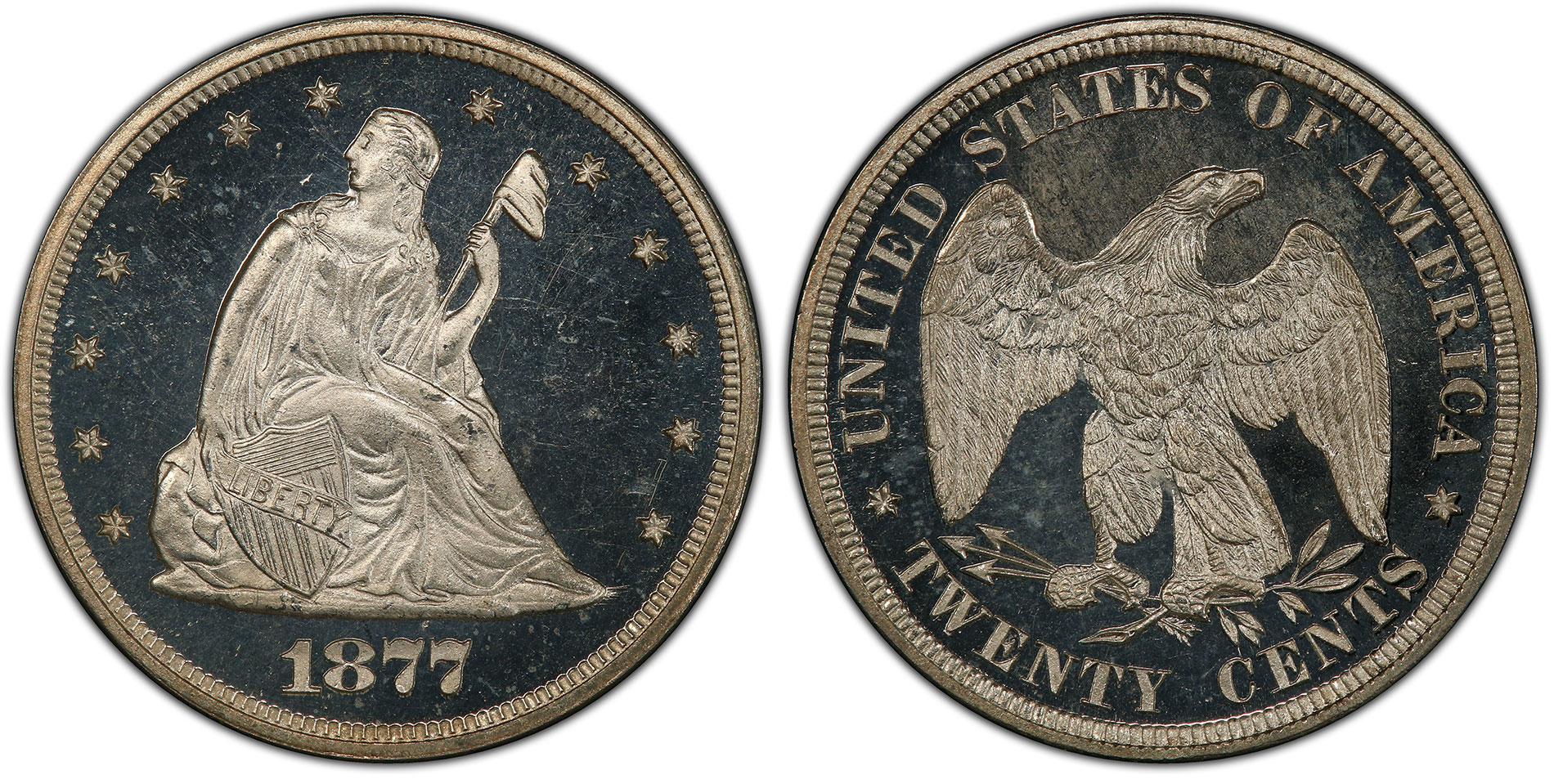
1877 20C, DCAM, PCGS PR66DCAM. Click image to enlarge.
The Twenty Cent Piece is one of the most intriguing of America’s short-lived coins. In production from 1875 through 1878, the denomination quickly proved to be a flop. Yet, in only four years of production, the coin saw nearly a dozen different issues minted at the Philadelphia, San Francisco, and Carson City Mints and went on to captivate generations of numismatists. Now largely regarded as a type coin, one often collected as a single specimen to represent this enigmatic denomination, the Twenty Cent Piece has revealed itself to also be one of the most challenging of 19th-century coins.
Designed by William Barber, the plain-edged silver coin weighs 5 grams and measures 22 millimeters in diameter – physical dimensions and appearances roughly similar to a modern-day nickel. It carries an obverse inspired by Christian Gobrecht’s Liberty Seated motif of the 1830s and a reverse showcasing an eagle regally spreading its wings, similar to that seen on the concurrently struck Trade Dollar. The only circulation issues struck are the 1875, 1875-CC, 1875-S, 1876, and 1876-CC. Proofs were struck alongside the business strikes in 1875 (including both Philadelphia and branch-mint San Francisco proofs that year) and 1876, while these numismatic-only pieces constitute the only issues struck to represent the last two years of the series in 1877 and 1878.
The Twenty Cent Piece was very unpopular with the public, which confused it with the quarter. What’s more, the coin served a rather limited role anyway, as its most practical asset was that it served as a transactional replacement for using two dimes. It wasn’t as though a 20-cent denomination was entirely unfamiliar with Americans, for the Spanish Two Reales (or “Pistareen”) had circulated freely in the United States as legal tender until it was demonetized in the states in 1857.
Nevertheless, the Twenty Cent Piece in its certain form as minted by the United States Mint apparently conjured up little nostalgia, let alone commercial enthusiasm, amongst Americans. The United States government quickly got that message during the first year of mintage for the “Double Dime.” Thus, limited output was seen for the coin’s second year of production in 1876, when mintages fell drastically for the 1876-dated pieces; most of the 1876-CC output, a paltry 10,000 pieces from the get-go, was never released and later melted at the mint.
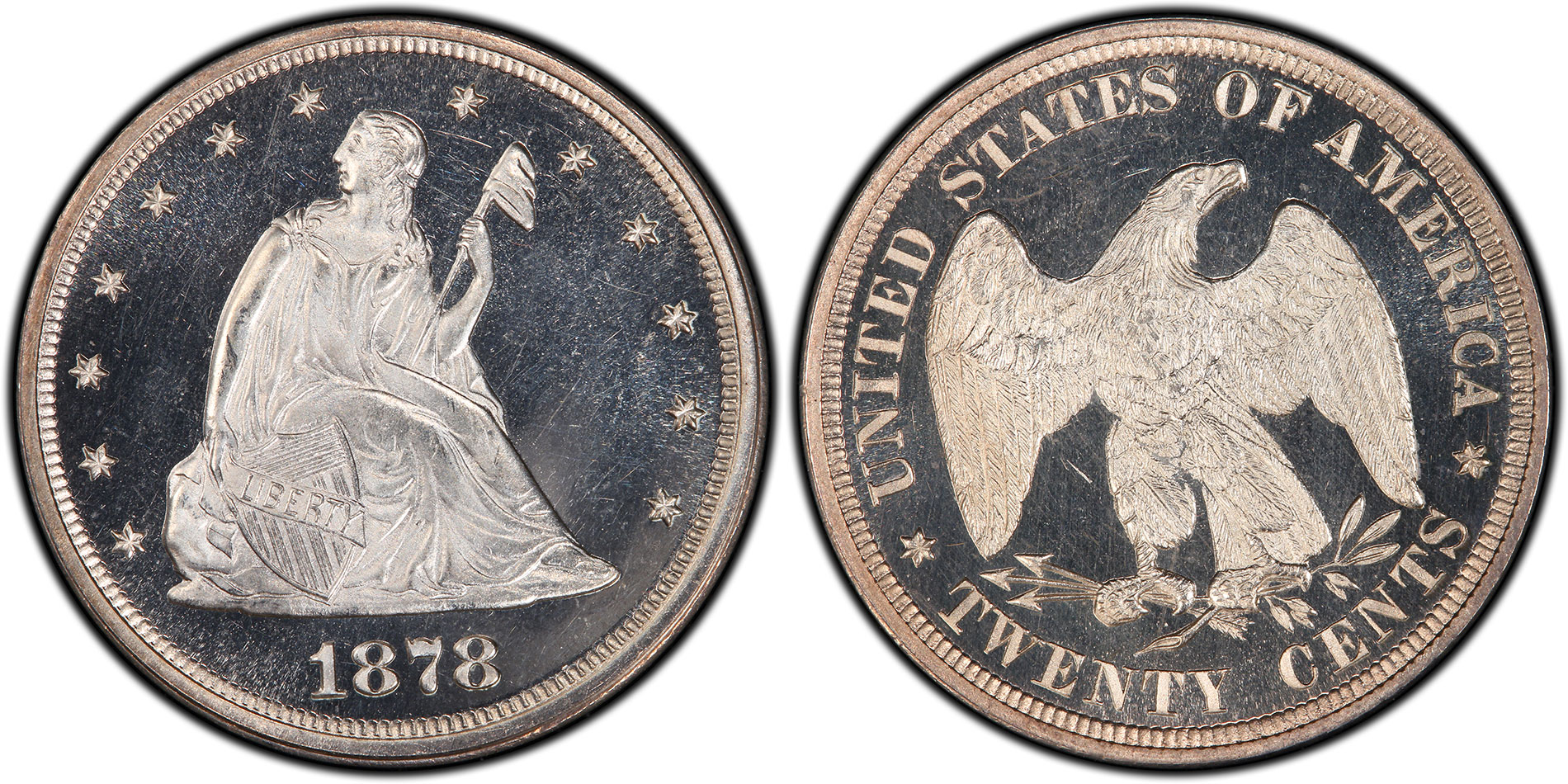
1878 20C, DCAM, PCGS PR66DCAM. Click image to enlarge.
So, why then did proof production of the Twenty Cent Piece continue for as long as two years after the demise of the denomination in circulation? Perhaps the answer can be chalked up to bureaucracy. A bill was introduced in July 1876 to repeal the law that stipulated the production of the Twenty Cent Piece. However, that bill didn’t become law until May 2, 1878. To that end, Director of the United States Mint Henry Linderman directed the melting of all Twenty Cent Pieces still on hand at the mints at the time of the repeal’s passage.
Today, the Twenty Cent Piece is a scarce across the grading spectrum, though the 1877 and 1878 Proofs are among the rarest coins in the series. The 1877 Proof, originally available to collectors for a small fee over face value, saw a tiny mintage of 510 pieces. The 1878 Proof saw a higher mintage of 600, though there is little reason to offer why that increase in production over the previous year was necessitated. Perhaps there was a demand increase associated with the Morgan Dollar (both coins and all others in production were offered together in proof sets), or perhaps some collectors knew that time was running out on the beleaguered Twenty Cent Piece and wanted examples for their cabinets.
Whatever the case may have been, the 1877 and 1878 Proof Twenty Cent Pieces collectively represent the low-mintage swan song for this ephemeral series, which came and went about as fast as the equally unpopular Susan B. Anthony Dollar a century later. And, among late 19th-century proofs, the 1877 and 1878 Twenty Cent Pieces reign as relatively scarcer than many of their contemporaries, including the higher-mintage (though admittedly more popular) 1895 Morgan Dollar, a proof-only issue with a production figure of 880.
Regardless of condition, Proof Twenty Cent Pieces are rarities, as any series enthusiast can attest. Still, some collectors will pursue the very best of the best of these coins for their PCGS Registry Sets, a handful of which include the Proof Twenty Cent Pieces. These Registry Sets include the four-piece Twenty Cents Proof 1875-1878, Twenty Cents Proof 1875-1878 – CAC (for examples accompanied by a Certified Acceptance Corporation sticker), Twenty Cents With Branch Mint Proof 1875-1878.
Relative rarity of the 1877 versus the 1878 shows that the former is noticeably though not incredibly scarcer than the latter, perhaps little surprise given the small but marked differences in mintage between the two. Interestingly, the higher-mintage 1878 is about twice as rare as the 1877 in Deep Cameo though similarly scarce as the other in Cameo. What’s more, both offer an equal estimated number of survivors in PR65DCAM or better, with three such pieces each; two of those Gem-level 1877 Proofs are graded by PCGS, both as PR66DCAM, while two of the 1878 Proofs reside in PCGS holders, one with a grade of PCGS PR65DCAM and the other PCGS PR66DCAM.
Some 1877 and 1878 Proofs are known in circulated condition. These coins, though technically impaired proofs, are still highly collectible due to the rarity of these two proof-only dates. These worn proofs typically sell for $2,000 to $3,500, depending on the date and individual eye appeal, and they represent opportunities for bargain seekers who wish to acquire “affordable” examples of these otherwise expensive coins. A base-level PCGS PR60 1877 trades for around $8,000 according to PCGS CoinFacts, while the more common 1878 fetches approximately $3,750 in a similar grade. Prices increase to $17,500 and $9,500, respectively, for PCGS PR65 examples of either date. All-time records go to an 1877 PCGS PR66DCAM that hammered for $57,600 in 2018, while an 1878 PCGS PR66 took $23,000 in 2011.
Sources:
- Breen, Walter. Complete Encyclopedia of U.S. And Colonial Proof Coins, 1722-1989. Bowers and Merena Galleries, 1989.
- Julian, R. W. "The Curious ‘Double-Dime.’” COINage. Beckett Media LLC, August 2014.
- Library of Congress. “45th Congress Session II.” 1878.


 Copper & Nickel
 Silver Coins
 Gold Coins
 Commemoratives
 Others
 Bullion
 World
 Coin Market
 Auctions
 Coin Collecting
 PCGS News