Reprinted with permission from David Hall's Inside View
The $20 gold pieces. The double eagles. For a period of 84 years these magnificent coins circulated in the United States as symbols of intrinsic worth, personal wealth, and real money. Today, 150 years after the first specimens were struck, they represent exactly the same thing. The only differences are that they no longer circulate and their value has grown significantly as a collectible, a historical artifact, a hedge against inflation, and an art form that saw its zenith nearly a century ago.
The $20 gold piece was first struck in 1849. The entire mintage for that year was one coin! That singular specimen still exists and is a cornerstone of the National Collection in the Smithsonian Institution. The first examples minted for circulation were issued in 1850, with specimens being struck in Philadelphia and New Orleans. Those coins are known today as the "No Motto" or "Type One" $20 Liberty gold pieces.
Following the Civil War (1861-65) the motto IN GOD WE TRUST was added to the reverse of the $20 Liberty. This variety, struck from 1866-76, is known as the "With Motto, TWENTY D." variety, or, more simply, the "Type Two."
In 1877 the reverse was modified once again. The TWENTY D. denomination was changed to read TWENTY DOLLARS. This basic design remained in use for the duration of the series, and is known today as the "With Motto, TWENTY DOLLARS" variety, or the "Type Three."
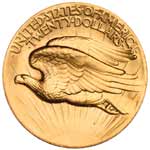
Even though these are coins of remarkable beauty in top quality mint state condition, they lost their visual impact as they reached circulation. President Theodore Roosevelt commissioned world-renowned artist/sculptor Augustus St. Gaudens to design a new $20 gold piece that would restore the artistic integrity to coins that existed during the days of ancient Greece and Rome. St. Gaudens complied with Roosevelt's wishes, creating the ultimate coin design, the MCMVII High Relief $20 gold piece.
The artistic triumph of this coin is virtually impossible to express in words. The old cliche that "You have to see it to believe it!" certainly applies. What do you say when someone exceeds your already high expectations one thousand fold? It must have been similar to the time when a young English playwright was asked to write a "little something" for the Globe Theater and he turned in Hamlet. It is the highest of high art.
The High Relief $20 was, tragically, impractical. It was too difficult to produce in quantity, requiring multiple strikings. Roosevelt was adamant, though. "Produce the coin even if it takes all day to make a single piece," he said. Ultimately 11,250 examples were minted before the project was abandoned.
Charles Barber modified the design to a lower relief and changed the date from the Roman numeral MCMVII to "1907." In that year and early 1908 the coin was issued without the motto IN GOD WE TRUST. Public outcry returned the motto to the denomination in mid-1908. This variety is known as the "No Motto $20 St. Gaudens," or just the "No Motto Saint."
From 1908 through 1933 the $20 St. Gaudens was produced with the motto IN GOD WE TRUST. Most of the examples minted in 1929 and later were never released and were melted as a direct result of Presidential Order 6260 in March of 1933 when the United States went off of the gold standard. The late1908 through 1933 coins are known as "With Motto $20 St. Gaudens" or, simply, "With Motto Saints."
The two major types of the $20 gold piece are the $20 Liberty and the $20 St. Gaudens. The subtypes mentioned above are equally "major," though, and are considered equivalently significant as U.S. coin rarities by most numismatists. In other words there are SIX important type coins in the $20 gold series, and this INSIDE VIEW will explore them all.
1850-1866
When the $20 gold pieces were introduced in 1850 they immediately went into circulation and stayed there. While many United States coins were saved in Gem condition in their first year of issue, this isn't the case with the $20 Liberty. No Philadelphia Mint examples from the 1850s are known to exist in MS65, and no New Orleans pieces are known of any date in Gem condition.
For generations a Gem quality "No Motto" $20 Liberty was the impossible dream. A "want list" card for this coin would yellow with age in a coin dealer's file. The chance of finding even a single specimen at a coin show was equal in probability to discovering a Van Gogh painting at a garage sale.
In 1989 the Columbus Discovery Group, headed by Tommy Thompson, worked 8,000 feet below the oceans surface to salvage the golden treasure that was lost with the sinking of the S. S. Central America in 1857. The famed nautical disaster claimed over 400 lives 143 years ago, and salvaging the gold coins and bars that went down with the "Ship of Gold" was believed to be a lost cause. Thompson and his crew prevailed, though, and the story of the recovery became a national event both inside and outside of the numismatic world.
The most significant find was over 5,000 1857-S $20 gold pieces. Many of the examples were of extremely high quality. After a decade of negotiations and court battles the vast majority of the coins (over 92%) were sold to the California Gold Group. The coins were sent to the Professional Coin Grading Service (PCGS) for grading and authentication, and marketing of the coins began in March of 2000. The coins immediately became the fastest-selling items in this price range in numismatic history.
In 1989 a MS65 "No Motto" $20 Liberty was a $100,000+ coin. The price meant very little in actuality, as the supply vas nearly zero. In the first ten years of PCGS’s existence only three "No Motto" $20 Liberty gold coins were graded and authenticated in MS65 or better condition. Even if a specimen became available over 98% of the collectors were "priced out" of the market. The coins of the S. S. Central America changed everything.
For the first time in history there was a supply of Gem quality "No Motto" $20 Liberty gold pieces and they were affordable! Not only was interest extremely high in these historic coins, excitement was aroused in other areas of numismatics as well, most notably for other $20 gold pieces. "What else is there?" became the most frequently asked question from enthusiastic collectors, many of whom were making their first numismatic purchase.
David Hall's North American Trading (DHNAT) was chosen as one of the three exclusive distributors of the S. S. Central America treasure. It is one of the most exciting times in numismatic history, and I urge you to take advantage of this historic opportunity!
(Type Two)
1866-1876
This variety was created with the addition of IN GOD WE TRUST to the reverse in 1866. This change took place on many U.S. coins beginning with the two cent piece in 1864. Some other coins remained the same, as the motto was never added to the gold dollar, the Liberty head quarter eagle or the three dollar gold piece, as well as a few other issues.
This was the era that introduced Carson City gold coins to the world. No example of a "CC" $20 Liberty is known to exist in MS65 or better condition at this time.
In order to understand the history of the "Type Two" $20 Liberty, it's important to remember that we live in a changing world. These coins are prohibitively rare in MS65 condition, yet 30 years ago they were considered little more than "bullion" coins. They were determined to be "common" because there was a relatively large supply of mint state pieces available that regularly showed up in shipments from the Swiss banks. No, they weren't Gem quality, but that was a term that was in its infancy when it came to many U.S. coins.
How can that be? Take a look at the grading books from those years and you'll notice a glaring omission. Grading ran from "about good" through "about uncirculated" and then STOPPED! There was no differentiation among the uncirculated coins! The philosophy of "Either it's unc or it ain’t" prevailed, as I've mentioned in other issues of INSIDE VIEW.
If you take a look at a current issue of The PCGS Population Report you will find some amazing statistics. There have been 3,336 mint state "Type Two" $20 Liberty gold pieces graded (through March 2000) but only 31 pieces have graded MS64 or better and only three have graded MS65 or better. If you’ve ever wondered what the term "condition rarity" means, here is its purest definition.
This means that only three six-piece $20 gold type sets can be assembled in Gem quality (MS65 or better), making this one of the most important gold type coins in the world. It also raises the significance of MS63 and (especially) MS64 specimens.
(Type Three)
1877-1907
The change from TWENTY D. to TWENTY DOLLARS may have been a minor one in the minds of the coin designers, but it has had a major impact on the world of numismatics.
This is the "common" type of the $20 Liberty, with "common" used only in a relative sense. There are 1,804 examples graded in MS65 or better out of a total of 215,633 pieces certified of this type. That's 0.83% (less than one in 119) that grades MS65 or better.
The price history of this coin is heroic, reaching 1989 highs of $18,000 in MS65, $40,500 in MS66 and $117,000 in MS67. The 1904 date comprises about 71 % of the Gem quality examples certified, with the 1901 date accounting for an additional 12%. Those seeking a 19th century date are limited to the 1895-S (five pieces), the 1898-S (19 pieces), and the 1899 (six pieces). Other than that the populations are two coins or less, usually zero. If you count 1900 as a 19th century date (some people do, others don't) there are an additional 14 pieces available for 19th century type sets.
The current price level is shockingly low; by far the lowest since the inception of PCGS in 1986. INSIDE VIEW readers are urged to take advantage of this market aberration.
1907(Only)
As mentioned in the introduction to this issue, this coin is of unrivaled beauty. It is not an ultrararity in the strictest sense, but the demand side of the equation tilts it that way. There are 287 pieces graded MS65 or better, but extremely few are in dealers' inventory. After 30 years of dealing in top quality coins, the $20 High Relief has always followed the same scenario: buy it, advertise it once, sell it, and go looking for another one. The coin dealer's best friend. The coin collector's most treasured acquisition.
This issue is known with two varieties. These are called the "Wire Edge" and the "Flat Edge." In reality there is no difference in the design elements of the two coins. All were intended to have a flat edge, but in 80% (or more) of the cases a wire edge was created when extra metal was trapped between the planchet and the collar during the striking process. This extra "lip" of metal is sometimes seen on other coins, most frequently on patterns struck in aluminum.
There is still another variety of this coin that is actually a totally different coin. It is called the "UltraHigh Relief" or "Extremely High Relief." This is a true ultra-rarity of the first order, with a mintage of 24 coins (some argue that 22 is the correct mintage). These coins are valued well in excess of $500,000 each in top quality, and are designated as proofs, with a finish that is similar to the "Roman Finish" proof gold coins of 1909-10. PCGS has graded four examples over the years, all in PR67 or PR68, even though circulated examples are known to exist. It is believed that these coins are precise representations of St. Gaudens's original concept of what the coin should look like. Talk about a 20th century treasure!
1907-1908
The Low Relief. The "No Motto." The "Arabic Date." This short-lived issue is known by many names, but its distinction is that it was issued without the motto IN GOD WE TRUST during 1907 and part of 1908 at the insistence of Theodore Roosevelt. It was not because TR was an agnostic; the contrary is true. He just objected arduously to the use of the term on our coinage.
The 1908 "No Motto" is the only date that sells for what is called "type coin money." The 1907 date carries a premium in MS65 of nearly three to one (around $3,000 in MS65 versus $1,200 or so for the 1908). The other dates sell for even more.
About 42% of the MS65 examples came from one hoard, the Wells Fargo Nevada holding. These coins were of phenomenal quality. Nearly 90 % of the MS66 examples graded came from this hoard, as well as 96 % of the MS67 pieces and 100 % of the MS68 and MS69 specimens. Even though this gigantic holding put over 8,000 PCGS-certified MS65 or better pieces into the marketplace, the prices have remained stable after an initial downward adjustment.
1908-1933
This is the most popular gold coin in the world. Not only was the motto IN GOD WE TRUST returned to the denomination in 1908 and later, but the design was tweaked here and there in other places to make the coin more attractive than the "No Motto" pieces. The most notable difference on the obverse is the slimmed-down leg of Miss Liberty.
This series is filled with rarities because of the melting in the 1930s. There is great demand for the (relatively) common type coins, the issues that are regarded as a "little better," the semi-keys and the great and famous rarities. PCGS has graded over 349,000 examples of this type in all grades combined and there’s still a supply problem at times!
In MS65 or better there have been 19,894 coins graded as of March 2000. The most frequently seen dates in top quality are the 1924, 1927, 1928, 1923-D and 1925, in that order. There have been 6,771 examples graded of the 1924 date alone in MS65 or better. In contrast, there have been only three specimens of the 1927-D certified in all grades combined: one MS65, one MS66, one MS67, and nothing else higher or lower!
PCGS does not certify the 1933 date because there is a question regarding the legality of private ownership of this coin. After 67 years the controversy still rages.
The current price level of the MS65 type coins of this series is staggeringly attractive. They cost no more today than a MS65 common date Morgan dollar cost in early 1986. As is true with the $20 Liberty, prices are the lowest since PCGS began certifying the coins in 1986.
There is a significant collecting characteristic regarding this series. It is highly popular with collectors to purchase one of the key dates for their gold type sets. You will sometimes find such rare dates as 1927-S, 1929, 1930-S, 1931, 1931-D or 1932 gracing the space where a "common" 1924 would have sufficed. Why? Because even though building a complete set is price-prohibitive to most collectors, they want at least one coin in their collection that represents the rarity as well as the beauty of this series.
The following prices are courtesy of the Coin Universe Daily Price Guide for current valuations and the Coin Universe Market Movement Report for historical price data from 1989.
$20 Liberty (type one)-In May of 1989 there were no coins from the Brother Jonathan or S. S. Central America treasure finds, so you have to take into account both a bull market peak and the extremely low supply of available coins when comparing prices to today. In MS64 this type was $47,500 versus today's $10,400. In MS65 the price was $117,000 against today’s $16,600. The MS66 price was not tracked in 1989 due to the exceptional rarity of the coin in that grade; today the price is posted at $32,000.
While the majority of the S. S. Central America coins have already been certified by PCGS there are still more coins still pending grading and authentication. This information is scheduled for publication in the April 2000 PCGS Population Report, but as this is being written it has not been published elsewhere.
1857-S $20 gold pieces from the S. S. Central America:
MS65: 583 coins.
MS66: 105 coins.
MS67: 6 (six) coins.
These numbers are the total of all pieces graded through March 28, 2000 in all eight of the die varieties combined.
$20 Liberty (type two) - This coin was a great rarity in 1989 and it still is today. The 1989 high was $40,500 in MS64 and it's $18,900 today. The price in MS65 was not tracked in 1989; today it is listed at $70,000.
$20 Liberty (type three) - The mid-1989 market was overheated to the boiling point on this issue. There were some trades at the Scottsdale show in May at $5,000 per coin for MS64 examples. (Only 44 years earlier that was the price Mr. Childs paid for the 1804 silver dollar that recently sold for $4.14 million!) The current price is $995. In MS65 the price was $18,000 compared to today's $2,500. The MS66 price was $40,500; today it's $9,125.
$20 MCMVII High Relief - It would have cost $73,000 to acquire an example in MS65 in 1989 while today's price is less than half that at $34,000. A MS66 specimen was a fast sale at $119,000 (if you could find one) while today it's listed at $49,000. Over the years 13 pieces have graded MS67. This incredible piece of art was worth $195,000 in that grade in 1989 versus today's value of $116,000.
$20 St. Gaudens (No Motto) - In 1989 the Wells Fargo Nevada hoard was unknown to the numismatic world. When you factor in the differences of the 1989 market with today and add the population explosion of this coin during those eleven years then these prices begin to make a semblance of sense. In MS65: $4,325 versus $1,175. In MS66: $15,900 against $2,350. In MS67: $35,500 in 1989, $9,425 today.
$20 St. Gaudens (With Motto) - The 1989 price in MS65 was $4,675 while today it's $1,025. In MS66 dealers and collectors alike fought over them at $12,600; now they’re $2,000. The MS67 price was $35,500 while they cost $10,500 today.
The following are my recommendations for the $20 gold types. These recommendations are for PCGS-certified coins ONLY. If you buy rare coins that aren't graded and authenticated by PCGS you may be settling for less than the best. Past performance is no assurance of future growth. See the main text of this issue for historical and present price information.
$20 Liberty (type one) - Which one of the grades fits your budget? The best deal is the best grade you can afford! The S. S. Central America treasure is an unprecedented opportunity. The timing is great (for you!), the coins are gorgeous, and the prices are a true bargain.
$20 Liberty (type two), MS64 - In the 20+ years of the INSIDE VIEW few MS64 coins have made the "Recommendations" page. This coin is a rare exception because of the prohibitive rarity in MS65. A highly significant type coin in top grades and a wonderful place to put your money!
$20 Liberty (type three), MS65, MS66 - These coins are big and heavy, and many collectors have never seen the Gem quality pieces with clean cheeks and problem-free fields with luster radiating from the surfaces. The difference between Gem specimens and the average $20 Liberty is amazing! The current prices are equally amazing (as in cheap!).
$20 MCMVII High Relief, MS65, MS66 - What is all the excitement about? One look and you will know. This coin will be a classic forever.
$20 St. Gaudens, No Motto, MS65, MS66, MS67 - The price adjustment on this issue appears to be complete, making this a great buy again. This issue of INSIDE VIEW has been about type coins and not about dates per se, but you can look at the 1907 date and its importance as a first-year-of-type coin or simply focus on the inexpensive 1908.
$20 St. Gaudens, With Motto, MS65, MS66, MS67 - Beauty, popularity, the lowest prices in the PCGS era and lots of potential with minimal risk. A prescription for success!
The Complete Six-Piece Type Set - Rarely does one set of coins offer such fantastic value, beauty, rarity, and potential! These are fabulous coins of great historical importance! They are immensely popular! They are in the ideal phase of the price cycle! These magnificent coins have my highest recommendation!
Would you like to add some of these beautiful coins to your portfolio? Call your DHNAT Account Representative today!
Visit our website @ www.davidhall.com. We offer a complete inventory listing that is updated twice daily, a Marketwatch section, spot prices on precious metals, information to help you "Find Out What Your Coins Are Worth," David's "Pick of the Day," and much, much more!


 Copper & Nickel
 Silver Coins
 Gold Coins
 Commemoratives
 Others
 Bullion
 World
World
 Coin Market
 Auctions
 Coin Collecting
 PCGS News