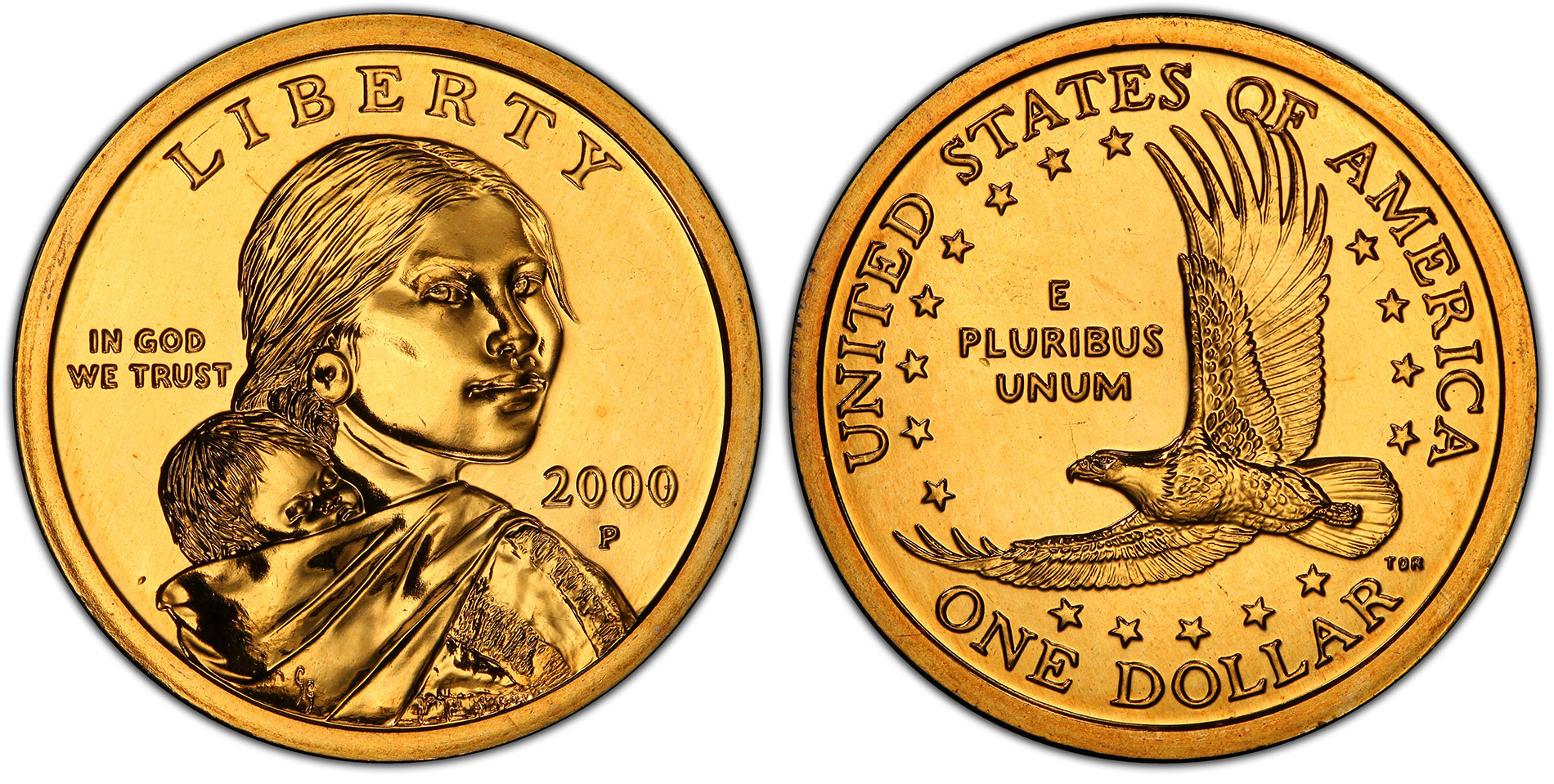
2000-P SAC$1 Goodacre Presentation, PCGS SP69. Click image to enlarge.
The Sacagawea Dollar was released in 2000 to great fanfare. The so-called “Golden Dollar,” a copper-core coin cladded in manganese brass, heralded a new chapter in the United States dollar coin saga. Over the previous three decades the United States had tried multiple times to resurrect a circulating dollar, first in 1971 with the Eisenhower Dollar, then in 1979 with the Susan B. Anthony Dollar. The latter was retired in 1981 but reprised for a brief encore in 1999 to fill a growing void in bank vaults that were becoming depleted of existing dollar coinage.
The Sacagawea Dollar ultimately failed to capture the nation’s interests, let alone catch on as a circulating coin. But it wasn’t for lack of trying on the part of the United States Mint. Unlike its Susan B. Anthony Dollar predecessor, the Sacagawea Dollar was visually distinctive and in no way looked like anything else being produced by the United States Mint in the late 1990s and early 2000s. The coin also had its artistic merits, thanks to a gorgeous obverse design featuring the namesake Shoshone woman Sacagawea and her young infant son, Jean Baptiste; the obverse by renowned artist Glenna Goodacre was coupled with a soaring reverse design of an American eagle by Thomas D. Rogers.
Perhaps the only thing holding the Sacagawea Dollar back from circulation success was a losing battle against the long-established $1 banknote – the very entity that fended off both the Eisenhower Dollar and Susan B. Anthony Dollar a generation earlier. Americans clearly seem to have a preference for folding money, and when given the option between the $1 bill or a dollar coin the paper buck won out every time against modern efforts to replace it with dollar coinage.
While the public eschewed the Sacagawea Dollar, the numismatic community largely embraced the new coin as a worthy collectible. Among the most noteworthy 2000-P Sacagawea Dollars stem from a grouping of 5,000 that were delivered to Goodacre by Director of the United States Mint Philip Diehl and a small cadre of security guards as the $5,000 payment for her obverse design. And these weren’t just any 5,000 Sacagawea Dollars. Most of them feature a burnished finish. While conveyed to Goodacre jangling in cloth bags, the coins maintained their superior surfaces with mostly minimal contact marks during their trip west to the artist’s New Mexico studio. They were unveiled during a special event on April 5, 2000.
All Sacagawea Dollars of Goodacre provenance carry a premium, but the majority of these pieces — featuring the burnished finish — are classified as “Special Strike” coins by PCGS. They stand out from circulation strikes with their nearly prooflike finishes, imparted by the planchets having first been burnished and then struck by polished dies on higher-tonnage presses; they were further treated with an antioxidant to mitigate the chances of discoloration – a characteristic problem with most Sacagawea Dollars. Collectors must beware of imposters posing as “burnished” coins that are in fact merely conventional circulation strikes altered with a post-mint polish.
Collectors should play it safe by sticking with PCGS-encapsulated pieces, the majority of which exist in Gem grades. The bulk of these grading SP66 or better. As of March 2021, PCGS has encapsulated more than 1,400 in SP67 and over 750 in SP68. The top grade at this point is SP69, which has fewer than three dozen representatives at that level. According to PCGS CoinFacts, prices range from around $385 for an SP65 specimen to $450 for an SP67. Meanwhile, one of the highest prices ever paid for a top-end specimen was $4,560, a figure fetched by a PCGS SP69 that traded hands during an August 2020 Heritage Auctions event.
Sources
- Bowers, Q. David. A Guide Book of Modern United States Dollar Coins. Whitman Publishing, 2016.
- “Glenna Goodacre’s ‘Presentation Dollars.’” SmallDollars.com. Accessed March 5, 2021.
- “2000 ‘Goodacre’ Sacagawea Dollar.” SacagaweaDollarGuide.com. Accessed March 5, 2021.



 Copper & Nickel
 Silver Coins
 Gold Coins
 Commemoratives
 Others
 Bullion
 World
World
 Coin Market
 Auctions
 Coin Collecting
 PCGS News