To paraphrase a well-known fictional character from the late 20th century: "Life is like a box of newly submitted coins. You never know what you're going to get." Indeed, a box of coins sent in for grading will usually contain high quality items of unquestioned authenticity. Sometimes, however, there are visitors from the land where danger and deception lurks.
Here are three recently seen alterations. The first, the added-on mintmark, is a common alteration as someone tried to make a $100 coin into a $10,000 coin. The second is less common, but still frequently seen. It is the altered date. The third alteration is something from the Twilight Zone.
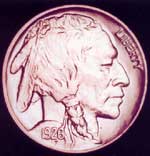
The 1926-S Buffalo nickel is highly desired in all grades. The coin has a mintage of less than one million pieces and only 170 examples have been certified in Mint State (all grades combined). With thousands of collectors looking for one, the temptation for counterfeiters can be overwhelming. This counterfeit is not easy to spot, either, as the strike characteristics and luster of the 1926-P and 1926-S are often similar. Both coins come with sharp strikes or fuzzy strikes; both come with radiant luster or subdued luster, depending on the individual coin.
 The giveaway on this particular altered coin is the mintmark. From 1913 until 1917 the same mintmark punch was used on the S-Mint Buffaloes as on the 1909-S V.D.B. cent. That boxy mintmark is always easy to identify. From late 1917 through the late 1920s a taller, thinner and more stylized S appeared. Fake mintmarks are usually placed on a coin through one of three methods. One is by embossing, which means going inside the coin and pushing out the metal in the shape of a mintmark. The second is by "chasing," which is pushing metal around on the surface to form an area where the mintmark can be built from scratch. The third method is creating a fake mintmark and gluing it to the coin with some kind of adhesive. In this case an adhesive was used, leaving sloppy residue behind the first loop of the S and at the bottom. In addition, the mintmark chosen by the counterfeiter is the old style (1913-17) and its boxy shape is an anachronism when paired with the 1926 obverse. Caught him!
 Need an 1893-S dollar? So does everyone, or so it seems, so this date is always closely scrutinized from every angle by the PCGS graders. There's a catch with this issue, though, as the same mintmark punch was used in 1893 and 1895 and 1897 and so forth until the major change in 1899, so putting a microscope on the Mintmark may not tell you a thing. The way to catch an altered 1893-S is by checking out the obverse diagnostics. The real ones are from a single obverse die. You'll find a die chip in the foot of the R of LIBERTY. You'll find a raised diagonal line through the top of the T in LIBERTY. You'll find that the first digit of the date is centered over a denticle and that the date slants upwards to the right.
 The "1893-S" pictured in this article is actually an 1898-S that has been altered. Check out the position of the first digit of the date. Wrong! The other diagnostics are missing as well. A close inspection of the final digit of the date shows conclusively that the 3 used to be an 8 before some "artistry" took place.
Hey, what is THIS? Yes, we've heard of the 1853 Arrows & Rays quarter. We've heard of the 1853 No Arrows, No Rays quarter. How about the 1853 No Arrows (but with Rays) quarter!? Well, here it is! Someone took a genuine 1853 Arrows & Rays quarter and removed the Arrows from the date. The purpose? Your guess is as good as mine. Was this supposed to be some "discovery coin" of a new die marriage? Whatever the intent, a cursory examination of the date area reveals tooling marks and other telltale signs that this coin has been altered.
The "1893-S" pictured in this article is actually an 1898-S that has been altered. Check out the position of the first digit of the date. Wrong! The other diagnostics are missing as well. A close inspection of the final digit of the date shows conclusively that the 3 used to be an 8 before some "artistry" took place.
Hey, what is THIS? Yes, we've heard of the 1853 Arrows & Rays quarter. We've heard of the 1853 No Arrows, No Rays quarter. How about the 1853 No Arrows (but with Rays) quarter!? Well, here it is! Someone took a genuine 1853 Arrows & Rays quarter and removed the Arrows from the date. The purpose? Your guess is as good as mine. Was this supposed to be some "discovery coin" of a new die marriage? Whatever the intent, a cursory examination of the date area reveals tooling marks and other telltale signs that this coin has been altered.
Added mintmarks and altered dates are only two of the many ways that today's counterfeiter is out to get you. Have every coin of value examined and certified by your friends at PCGS.
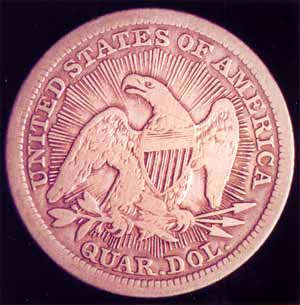
This is the genuine and unaltered reverse of an 1853 Arrows & Rays quarter.
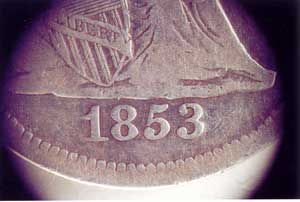
This is the genuine and unaltered reverse of an 1853 Arrows & Rays quarter.




 Copper & Nickel
 Silver Coins
 Gold Coins
 Commemoratives
 Others
 Bullion
 World
World
 Coin Market
 Auctions
 Coin Collecting
 PCGS News