
Some may say "what does gold in its natural state have to do with coins," but the first real money was gold a la natural, introduced in approximately 600 B.C. by the Byzantines (yes, salt and other bartered goods came first, but gold was the first real money). It was electrum, or gold in its natural state, which usually consists of gold and silver with trace amounts of other metals such as copper, iron, etc. At first, lumps of this precious substance were used with no attention paid to the fineness, but soon the first counterfeiter was born and adulterated the mass with impurities. Stamping the lumps with markings to indicate weight and value followed - a few hundred years later, hammered coins with portraits, animal depictions, and other motifs were the norm.
However, in the more recent past, natural gold played an important part in the development of the United States. With the discovery of gold in California in 1848, thousands of treasure seekers flooded the West and the shortage of coins forced the reintroduction of natural gold as money - necessity, the mother of invention. The recovery of the treasure from the S.S. Central America has placed this unique event in history into the forefront of the minds of many numismatists. While most have concentrated on the unprecedented cache of coins and bars recovered from this time capsule, a few have noted the gold nuggets, flakes, grain, dust, and flour that also were plucked from the deep. The coins and bars mainly belonged to businesses and banks, while the bulk of the natural gold likely was in pouches and belts of returning miners. Most of these men (the women were all saved) went down with the ship to the murky depths of the Atlantic Ocean, some possibly still grasping at their glittering fortunes as their lives flashed before them. Their previous giddiness at the prospect of returning home as wealthy men turned to horror as the giant side-wheel steamer groaned one last time and slipped beneath the hurricane waves, sucking their lives and gold from them.
Today, having examined several hundred ounces of the Central America’s natural gold, I feel closely connected to those departed souls. Mixed emotions are often felt in numismatics, the pedigrees of items often nearly as important to collectors as the objects themselves. Musing about past owners of numismatic properties is an oft-heard chatter on bourse floors, in auction rooms, and at any gathering of serious numismatists.
Because of the desperate need for coins, natural gold became a savior to the commerce of the West until the establishment of the San Francisco Mint in 1854. (The private coiners slightly helped to alleviate the coin shortage, but after the "problems" with underweight territorials, some merchants obviously took raw gold over slightly to rather severely "debased" coin gold.) Even after the San Francisco Mint opened in 1854, some miners and others obviously kept their wealth in natural gold or we would not have the nuggets and other forms of gold that were recovered from the Central America.
Everyone has seen the Western movies where the grizzled old miner plunks down his buckskin pouch of gold on a bar and has the bartender extract a "pinch of gold" for the liquid refreshment. Most people do not realize that nearly every business in the West had scales to weigh raw gold to pay for whatever the person was buying. In San Francisco, meetings were even held to establish a uniform price for gold "dust." Sixteen dollars an ounce was the "trading value" for most gold "dust" as the fineness of California gold was approximately eighty-six percent. The local assayers got so proficient at "eyeballing" raw gold that they could usually tell what locale from which the miner had extracted his fortune. Of course, as time went by, the purity of California (and Nevada, Idaho, etc.) gold was found to range from less than fifty percent to over ninety percent. So, most buyers of natural gold would "average" their buys when they went to assayers to obtain bars or coins. Some weeks for gold buyers must have been much better monetarily than others, as such a wide range of purity would lead to quite different amounts of money received for similar weights of gold. Obviously those proficient at "eyeballing" the quality of raw gold, financially, did just fine!
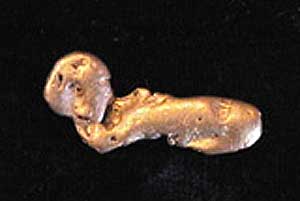
Naturally occurring gold mainly falls into two basic categories - placer (alluvial) and mountainous (eluvial). Thus natural gold is mainly found in mountainous regions or near streams where water has "washed" gold from the mountains and scattered it in alluvial deposits downstream. These sandy areas of gold, called alluvial or placer deposits, are the most common way that gold was originally found and "mined" in California. When one thinks of this exciting part of American history, the "miner crouched in a stream with his gold pan" is the most common picture conjured by the mind’s eye. This backbreaking task, the proverbial panning for gold, is the definition of the Gold rush. In fact, most of the raw gold recovered from the wreck of the Central America was alluvial gold. Smooth nuggets, flakes, grain, dust, and flour made up ninety percent of the recovered treasure of natural gold. Eluvial gold (weather worn nuggets) represented a small percentage of the trove recovered from the most famous numismatic treasure ship of all time.
It has been said that a one ounce gold nugget is more rare than a five-carat diamond. I do not know whether that statement is true, but large nuggets are very scarce. The Central America contained only a couple of nuggets that weighed over one ounce, although, of course, most of the gold by 1857 was assayed and either cast into bars or made into coins. Still, large nuggets are elusive today and any find of immense size is worldwide news (the giant nugget found in Australia a few years ago was reported by all the news media).
How does gold end up as nuggets, flakes, grain, dust, and flour? When gold is spewed from the inside of the earth to its surface, it is molten. Veins of gold are formed by the gold flowing down a mountain as it cools. Thus, natural gold is formed. Quartz is often found embedded in these veins and still can be seen in some of the natural gold. A few of the nuggets from the Central America have some quartz imbedded in the gold - both alluvial and eluvial types. The best examples are Lot 85 (eluvial) and Lot 86 (alluvial) from the Sotheby’s June 2000 auction of some of the Central America treasure.
As weather erodes mountains, the gold in veins is exposed and broken apart. These broken pieces are washed down the sides of mountains and become the nuggets, flakes, etc., found in the alluvial deposits downstream. If gold is found in the mountain, such as in mines, the quartz matrix is often found intact within the nuggets (some would say the gold is in the quartz). These nuggets that have gold and quartz mixed are the most desirable of all gold nuggets among mineral collectors. A few alluvial nuggets contain quartz, but the smoothing that results from the tumbling in streams and rivers usually destroys the internal matrix and the quartz is smoothed like the gold. So, when placer gold is found with quartz, it is usually cloudy and lacking the mineral look of natural quartz. These nuggets often look like marbles, this because of their round shape and their multi-element constitution.
Because gold has so many natural shapes and sizes, the assayers and some merchants of the Gold Rush era developed a keen eye for the differing natural gold. As previously noted, the best assayers could look at a group of nuggets and tell the county where it was mined, sometimes even specifying a particular gulch or other specific region. Various names were used to describe the particular gold. "String" gold was found in one place, while "moccasin" gold was found in another. Other monikers were commonplace. These descriptive names may seem quaint today, but at the time, it was important, as adulterated gold was commonplace. Devious folk tried to scam merchants by mixing brass filings or other adulterants with real gold. Knowing the various types of gold was important to anyone who dealt in the unrefined metal and it is evident by the historical accounts that some were quite skilled at this procedure. I am sure it took only one bad deal for an assayer or merchant to become a more careful observer of the next batch of nuggets, flakes, et al.
So, natural gold played a very important part in the commerce of the emerging West. Until coins became plentiful enough to be used for all transactions, gold nuggets, flakes, grain, dust, and flour were a necessity. Today, few in our Baby Boomer/GenX world are old enough to remember gold coins in circulation (the majority of Americans probably do not remember silver coinage!), so the use of gold in any form as payment for goods or service seems quaint. There was a time, however, that a pinch of gold for payment was as natural as a giant sequoia tree in the Redwood National Forest. Gold in its natural state was a natural.


 Copper & Nickel
 Silver Coins
 Gold Coins
 Commemoratives
 Others
 Bullion
 World
 Coin Market
 Auctions
 Coin Collecting
 PCGS News