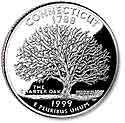
The difference between the cost of minting a coin and its face value is called seigniorage. Because it contains no precious metal, the seigniorage percentage on each new commemorative quarter is enormous. In fact, I believe the primary reason this ambitious series of circulating commemoratives was approved is because legislators expect the Treasury Department to reap huge profits as citizens begin hoarding these coins. Every time a new quarter is removed from circulation the government has an excuse to produce more, thus gaining additional seignorage. If every American saves just a few of each of the new quarters, our government stands to save billions in interest over the next few decades.
The hoarding of coins by the public is nothing new. In recent times, millions of Kennedy Half Dollars and Eisenhower Dollars have been stashed in dresser drawers across America. Recently, my company purchased at face value several thousand 1971 Eisenhower dollars as part of a much larger collection. The collector acknowledged he’d been foolish to remove these coins from circulation, but defended his action by stating it had been a good way to save money. Famous for my tact (not!), I restrained myself from pointing out that if he had put two thousand dollars in a savings account in 1971, and received only nominal interest since, that same two thousand dollars would have now grown to more than $6000. Or that based on the Coin Universe Market Index, these same funds could have otherwise been used to purchase interesting and valuable rare coins, which would now, on average, bring about $108,000! For this collector, saving the Eisenhower dollars may have been an easy thing to do, but by almost any measure it was financially unfortunate.
I’m not suggesting you ignore the new quarters. Study them. Perhaps you'll discover an important variety or the next “Doubled Die.” Assembling a few sets of these coins from circulation could be great fun. What I hope you avoid is any temptation to hoard quantities of these coins in the expectation that you'll some day sell them for a profit.
In fact, now might be an appropriate time to review all the coins and currency you've put aside. Are those two dollar bills and Post-1970 Kennedy Half Dollars a meaningful part of your collection? Might your grandchildren benefit more if you took these common coins to the bank and used the funds to purchase a nice Flying Eagle Cent or nineteenth-century gold coin?
True, there are isolated incidents where hoarders eventually reap huge profits, but such cases are well scattered and exceptional. Instead, I would hope your interest in what can now be found in pocket change inspires you to learn more about the hobby of coin collecting.
James Halperin is co-chairman of Heritage Rare Coin Galleries and Heritage Numismatic Auctions, of Dallas, Texas, the world's largest rare coin dealer and auctioneer. Jim has been one of the top coin traders in the world for the past 25 years. He is also the author of two best-selling futurism novels, The Truth Machine and The First Immortal. Send your coin questions for James Halperin to [email protected] or visit his Web Site.


 Copper & Nickel
 Silver Coins
 Gold Coins
 Commemoratives
 Others
 Bullion
 World
World
 Coin Market
 Auctions
 Coin Collecting
 PCGS News