 Note: To read the first part of this article, click here.
 Life with father wasn't always easy for young Bob Weinman and his two older siblings, brother Howard and sister Katherine.
"As a parent," Weinman confided, "the old man was a real son of a bitch. If he didn't like the way you were obeying the rules, why, he'd set up a new set of rules. Right or wrong, you couldn't win. He was always right.
"I always had the feeling we were poor, because to get a nickel out of that guy for an ice cream cone or a movie, you had to take so much guff. I thought, `Jeez, we must be starving.' He certainly had me cowed.
"In fact, it wasn't until I went in the Army in 1942 that I finally began to realize, `Hey, I don't have two heads after all. The world isn't that complicated and I'm not innately bad.' It took one Adolf [Hitler] to get me over the other Adolph."
Young Weinman found the same kind of attitude when he worked in his father's studio as an apprentice.
"I don't know whether it's because he was a German or a European or Victorian or all three -- but my summation is, they're either kissing your ass or kicking it. For the client, nothing was too good; for the employee, everything was too good. And as far as the family was concerned, that varied with the barometric pressure."
He quickly added, however, that A.A. Weinman had some positive qualities, too -- and not just his unquestioned gift for turning out works of art.
"Dad was a tower of ethical strength," he declared. "As far as honesty goes, he was strictly beyond reproach. If he were judging art works, or serving on a committee to select a portrait statue for East Dubuque, Iowa, or the like, he would do impeccably.
"He also was very generous to young artists. And that wasn't always the case with other leading figures in the field. It always seemed to me that if [James Earle] Fraser, for example, had six years' work in the studio and another job came in, he'd take it -- and six years later, it might come out of the studio. But Adolph would parcel it out to one of the younger men, and so they could earn while they learned."
In a number of important respects, Robert Weinman's career paralleled that of his father. A.A. Weinman served as president of the National Sculpture Society for three years; so did his son. In 1920, the American Numismatic Society honored the elder Weinman with its J. Sanford Saltus Award for distinction in the field of medallic art; in 1964, it similarly honored his son.
And, while Robert Weinman never designed a U.S. coin, he did serve as chairman of the five-member panel of judges that selected the designs of the three Bicentennial coins for the U.S. Treasury.
Still, Adolph Weinman cast a long shadow -- and even in his 80s, Robert Weinman found himself dealing with a lifelong identity crisis. This, in fact, prompted him to decline an invitation to take part in the contest aimed at obtaining designs for the 1988 U.S. commemorative coins honoring that year's Olympians.
"There's too much of an old-man bugaboo about that whole coin thing," he exclaimed. "Dad did so well. And it's like too much of my life, where everybody's saying, `Oh, he's been there first.'
"He's a tough act to follow."
Robert Weinman's brother Howard did design a U.S. coin: the 1936 commemorative half dollar marking the 300th anniversary of the first white settlement on Long Island.
During his long career, A.A. Weinman created dozens of massive sculptures, especially for public buildings in and around New York City. Among them were panels for the J. Pierpont Morgan Library, sculpture for the facade of the New York Municipal Building and all the sculptural art work for the old Pennsylvania Station.
Ironically, however, the works that have preserved his memory best -- and stand as his most enduring legacy -- are perhaps his two smallest.
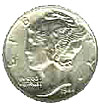
The Winged Liberty dime and Walking Liberty half dollar prove, once again, that little things mean a lot.
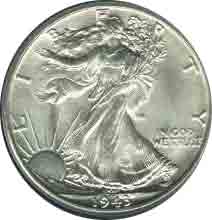
Walking Liberty half-dollar


 Copper & Nickel
 Silver Coins
 Gold Coins
 Commemoratives
 Others
 Bullion
 World
World
 Coin Market
 Auctions
 Coin Collecting
 PCGS News