The just-completed Santa Clara coin show has an excellent reputation as a "good little show" that fills the gap between the Baltimore convention of early November and the F.U.N. show of early January. Every element of that reputation was proved true last week, except that the adjective "little" might have to be deleted. Price records were crushed beneath two steamroller sales from Heritage Numismatic Auctions as collectors and dealers vied for ever-scarcer numismatic prizes.
"It was a tremendously active show for all three days that I was there," said Mike Sargent of the Heritage staff. "It is extremely difficult to buy inventory right now, but it's a terrific sellers' market."
Here are a few highlights from the Heritage sales in Santa Clara:
- 1877 Indian cent (PCGS PR65 CAM) $13,513
- 1915-S Lincoln cent (PCGS MS65RD) $10,925
- 1950 Lincoln cent (PCGS PR65 DCAM) $8,913
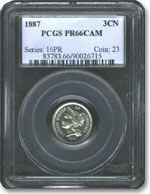
- 1887 Three Cent nickel (PCGS PR66 CAM) $10,350
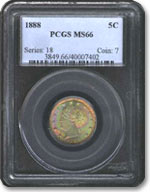
- 1888 Liberty nickel (PCGS MS66) $21,850
- 1936-D W.L. half dollar (PCGS MS67) $8,338
- 1946-S W.L. half dollar (PCGS MS67) $9,200
- 1863 Liberty Seated dollar (PCGS PR65) $17,250
- 1879 $20 Liberty (PCGS MS63) $13,800
- 1888-S $20 Liberty (PCGS MS64) $16,100
Optimism reigns supreme.
"I am extremely optimistic about the rare coin market right now," says Barry Stuppler, a 40-year veteran of numismatics from Woodland Hills, California. "There are a tremendous number of new people coming into the market. They may be first-time buyers, but they're interested in true value and quality, not just generic items. Business is way up, and customers are looking for gold, type coins and Morgan dollars."
If the customer asks for direction, which way do you point? "The rarities," Stuppler answered. "Rarities are the most undervalued area of the market, or they offer the most potential for growth. I'm talking about early type coins, Proof gold, Bust dollars and Liberty Seated Proofs. Some of the Liberty Seated Proofs have begun to bring really good money at auction. That's a great sign, because it shows that support and interest are growing for this somewhat overlooked market segment."
Mr. Stuppler's optimism has prompted him to write an article about the "11 Early Signs of a Bull Market." How many of these signs are currently in evidence? According to Stuppler: all eleven!
If silver commems are common, where are they?
"Silver commemoratives are doing really well right now," says Mark Machin of American Federal Rare Coin & Bullion in Phoenix, Arizona. "For a while I was having trouble finding really nice coins to sell. Now I'm having trouble finding ANY coins to sell. Dealers are calling and asking if there's anything that I can offer them. The answer is: 'Not much.'"
Mark, does this mean that I can't see you at a show and look through six double-row boxes of commems like I used to? "I doubt if I have 40 coins total in stock right now," Machin answered.
What about gold commemoratives? "Gold commems are a different story. If there's one area of the market that might come down a little it's gold commemoratives. They've had a long upward run, but right now they have to be discounted a little from bid in order to sell them. I don't anticipate a major price adjustment, just something in the 10% range."
Type and gold remain highly active.
Type coins and gold continue to be in tremendous demand, according to Machin (and everyone else, for that matter). "Silver type is easy to sell at 10% over bid," Machin said. "The only thing that has to be discounted is dark coins, but anything with life to it flies out the door.
"MS65 and MS66 gold is almost nonexistent, at least in the areas that I'm trying to locate for clients. That includes $2½ Liberties and Indians as well as $5 Libs and Indians. I haven't been able to buy more than four coins a week for quite a while."
What about generic gold? "I just bought 700 pieces of MS62 and MS63 $20 St. Gaudens and sold them to dealers for over bid. When dealers are stretching to buy common coins then you know that there's a supply problem."
What about the other areas of the market? "The CAM and DCAM [cameo and deep cameo] Proof coins are proving to be popular. There was some confusion among a few customers at first, but they've adapted to the designations and the premiums. Proof Mercury dimes and Walking Liberty half dollars continue to roar."
Coins with color bringing huge premiums.
One of the hottest market segments is numismatic items with spectacular color. Mr. Machin shared this story about a recent show. "I took 15 MS64 silver dollars with great toning to the New Silver Dollar Show in St. Louis a few weeks ago. These were coins that I'd picked out of deals over the years and put away. They were all common dates, with bid on the lot adding up to about $500. I sold the coins for $8,000.
"One of the unusual aspects of this market is that a $10,000 coin with great color is still a $10,000 coin, but a $30 coin with great color is a $500 coin. Most of the big premiums are paid on items that are $1,000 or less."
Photos used in this article appear courtesy of Heritage Numismatic Auctions. Photos © 2002 HeritageCoin.com.
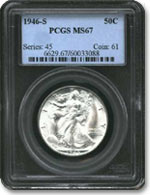
1946-S Walking Liberty half dollar (PCGS MS67), sold for $9,200.
1946-S Walking Liberty half dollar (PCGS MS67), sold for $9,200.



 Copper & Nickel
 Silver Coins
 Gold Coins
 Commemoratives
 Others
 Bullion
 World
World
 Coin Market
 Auctions
 Coin Collecting
 PCGS News