In part one of this three-part series on Christian Gobrecht, I discussed the early years of Gobrecht’s life including his contract work with the U.S. Mint as early as 1823. In part two of this series, I expand on the work of Gobrecht up to and including his appointment as third chief engraver of the U.S. Mint. Gobrecht was a busy man!
Our country was growing both geographically and economically during the 1820s and ‘30s. Gold strikes in North Carolina and Georgia bolstered the economy. New technology was being invented that aided this economic growth. Gobrecht’s early training with the intricacies of clocks would have been a perfect introduction as a natural avenue for one who embraced new ideas and technologies.
We would refer to Gobrecht today as someone who was detail oriented. Indeed, his numerous projects covered a variety of topics of which almost all included some attention to minute details. There is no question Gobrecht was willing to innovate. Others noticed, too.
Gobrecht had first worked for the U.S. Mint after the death of Chief Engraver Robert Scot in 1823. William Kneass had served as the second chief engraver for the U.S. Mint since 1824, when he was chosen over Gobrecht for the job. Despite being offered an assistant engraver position in 1825 by Mint Director Samuel Moore, Gobrecht chose to continue his contract work for the U.S. Mint while still pursuing his other business ventures. The chief engraver was paid $1,200 per year while the assistant engraver was paid $600.
While it’s difficult to ascertain the extent of Gobrecht’s contract work with the Mint, numismatic researcher Walter Breen postulates in his Encyclopedia of U.S. and Colonial Proof Coins that because Gobrecht was working as an unofficial mint engraver from 1824 onward, he “would have had a hand in any proof coin production including the King of Siam set and the 1804 dollar restrikes.”
Let me briefly explain Gobrecht’s probable role in proof coin production. Proof coins were not produced often and their production would have been a specialized process outside of the normal minting of coins for commerce. As an outside contractor, Gobrecht would very likely have been assigned specialized projects because they were outside the normal day-to-day operations of the mint itself.
As more collectors requested proof coins, more were produced, albeit over a several-decade time period from roughly 1825 until the late 1850s. While official sales of U.S. proof coins started in 1858, proof set sales took place much earlier. Indeed, Breen claims that 10-piece sets were sold for $22.50 (printed on a card included with the set) in 1843 and 1844. These sets, if they exist, would have been issued during Gobrecht’s tenure. Prior to 1858, Breen says these proof coins were called “master coins.”
Pricing for proof coins, although produced only sporadically and in limited quantities prior to 1858, was introduced by U.S. Mint Director James Ross Snowden in 1858 and remained unchanged through 1867. The price breakdown for proof sets was $3 for minor coins and $43 dollars for the gold coins, or $46 total for both. Work on any proof issues from the 1820s and 1830s would most likely have included that of Gobrecht.
According to Breen, newer technologies and developments in coining came rather late to the Philadelphia Mint between about 1828 and 1837. In his article “The Mechanization of Coinage” from the March 1951 issue of The Numismatist, Breen mentions numerous examples of improvements made by Kneass after 1828 and through 1834. After 1834, Breen mentions a slight regression, possibly due to Kneass’s declining health, in progress through 1836. Breen states:
“A slight regression apparently took place in the later part of 1834 and through 1836: border beading was again abandoned for radial lines, generally much finer than on previous issues. With the Gobrecht patterns of 1836, however, beading was reintroduced, and continued (slightly modified) on all issues except a few patterns until the 1909 Lincoln Cent and designs thereafter adopted.”
The beaded border on the 1804 Dollar was done by either Kneass or Gobrecht. I’m betting it was Gobrecht. Curiously, “documentation is provided in the 1836 Report of the Director of the Mint, dated January 17, 1837, for the last bout of mechanization of diemaking at the mint, under Gobrecht and Kneass. Dr. Robert M. Patterson became mint director in early July 1835.
In a somewhat serendipitous series of events, coinage in the U.S. took an immense leap forward in 1836. Between Patterson’s appointment, Gobrecht’s appointment, and the gigantic leap in technology the coinage of the U.S. was entering a period of relative issue stability. New designs from Gobrecht for a large portion of our circulating coinage — all Liberty Seated silver coinage as well as the quarter, half, and eagle Liberty gold designs through 1891 and 1907 respectively — are some of the most significant in U.S. Mint history.
Early that spring, on March 23, 1836, “the first steam coinage in America was executed at this mint, and the performance of the press in which the power of the lever was substituted for that of the screw, has answered all our expectations.” In addition, “the milling of the pieces, heretofore exclusively done by hand, is now [...] executed by steam power.” The old lettered-edge design was retired and never returned but for a few pattern issues.
The Kneass stroke occurred during a pivotal period in U.S. coin production. New machinery was being installed at the mint. The King of Siam Proof Set as well as 1804 Dollars were produced during this time period. Gobrecht was made a second mint engraver (not assistant) and his compensation was increased accordingly.
A great article by Joseph H. Colville titled “Christian Gobrecht, Genius” was published in the April 1989 edition of The Numismatist. Colville probably hit the mark with his moniker “Genius”! In addition to his engraving work and medal-ruling machine invention, Gobrecht also invented a reed organ (sometime between 1816-21), which was similar to the later cabinet organs developed by others. Gobrecht’s numerous endeavors were noticed by others, too.
Gobrecht was very well thought of in his profession by his peers. Q. David Bowers in his two-volume ANA Centennial, cites a letter from the March 1913 The Numismatist. The letter dated June 18, 1836, was written by one of Gobrecht’s peers, a Mr. Charles Toppan, a Philadelphia banknote engraver. Toppan is writing to another Gobrecht peer, Edward Stabler, Esq. In the letter Toppan writes:
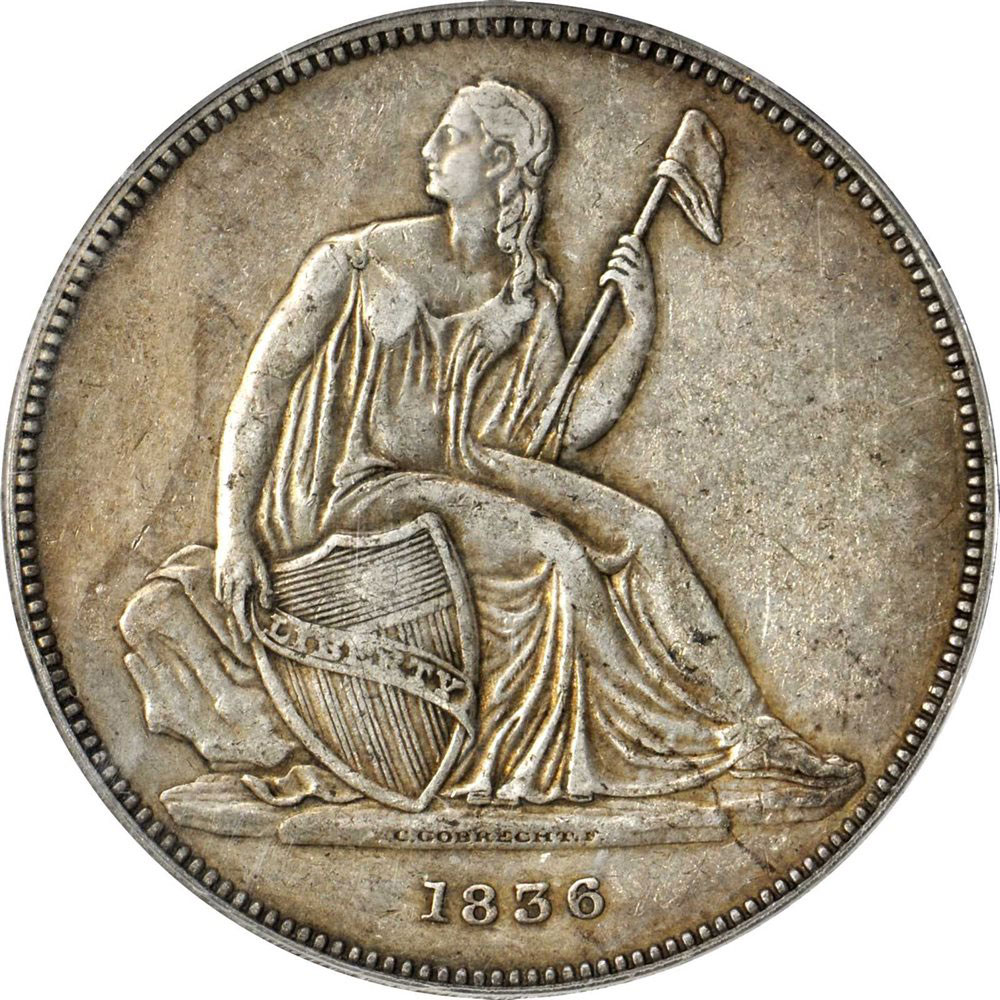
“You will no doubt be pleased to hear that friend Gobrecht is employed by Uncle Sam, preparing dies for a new coin, after designs by Sully. Instead of the head of Liberty on the dexter side, there is to be a full length figure of her ladyship, in a sitting posture, holding the staff and cap in one hand and the shield in the other by her side, the reverse is to be the imperial bird flying, surrounded by stars and disencumbered by the gridiron olive branch and arrows. The engraving is well advanced and bids fair to do credit to the skill of the artist. When finished, I hope both of us will have frequent opportunities of criticizing the work upon the golden stamp.”
Both friends and colleagues admired Gobrecht. His professionalism and integrity were recognized early by both Mint Directors Moore and Patterson. His friends, while poking a little fun at Gobrecht, clearly admired, were appreciative of the honor, and definitely approved of his appointment to the U.S. Mint. The ironic part of this is that Gobrecht had already been working for the mint for 12 years.
Gobrecht was unexcelled as a die-sinker. Examples of his early work include the Charles Carroll medal, the Charles Willson Peale medal, and the seal of the Pennsylvania Institute for the Instruction of the Blind. Gobrecht was the 25th member of the Franklin Institute to affix his signature to the charter and bylaws of the organization. He served as a member of Franklin Institute’s Board of Management from 1828-1830 and was a member of its Committee on Science and Arts from 1834 until his death in 1844.
Was it serendipitous that Gobrecht took the position with the U.S. Mint in 1835 as second engraver, equal in rank to William Kneass, then chief engraver? Yes. Despite the tragedy of the Kneass stroke, there was no one better qualified than Gobrecht. Not only was Gobrecht perfectly positioned to adequately fulfill the engraver’s responsibilities, but also to usher in the design and production of our first silver dollar coin since 1804.
By the early 1820s Mint Director Moore was advocating for the revival of U.S. silver dollar production. Moore received authorization from Congress in 1831, but little progress toward the issuance was made. During this period of time 1831-1835 other mechanization projects were underway. Interestingly, very little progress was made until both Patterson and Gobrecht had arrived.
Patterson took command as mint director in July 1835 with profound changes in mind. Patterson aspired to achieve a mint product that was struck with the latest technology but also embodied a more worldly aesthetic. Patterson had lived in Paris in the early 1800s. European coinage was superior to U.S. coinage at this time. Patterson planned to change that fact.
Production at the U.S. Mint from steam presses first began with copper coinage and then progressed to the smaller silver and gold issues. Not all coins produced in 1836 employed the steam press. Only a few thousand Reeded Edge Half Dollars were produced in 1836 not using the steam press because of a partial failure of a press and ejection problems making them quite scarce.
Incidentally, this issue, too, is the last coin until the 1849 Double Eagle that used the motto “E Pluribus Unum.” Patterson wasn’t a fan. In 1873, among many coinage change rules enacted that year, the motto was once again added to all U.S. coins, where it remains today. Numismatic scholar R.W. Julian points out in his excellent article “The Mint and Coinage of 1837” that Patterson had come to the conclusion “that this motto was nothing more than a punning way of saying UNITED STATES in Latin.”
When Mint Director Patterson approached both Thomas Sully and Titian Peale in an ambitious (and quite successful) attempt to make an artistic statement, he commissioned Sully to make sketches of a full figure of Liberty. He also commissioned Peale to fashion the eagle for the reverse. Gobrecht was then to “translate the designs to metal.” Using a composite of both Sully and Peales’ work, Gobrecht contributed his own expertise into a masterful piece. The new design received immediate acclaim and President Andrew Jackson and his cabinet were favorably impressed by Gobrecht’s sketches on October 17, 1835.
Like today, the issuance of the Gobrecht Dollar wasn’t without political controversy. Much like the brouhaha surrounding Victor D. Brenner’s initials on the Lincoln Cent he designed, the first Gobrecht Dollars appeared with the designer’s moniker “C. GOBRECHT F.” in small letters in the field beneath Miss Liberty. “F” stands for “he made it.” Mint Director Patterson had ordered Gobrecht to place his name on the new coin.
Maybe I’m overreaching here, but isn’t it obvious that Mint Director Robert Patterson was immensely pleased with Gobrecht’s work and wanted others to know too? After all, his goal was to bring to the people coin designs our country could be proud of, right?
To conclude part two of this three part series, I wanted to focus on what led to Gobrecht’s contributions to U.S. coinage. Between the new technology, the appointment of Dr. Patterson as the new mint director in 1835, and most importantly Gobrecht’s appointment as a full mint engraver in 1835 (after Kneass’s stroke), coin production at the U.S. Mint took a gigantic leap. These factors, of which Gobrecht was an integral part, were to define the majority of U.S. coinage through the end of the 19th century.
In part three of this three-part series I concentrate on the Gobrecht Dollar itself, but I will also touch on other Gobrecht issues and patterns. Like the Gobrecht Dollar, the 1837 Half Dime and Dime issues have no stars on the obverse. Why? I’ll also discuss some of the misconceptions and problems with early attribution of many of the Gobrecht Dollar issues.


 Copper & Nickel
 Silver Coins
 Gold Coins
 Commemoratives
 Others
 Bullion
 World
World
 Coin Market
 Auctions
 Coin Collecting
 PCGS News