The subject of Conder Tokens has always been fascinating to me. I have had the opportunity as a grader, dealer, and collector to examine some fantastic pieces. It has always been puzzling that with such low mintages, beautiful designs, fabulous workmanship, and generally high available grades that they are not more avidly collected. There are some of the more common examples that a token from England minted in the 1790’s, and grading mint state can be had for only a few hundred dollars. Worn examples can be had for as little as $25-$50! This particular interview was very enjoyable with a collector who not only specializes in them but has also travelled to England multiple times to seek out the scarcities! I hope you enjoy.
When did you start collecting coins?
When I was five years old. My grandpa had a bunch of silver dollars, he wasn’t a collector, but he showed them to me. I was fascinated by the size and the design. Obviously the older the date, the cooler they were to me. I was fortunate that growing up there was still silver to be found in circulation. So, I had the opportunity to get some old Whitman “thumb buster” albums and fill in the holes. I started to become a more serious collector when I was around 29 and started making some decent money. I had learned a lot in the meantime, but I took a full year and instead of buying coins, I bought books and I studied. I am not much of a reader, but I knew that to spend good money on coins, I needed to know what I was doing. When I was 30 is when I started going after what I would consider real collector coins.
I know, among other things, you collect Conder Tokens. What exactly is a Conder Token, and why do you feel an affinity towards them?
Conder Tokens are generally copper coins that were minted by private individuals for the purpose of being used in trade and advertising. The majority of the tokens were minted in the 1700’s and come in three denominations; quarter penny or farthing, half penny, and penny. From everything that I have read and heard, the purpose of their existence is that the UK had a major shortage of small denomination coinage and the Crown didn’t seem like they were in a hurry to strike more. I have heard stories of “group payments” where say three employees would get paid by an employer in silver, and it was up to the three to be able to split the payment. This obviously created some issues as small change was scarce. Conder Tokens were minted by business owners mainly, and the Crown didn’t seem to care that it was being done as the content was accurate. In fact, many Conder Tokens tend to have more copper, or value, than the English made equivalent. It also became a great way for individual business owners to advertise. The only time this practice upset the government was when there were satirical items made that poked fun of the king. He didn’t seem to find it as humorous as the merchants did!
What does the term “Conder” mean?
Conder was the last name of an individual, James Conder, who had done a lot of research on the subject. Conder tokens in England are generally referred to “provincial tokens.”
What was the first Conder Token that you purchased? What started it all?
The seed was planted when one of my employees purchased a “hangman token” and I remember thinking it was a really neat item. There was a time that I did collect Early American Copper, but it became too difficult and expensive for me to continue. Once I started learning the history of Conder Tokens, and realized I could get super high grade items with great scarcity for a few hundred to a few thousand dollars, I was hooked. If that was an early U.S. coin with that type of rarity and condition, we would be talking high five figures. The thing that tipped me over the edge was purchasing a decent collection of hangman tokens that had such great designs and so much history.

Example of a “hangman token.” 1796 Tk 1/4D, DH-1123a Middlesex,Spence's, Great Britain, PCGS MS66RB. Click image to enlarge.
How many varieties exist of Conder Tokens?
There are over four thousand individual varieties, and I feel that is being conservative. One of the reasons for this is the muling of dies. There were several hundred different establishments; shoemakers, leather smiths, mines etc and were producing these small denomination tokens to help pay their employees. They would also mule obverse and reverse dies from different makers. The dies could also be interchanged and sold, and were used over and over. Most of the dies were very well made, and many have multiples variations of edge lettering. It has been said that there were collectors in those days who could go to a specific maker and request that a certain die pair be used to strike a token for their collection. This is the reason why there are some tokens out there that are unique. In many of the varieties there are only 4-6 known. And for the amount of money that these rarities cost, you would get a US coin where there are hundreds or thousands known, and much lower grade.

1797 Tkn 1/2D DH-906 Middlesex Edge: Plain, Great Britain, PCGS MS65RB. Click image to enlarge.

1796 Tk 1D DH-24 Middlesex, Hackney, Great Britain, PCGS MS65BN. Click image to enlarge.
Do you have a favorite sub-series in Conder Token?
I love the hangman tokens, although I am fascinated by them all. I know it sounds morbid, but there is something about them that gets my curiosity going. Thinking that motif could be used on a coin seems so…wrong somehow. I currently have 31 individual varieties of hangmen, and I don’t think there are many more than that. The examples from Ireland tend to be really difficult to find, as well as the pennies, of which I have four. One of them is an “RRR” which is the scarcest designation other than unique!
What is your “dream token?”
There is one that I don’t have yet, it is made in Middlesex by the maker Pidcock and features a zebra. The book only calls it rare, instead of very rare or extremely rare, but try to find a nice example; they just aren’t there. That is one that I will be excited to add to the collection one day. Pidcock was known for presenting animal motifs, some rather common, but the zebra is elusive.
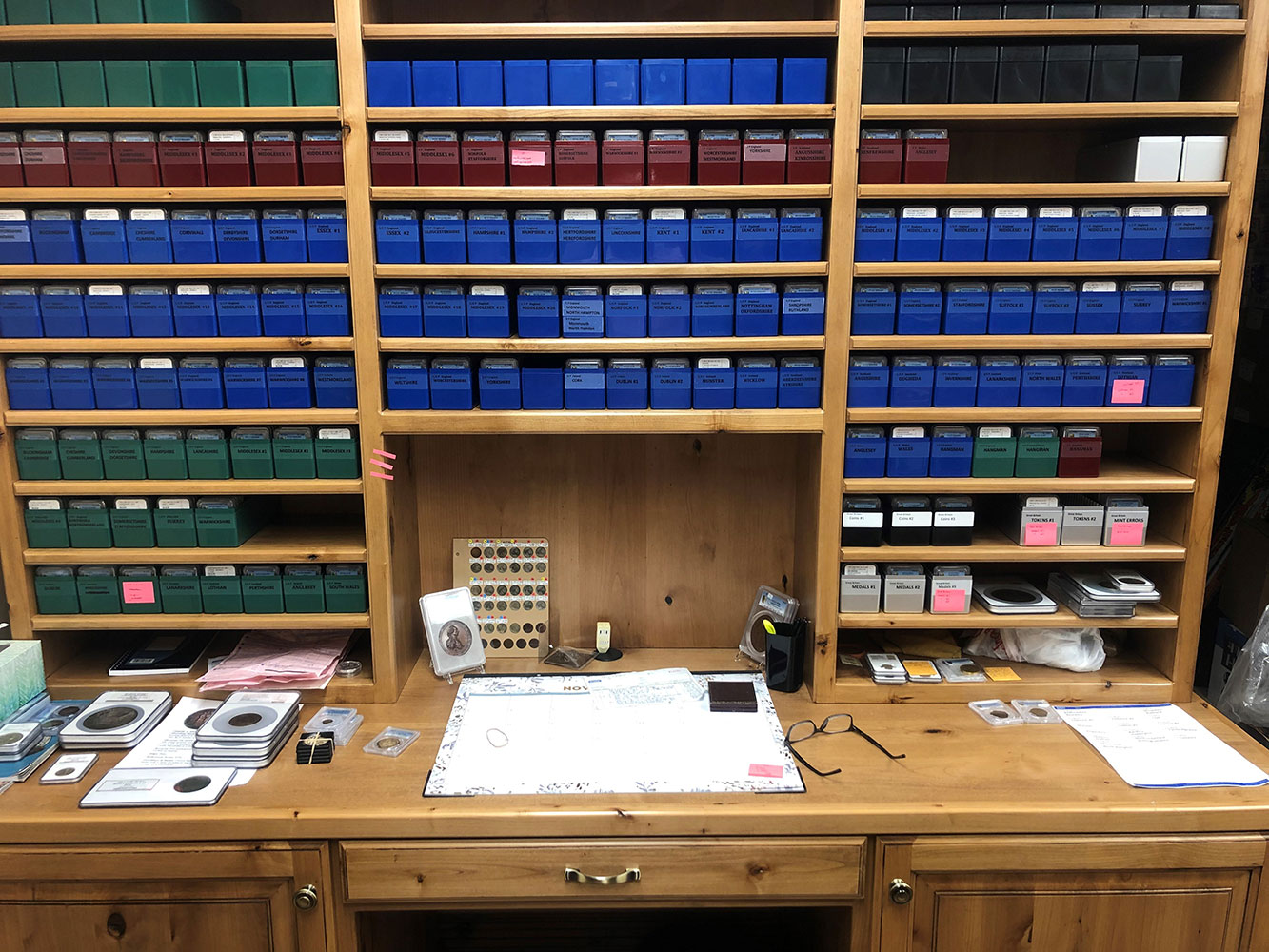
Picture of a beautiful organized, custom desk. Courtesy of the collector. Click image to enlarge.
Why do so many of these tokens seem to be available in uncirculated condition?
These were well struck, pretty, different, interesting, and you didn’t have to be an elite individual to collect them. They were available at face value. As these were made, people would collect them in coin chests and put sets together for preservation. As there were so many different designs, many people wanted to grow the collection and lots of trading occurred. And, if you found yourself hard up, you were only in them at face value so you could spend them. This is why, I believe, many can be found in uncirculated condition.
Do you have any advice for someone who may be wanting to collect Conders?
Probably the best advice that I would have wanted to know early on, is get in contact with someone who knows a lot about them. Someone who can tell you the stories, give you information, and help with pricing. It was fun for me when I started, but when I started meeting other people who know more than me, that is when it became very exciting. The amount of knowledge, and free education that you can glean is invaluable. There is great literature, but it tends to be expensive. So, getting good facetime with a specialist is key.


 Copper & Nickel
 Silver Coins
 Gold Coins
 Commemoratives
 Others
 Bullion
 World
 Coin Market
 Auctions
 Coin Collecting
 PCGS News