Counterfeiting workshops, particularly those in China, have produced thousands of different counterfeits of Chinese coins and other numismatic issues from around the world. As a result, counterfeiters can have thousands of different dies at their disposal. Counterfeits of inferior quality don’t get easily passed off as genuine, or they become exposed as fake, which often gives counterfeiters motivation to try fixing their dies to produce better specimens – or produce “errors” to pass them off as premium pieces that defraud people. Over the last few years, hundreds of these pieces struck or overstruck with counterfeit dies have been submitted to PCGS and returned as not genuine. Yet they continue to appear on the market being sold as genuine mint errors and have even been certified as genuine by some other services. Today, I will highlight four different types of examples we have seen.
Click image to enlarge.
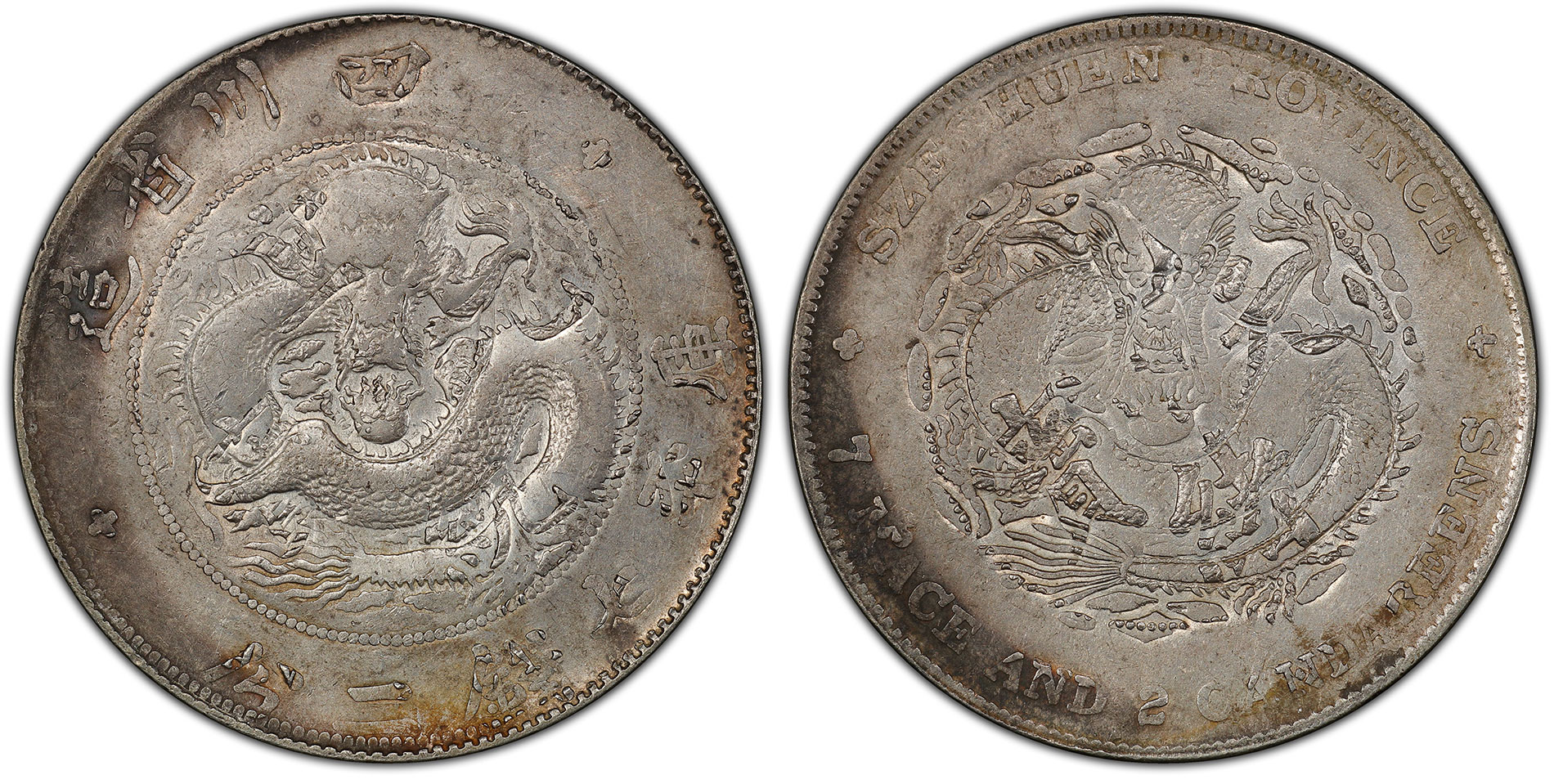
This first piece is a China Szechuan 7 Mace 2 Candareens or Dollar (1901-08) listed as Y-238.1 and L&M-346 with the variety where the V for PROVINCE is an inverted A. This piece is struck with counterfeit dies and flipped over and struck again with counterfeit dies. This intentional flip-over double strike is counterfeit. One can tell from the newly struck luster on this “circulated details” coin. Another diagnostic is the way the striking occurred, with both strikes being within the collar and details from one of the strikes being off-set; this would have happened only if being broadstruck or off-center, which that strike would have been partial or out of collar. Another diagnostic is the inconsistent striking details of what appears on both sides; the counterfeiters wanted the appearance of a dramatic error for premium sale, but what is struck – and double struck – is inconsistent with actual mint produced strikes and actual errors.
Click image to enlarge.
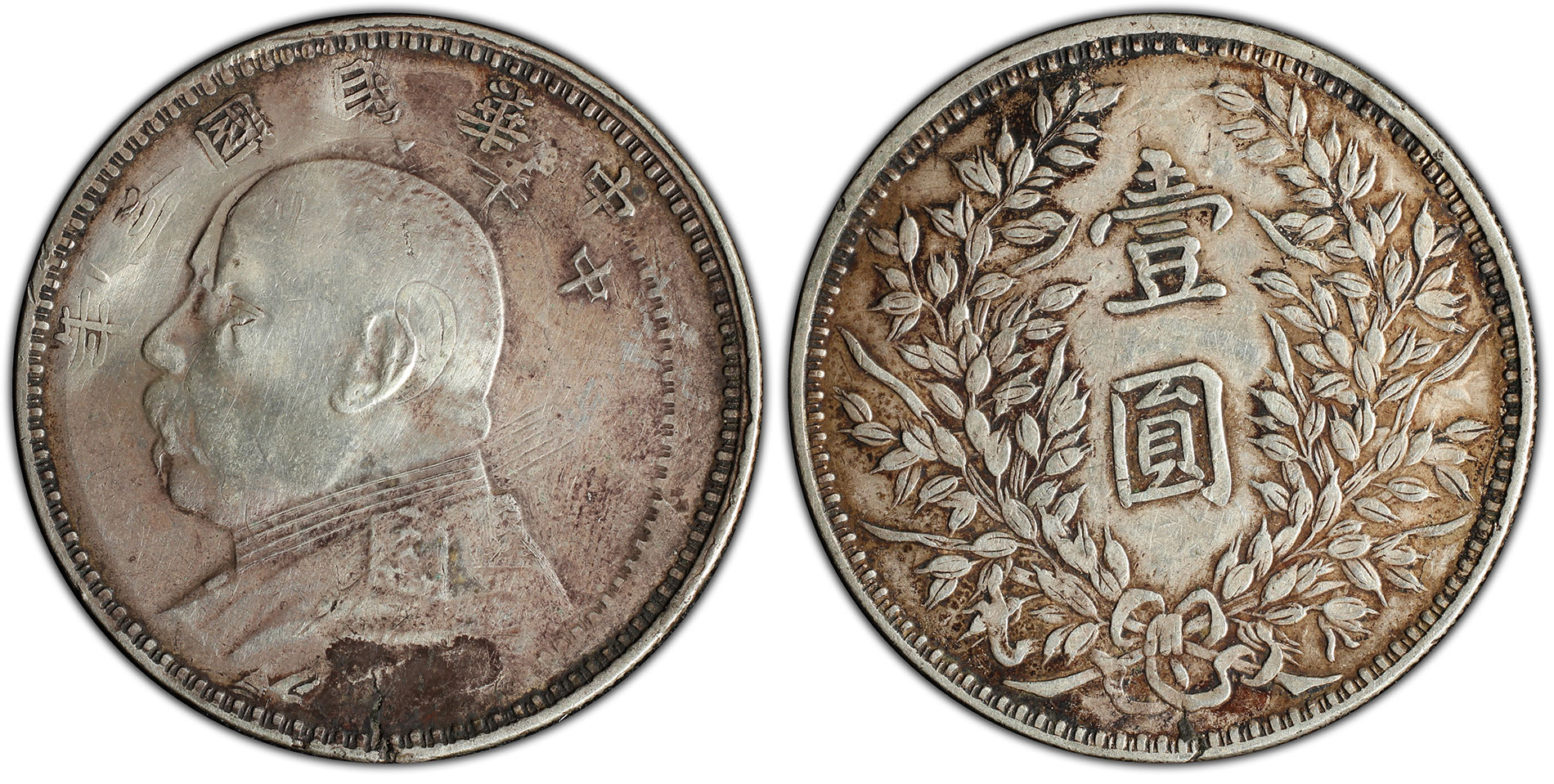
This second piece is a China year 3 (1914) Dollar listed as Y-339 and L&M-63D the Kansu bust variety with the straight stroke “Min” Chinese character. The coin is counterfeit, but a decent counterfeit. However, the counterfeiters decided to use the obverse die, and only the obverse die, to strike over the obverse multiple times. One obverse strike added the extra, distorted ear; another added extra shirt collar lines into the field, and yet another added denticle details into the field as well as the additional Chinese characters all from different strikes of one die. Artificial corrosion has been added to the coin to give the coin a sense of patina and the appearance of age. While there are genuine mint errors that occur with double striking on only one side, they are scarce. Multiple strikes outside of the collar with one die is a good sign the piece is not genuine.
Click image to enlarge.
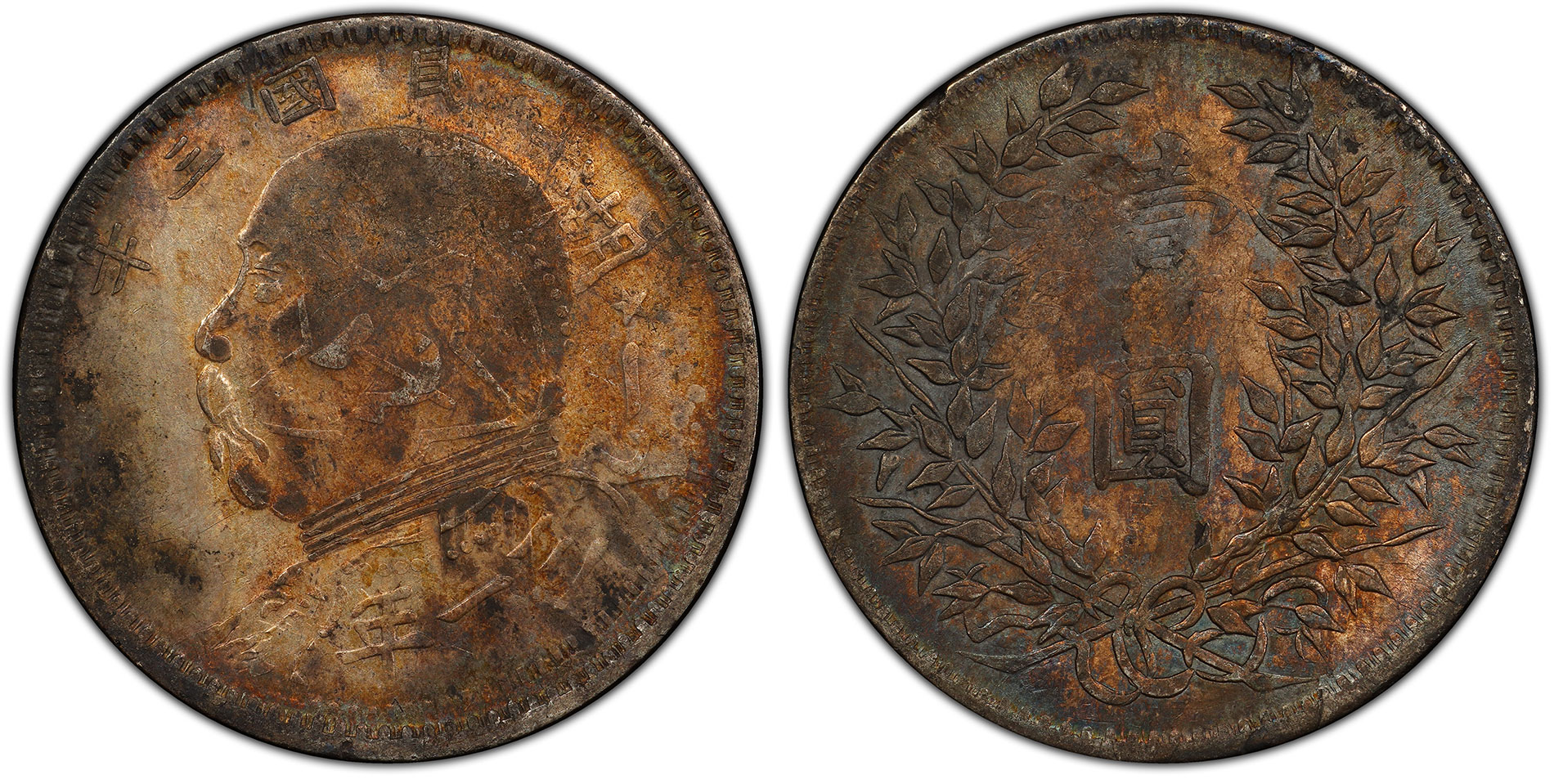
This third piece is a fun example. The piece is a China year 3 (1914) Dollar listed as L&M-63G with the Sinkiang bust made in the Sinkiang region of China. This piece is struck over a Soviet Star Dollar, which would have been made in 1931 and is an incredibly rare and heavily counterfeited coin. The chances of a 1914 coin being struck over a 1931 coin are almost none. The coin also has the wrong details, strike, and luster for Sinkiang issue 1914 Dollars. The coin has been artificially toned to give the appearance of age.

Click image to enlarge.
This final piece is an Australia 2008 Dollar made for circulation. Unlike the other coins depicted in this article, the host coin original strike is genuine. The second strike, which occurred off-center, is counterfeit. It is not uncommon for circulation-issue coins such as British Pounds or Australian Dollars to be counterfeited with the intention of being spent in circulation. However, this piece started with a genuine example and the counterfeiter used a fake die to double strike the piece to make it a “mint error” – a piece that would bring substantially more than the face value of the coin. Notice the differences in the lettering, hair details, and Kangaroo details of the secondary strike. These aspects are wrong with a pitted, mushy detail compared to the sharp, detailed first strike of the genuine coin. With most genuine double-struck coins, the second strike is going to be with the same die as the first. It is very unlikely genuine secondary strikes are from different dies. When they are, they are most likely created on purpose or, as with this piece, because it’s a counterfeit.
For avoiding counterfeits like these, using common sense goes a long way. As the old saying goes, “if it is too good to be true, it usually is.” Acquiring general knowledge will allow you to avoid issues like this, and having the protection of pieces authenticated and graded by the experts at PCGS will help you avoid counterfeits and other dangerous pieces.




 Copper & Nickel
 Silver Coins
 Gold Coins
 Commemoratives
 Others
 Bullion
 World
World
 Coin Market
 Auctions
 Coin Collecting
 PCGS News