Many coin collectors are familiar with ounces and grams as units of measurement for weighing coins. However, there is another type of weight measurement with which collectors are typically familiar, and that’s the grain. The grain is a measure of weight dating back to the days of antiquity. Its roots are firmly planted in the Bronze Age, when this unit of mass was used to correlate to the weight of a single grain of barley. The equivalent today is 64.79881 milligrams in the troy, avoirdupois, and Apothecaries weight systems, and is the only such unit that maintains its equity across those three widely used weighing formulas.
The grain was also the basis of English weight systems, though in England’s pre-1527 so-called “Tower weights” the name referenced not a grain of barley but rather a grain of wheat, which was noted as being 45/64 of a troy grain. Extrapolating this further, one gram is equal to about 15.43 grains, and there are 7,000 grains per avoirdupois pound or 5,760 per troy pound or Apothecaries pound.
While the use of grains as a legally viable and commercially referenced unit of weight has waned since the early 19th century, but in jewelry circles it maintained relevance in the use of carats, a single unit of which was defined as equaling four grains. The carat was later redesignated as totaling 205 milligrams and eventually 200 milligrams.
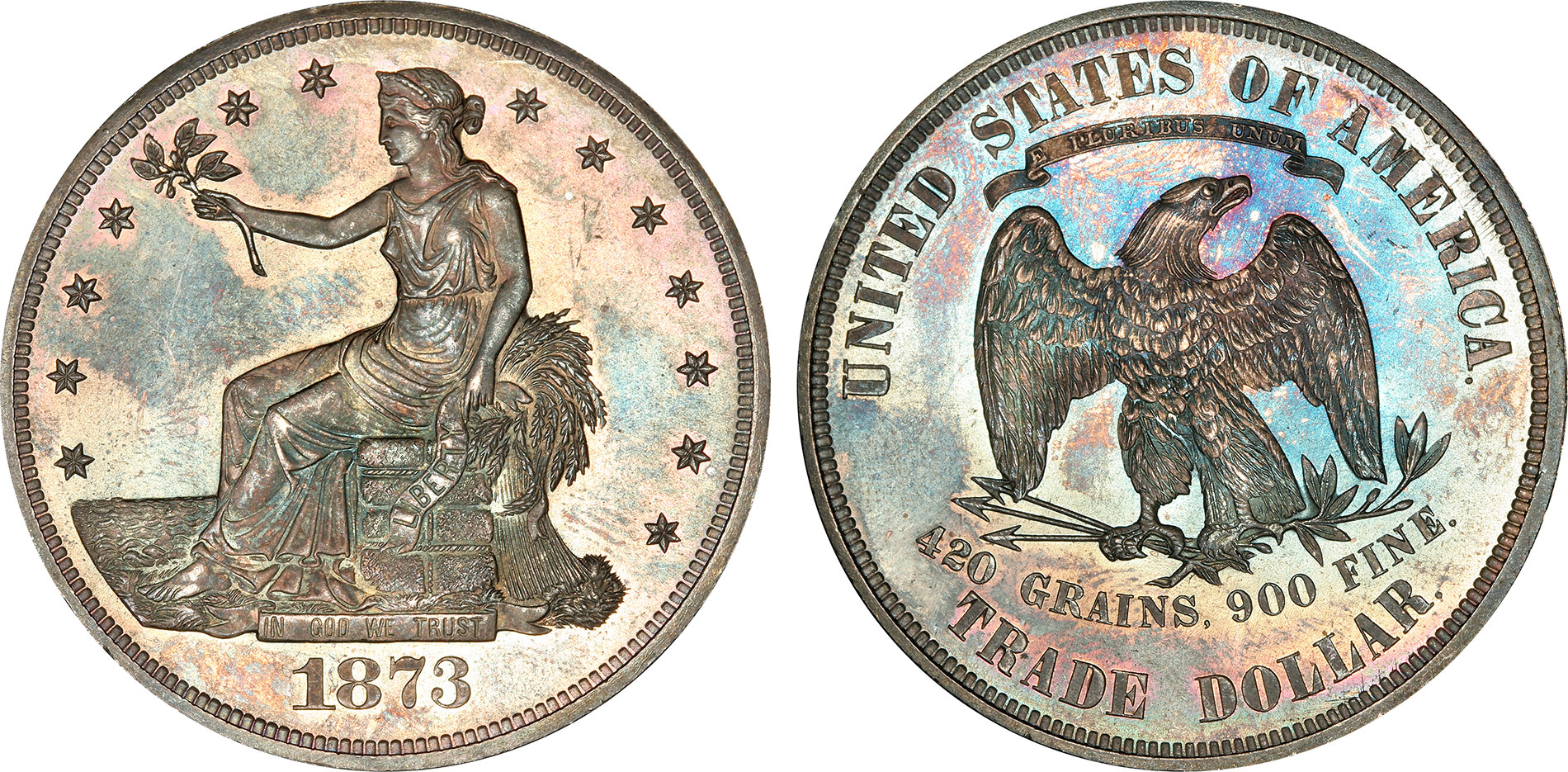
In the numismatic arena, the grain as a unit of measurement had a purpose in providing set weights for coinage throughout the 19th century. This was certainly the case when the Bland-Allison Act of 1878 required the silver dollar to weigh exactly 412.5 grains troy. Meanwhile, the Trade Dollar, which was issued from 1873 through 1885 and intended for circulation overseas, was pegged at 420 grains. This weight is stated on the reverse of the Trade Dollar, which saw wide use in southeast Asia and was encountered in places where various ancient and modern weight standards might have been in use. It should be noted that the Trade Dollar is also weighted to 27.22 grams, which – with rounding – equates back to the 15.43 grains per gram as stated earlier.
The grain certainly had its place in providing a precise unit of measuring the physical weight of a coin, and for the longest time it served a critical role in guiding both coinage legislation and individuals who carried out the task of making coins. But today the grain remains in numismatic literature as little more than an historical vestige of bygone days and obsolete ways.
Sources
- Breen, Walter. Walter Breen’s Complete Encyclopedia of U.S. and Colonial Coins. Doubleday, 1988.
- Connor, R. D. The weights and measures of England. H.M.S.O., 1987. Retrieved August 20, 2021.
- McDonald, Daniel McLean and Christopher Scarre. The Origins of Metrology: Collected Papers of Dr. Daniel McLean McDonald. McDonald Institute for Archaeological Research. 1992.


 Copper & Nickel
 Silver Coins
 Gold Coins
 Commemoratives
 Others
 Bullion
 World
World
 Coin Market
 Auctions
 Coin Collecting
 PCGS News