Ever wonder what all those numbers on the front of a PCGS coin encapsulation label mean? You wouldn’t be the first. Collectors ask us all the time how to read the numbers on a PCGS label. While we’re always glad to explain this to our customers, we thought it might be more convenient for you if we save you the phone call or email and explain in clear terms what the importance of those numbers on PCGS labels right here in this article.
Reading a PCGS Label
With a few notable exceptions, every iteration of the PCGS label going back to the first issued in February 1986 shows the same basic information: the coin’s date, mintmark if applicable, denomination and an adjectival grade paired with the numerical grade number; there are also cases in which a label might read “No Date,” “Circa,” show date ranges, or list odd denominations unfamiliar to many collectors. Other information that might be seen on a label might include information pertaining to the identification of an error or variety, pedigree, or “Details” information describing mitigating attributes detracting from the coin’s overall grade or appearance. Of course, most of this information is pretty self-explanatory and usually does not relate to the label markings that compel a typical collector to take their time when deciphering a PCGS label.
The data that seems to cause the most confusion is the row of numbers toward the bottom of the label, as seen just below.
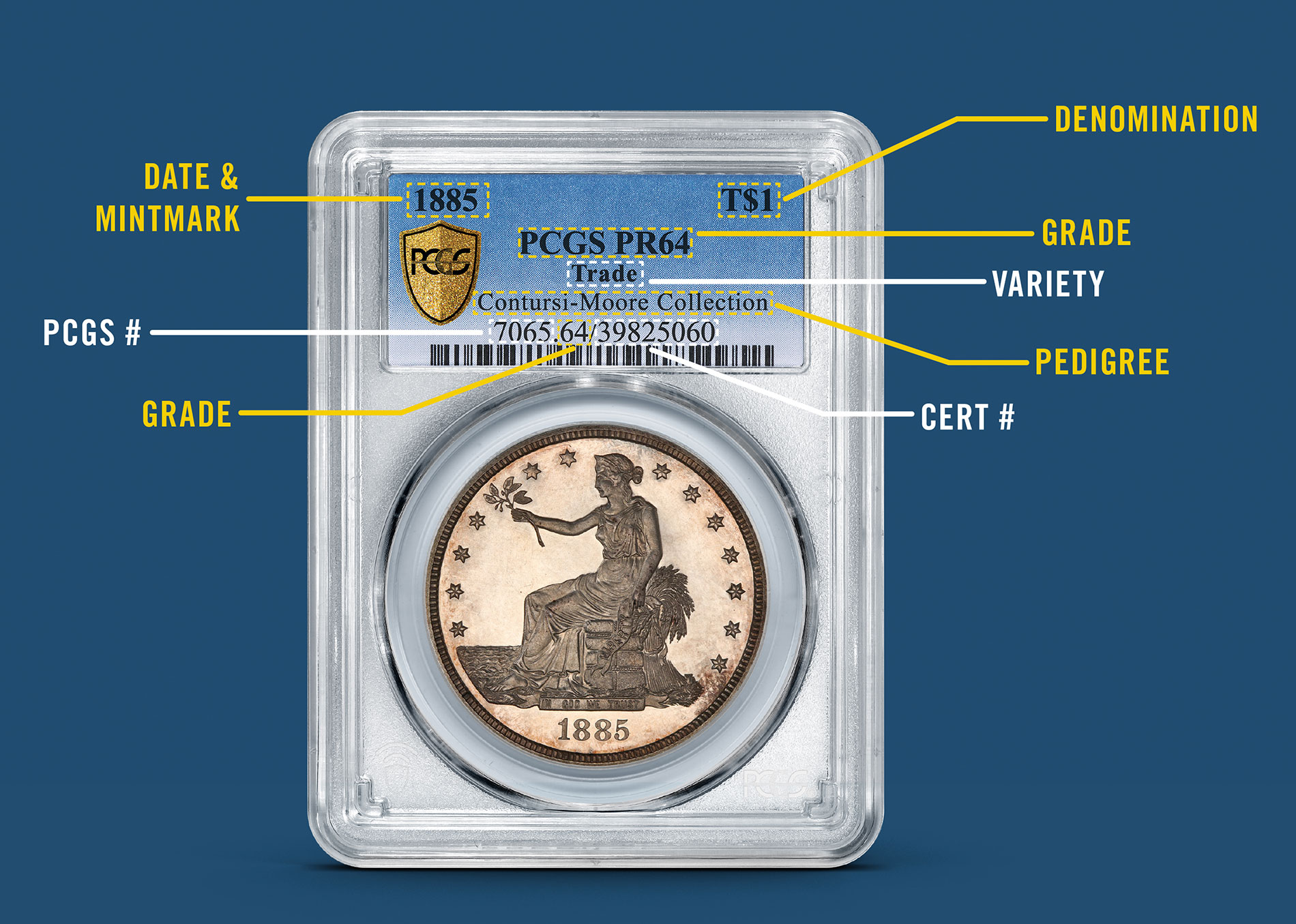
There are some exceptions to the number of digits preceding the period. For example, consider coins boasting a variety, special finish, boasting a special designation (such as RB on Indian Cents), or some other unusual attribute worthy of its own PCGS classification number. Numerical notation of these novelties usually translates to the addition of one or two digits to the issue’s root ID number. Also, many modern U.S. coins are represented by five- or six-digit ID numbers, regardless of the presence of any special qualifiers.
There are some PCGS labels that show a “Series” number and “Coin” number, as seen here:
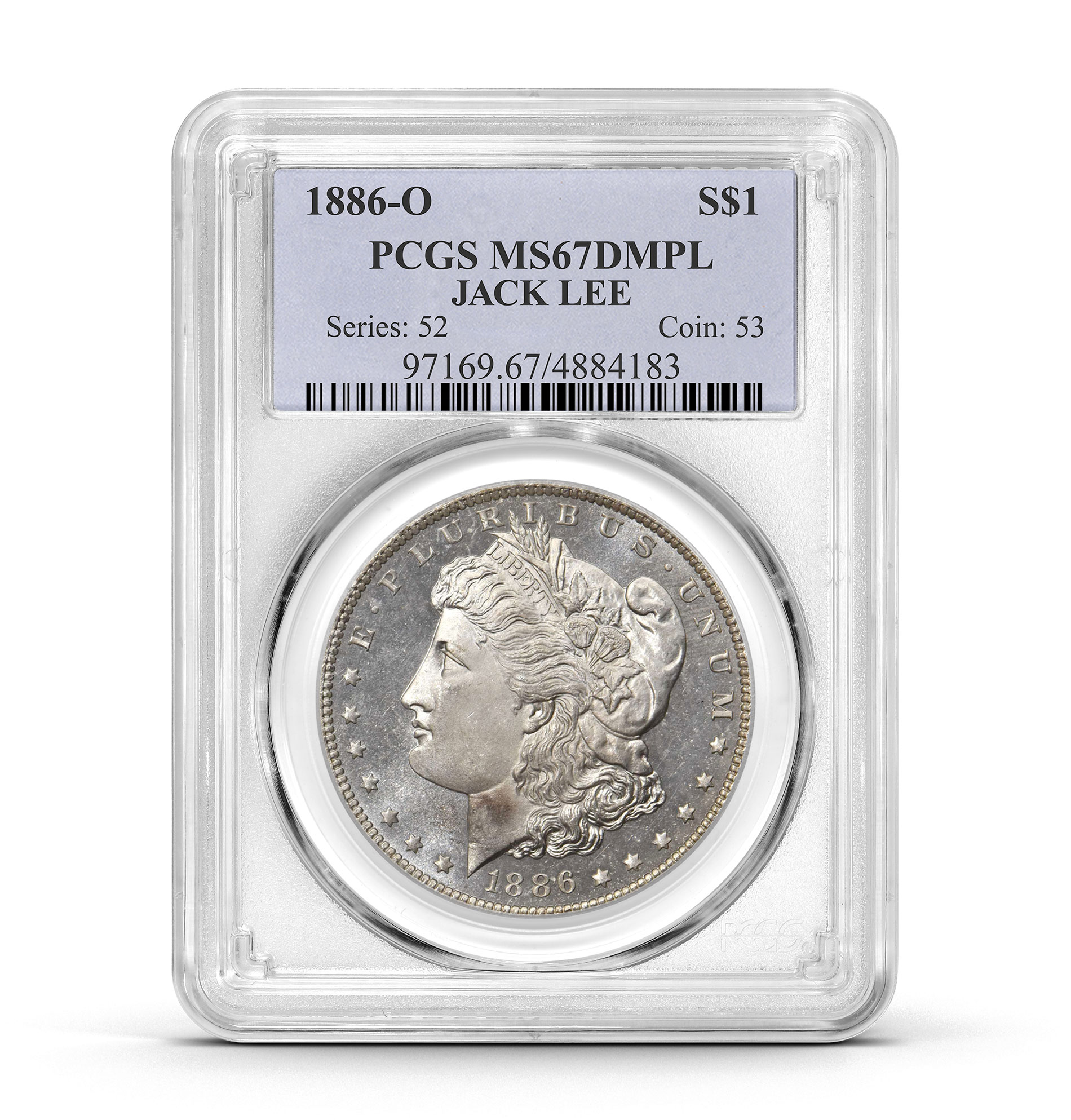
The most frequently encountered configuration of numbers involves a four-digit figure followed by a period and two more numerals, proceeded by a forward slash and either seven or eight more numerals. These figures can help you locate coins more easily on PCGS CoinFacts, the PCGS Population Reports, the PCGS Price Guide, and in other directories.
What About Series and Coin Numbers?
What about the “Series” and “Coin” number as displayed on many PCGS labels from the late 1990s through mid-2000s? A Series number was ascribed to each United States type, while the Coin number was sequentially awarded to each issue from first to last (or most current). For example, the Morgan Dollar is listed as Series 52, while the 1901-O business strike is Coin 82. Another example? The Two Cent is Series 15, and proof Two Cent pieces are denoted as 15PR. The 1870 Proof Two Cent is Coin 7.


 Copper & Nickel
 Silver Coins
 Gold Coins
 Commemoratives
 Others
 Bullion
 World
World
 Coin Market
 Auctions
 Coin Collecting
 PCGS News