It’s August 7, 1984 at the Long Beach Arena in California: China meets America in the women’s volleyball gold medal match. The U.S.A. comes in with the best record from the preliminary round with China in a close second. As the Chinese team takes the floor its star player, Lang Ping, glimpses a television image of the top-ranked American team wearing gold medals. She challenges her teammates, “Let's pluck the medals from their necks.”
The Chinese team is already respected. Lang Ping and her teammates are the winners of the 1979 Asian Games, the 1981 World Cup and the 1982 World Championship. Those victories establish them as top-level international competitors and they are wildly popular in their homeland. The China Mint notices.
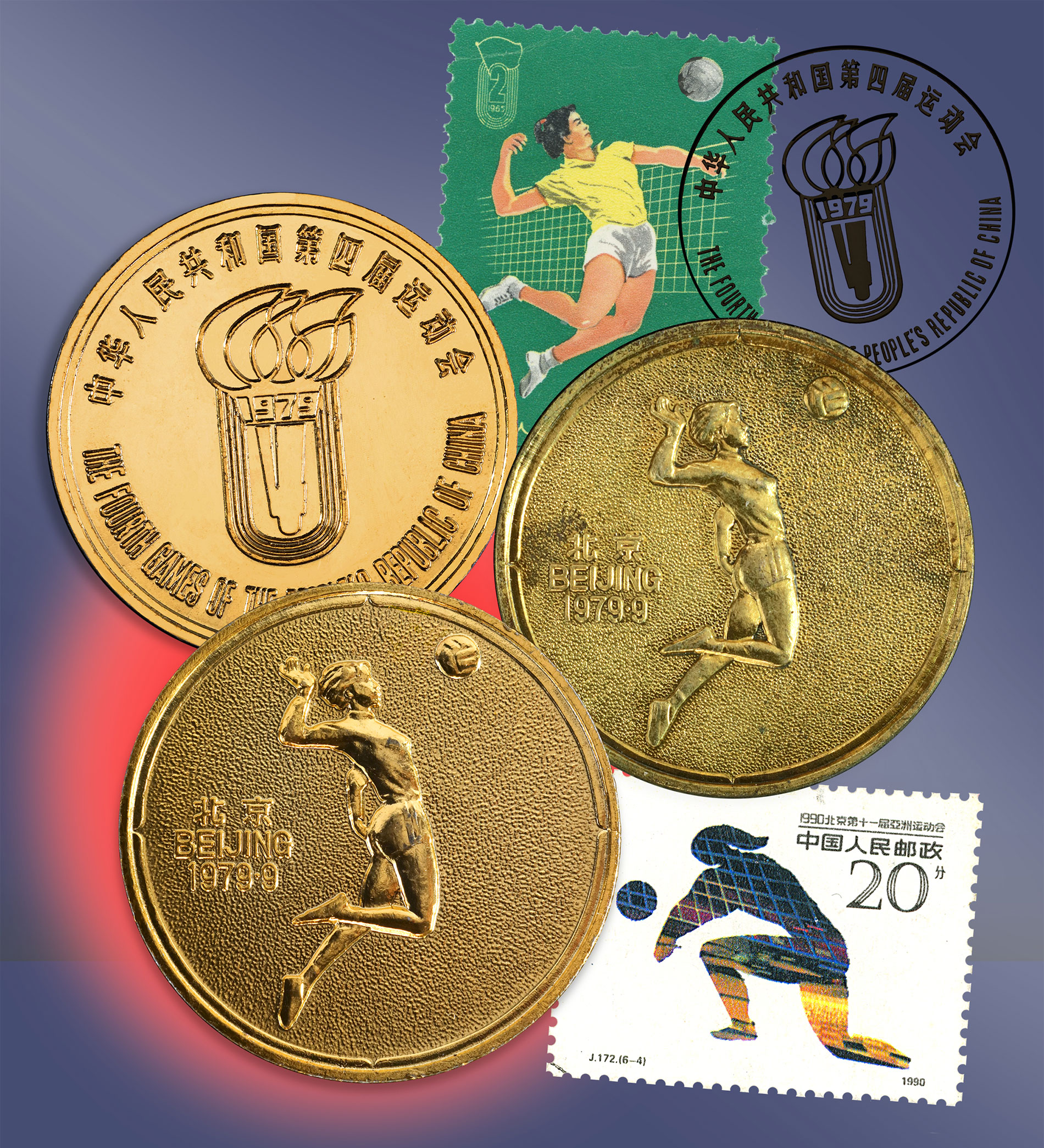
For instance, for the 1979, “Fourth Games of The People’s Republic of China,” it releases a 30-millimeter-diameter silver medal of a woman volleyballer spiking a ball. The medal weighs .40 ounce and 30,000 are produced as part of a three-piece set. A more affordable 33-millimeter-diameter brass medal of the same design is struck at the Shenyang Mint, too.
Two years later, Chinese sports fans can celebrate their team’s 1981 World Cup championship with a 40-millimeter-diameter brass medal. The design features portraits of every player that form a circle around their coach, Yuan Weimin. The Shenyang Mint distributes 1,000 of these. When the team wins the 1982 World Championship, the Mint strikes another brass medal with a similar design and the same mintage.
For the 1984 Olympic Games in Los Angeles, China spotlights its women’s volleyball team with a 10 Yuan coin. Struck at the Shanghai Mint, it contains one-half ounce of 92.5% pure silver. In the design by Gu Xingbao an airborne striker is about to spike the ball. The authorized mintage is 6,000, but according to the Gold & Silver Coins of China Standard Catalogue only 4,500 are minted. That’s partly because 1,100 are set aside for a matte-finish edition.
Now, in Long Beach, the People’s Republic of China team leads against the U.S.A. two games to zero in the finals. The score is 14-5 — match point for China — in the third game. The crowd bellows as a Chinese serve arcs over the net and is met. The U.S.A. passes, sets, and out of nowhere South Korea-born Debbie Green, her team’s smallest player and top setter, suddenly jumps up and angles the ball over the net. It falls untouched on China’s side. The stadium shakes.
From 14-6 the score goes to 14-7, then 14-8. A U.S.A. serve floats over the net and a Chinese player passes the volleyball forward, then – spike! The ball is a blur, but Green dives and digs it out just off the floor to keep the rally alive. A quick set, a smash – and the game is 14-9. The U.S.A. team rotates in its star striker Flo Hyman (who would die of an undiagnosed heart condition just two years later). American flags wave as the building rocks back and forth.
A timeout is called. The U.S.A. serves and China responds with a little dink shot that falls – their ball. China serves, the U.S.A. passes, sets, and spikes, but China partially blocks the ball and saves. One quick set follows before Lang Ping hammers it downward. The ball bounces off a diving American player and flies high and backwards out of bounds. Hyman helplessly chases after it. China takes the gold!
The Chinese team leaps, laughs, and cries as it huddles together to celebrate their country’s first-ever team medal in the Olympic Games. Afterward, both teams meet at the net to shake hands. As the Chinese team walks to the medal ceremony the Long Beach Arena crowd, quiet at last, shows its respect and applauds the new Olympic champions.
The People’s Republic is jubilant. All the teammates, but most of all Lang Ping, are national heroes. “Her precise and powerful spikes earned her the name ‘Iron Hammer.’ After the 1984 Olympics, the image of her spike could be found on stamps, souvenirs, and even utensils,” wrote an article in People’s Daily Online, which went on to express what the victories meant at the time. “Throughout that era, the Chinese women’s volleyball team carried a whole nation’s dreams and expectations… Volleyball rebuilt the nation’s confidence. Students from Peking University and other schools popularized the slogan ‘Learn from women’s volleyball, rejuvenate China.’ Soon, the ‘women’s volleyball spirit’ was disseminated throughout the country as a model to be emulated by all trades and professions.”
Although Coach Yuan leaves the team after the 1984 Olympics, the women volleyballers continue to win. They capture gold medals at the 1985 World Cup and the 1986 World Championship. Success breeds success and one good coin deserves another, in this case a 1 Jiao of a woman volleyball striker. It is minted for the 1987 Sixth National Games. Struck from a copper-zinc alloy, it is part of a set of three 20-millimeter-diameter coins with a total mintage of 3.51 million. Some 20,000 of those are sample coins, but they are identical to the regular issue. Only their blue packaging gives their special status away.
As the 1988 Summer Olympic Games in Seoul draw near, the China Mint promotes Women’s Volleyball with a 70-millimeter silver coin. It shows a pair of players; one sets the ball as the other leaps to spike it. The coin contains five ounces of pure .999-fine silver and only 3,898 were struck.
Lang Ping retires in 1986 to pursue a career in coaching. Although fans of the team dream of more Olympic gold at the 1988 Seoul Games, this is a team in transition. It still has some outstanding players, like Yang Xilan, who is voted the best setter at the Olympic Games. This time, though, China takes home bronze.
Ping returns to the team as head coach in 1995. With her guidance the team earns a silver medal at the 1996 Summer Olympics in Atlanta, Georgia. She is also chosen as FIVB head coach of the year. The Chinese team goes on to place second at the 1998 World Championships. Ping then retires again and moves abroad.
After three futile seasons China hands the team to a new head coach, Chen Zhonghe. Never a top-level athlete himself, Chen nevertheless understands the game more deeply than any of his peers. Within two years China is the 2003 World Cup winner.
One year later in Athens, Greece, an injury-depleted Chinese team squared off against favored Russia in the Olympics championship game. The taller Russian team steamrolls through the first two sets and looks ready to be crowned. Yet, “The taller the bamboo grows, the lower it bends.” This Chinese team has bent as low as it will go this day. Chen has pinpointed a Russian weakness — he makes a surprise substitution that baffles his opponent. Point by excruciating point, play by play, his team claws its way back to a 2-2 tie. In the final set China completes its electrifying comeback.
The team screams and cries as do millions of people in China who saw the improbable, impossible, unforgettable triumph. Coach Chen laughs, but his hands shake so badly he cannot hold anything.
After Athens, the next Summer Olympic Games are in 2008 in Beijing. China issues dozens of numismatic keepsakes for it. Among them is a 2006 set of 38 medals measuring 25 millimeters wide that feature a cartoonish character in each event. Naturally, one of the medals features women’s volleyball.
Unfortunately for its fans, the Chinese team does not medal on its home court. Not only that, but the silver-medal-winning U.S.A. team is coached by — Lang Ping! Four years later, at the 2012 Games, China ties for fifth place. At home there are murmurs that time and the sport have passed the team by. Then, in 2013, a ray of hope appears. Ping returns to coach the national team! It is a final chance to return, teach a new generation, and pass on the spirit of China’s women’s volleyball team.
Coach Lang makes some immediate roster changes. One is to call up a young woman from the junior level. This is tall and gangly Zhu Ting, born in rural Central China to a family with no sports background. “She is gifted, flexible, and is exactly the same type of player as I was when I was young,” the coach announces.
For the first time in a decade, China’s national team climbs onto the winner’s stand at the 2014 Women’s World Volleyball Championship as silver medalists. A year later they bring home gold medals from the World Cup and Zhu Ting is named the tournament’s most valuable player. Momentum is on their side as the women depart for Rio de Janeiro and the 2016 Olympic Games.
Fast forward to August 12, 2016; the mood in the hotel dining room in Shenyang is tense. On the TV, China’s women’s volleyball team game trails Serbia in a preliminary round game. The first set goes to Serbia 25-19, as does the second set. In the third set the Chinese players dig in their heels. “Go China!” somebody shouts after a good play. But, Serbia wins the final set 25-22. Zhu Ting has 14 points for China, but number 19 of Serbia scores 23 and number 9 has 19. The diners quietly turn their attention back to the buffet.
Two days later, China’s team loses again, this time to the U.S.A. The Chinese qualify for the quarter finals, but just barely. In the next game they must beat top-ranked and supremely confident Brazil on its home court, a nearly impossible task. A serious Lang Ping quietly observes, “Every group stage match will be a life-or-death situation. We have to be more prepared… It is possible we won’t have much time to improve our form. We will give our best to get ready.”
Brazil appears unstoppable in a first-set victory, 25-15. “The crowd is so loud that it’s blowing the roof off the stadium,” the Chinese broadcaster yells into his microphone. As the second set begins the Chinese teammates shut out the wall of noise and find their rhythm. Wei Qiyue sets the ball for a soaring Zhu Ting who unleashes spike after spike as China wins the second set and then the third. Mistakes on serves allow Brazil to grab the fourth and trigger a decisive fifth set. The pressure on both teams could crush steel. Finally, on a heart-stopping play Zhu Ting leaps high, smashes the ball and China becomes the victor, 15-13. Afterward, the cameras show Zhu in tears as she hugs Wei Qiyue. The Olympic news wire from Rio reports that Zhu, “played an amazing performance with 28 points, including 26 attacks and two blocks.”
It seemed like the Brazil match had set the country on fire. Volleyball talk is everywhere. Two days later China tops the Netherlands in the semi-finals to set up a rematch with Serbia. With the gold medal on the line Serbia takes a quick lead, but as the news wire reports, “After a slow start, China recovered composure playing excellent defense to back the brilliant performance of Zhu...” China wins three sets to one; Zhu Ting is named tournament MVP and Lang Ping becomes the first person to ever win an Olympic volleyball gold medal as both a player and a coach.
After all the ups and downs, the scene from Rio of the teammates hugging and crying is frozen forever in the public’s memory. It’s also the theme of a fabulous 60-millimeter brass medal of which the Shenyang Mint struck 1,000.
This medal was designed and engraved by an all-star numismatic team of its own: Chang Huan and Liao Bo. Chang Huan is the former leader of the Shenyang Mint design department and is the artist of the 2006 Panda coin, among her many accomplishments. Liao Bo is widely respected for his outstanding coin and medal designs on Buddhist themes, as well as for being an exceptional engraver.
On one side of the 2016 volleyball medal a striker rises high above the floor to spike a volleyball. Behind this figure are two nets that cross. On them are engraved the dates and scores of every match that China played in Rio. An image of the team huddled together with one player’s fist lifted high fills the opposite side. Two players can be identified by their numbers: Team Captain Hui Ruoqi (12) and Wei Qiyue (7). Chang Huan once hinted that the raised fist is Zhu Ting’s. This medal represents the resolve of China’s women’s volleyball program. As Ping said, “Since we are a team, we never give up and unite as one to overcome difficulties. That makes the spirit valuable for all walks of life… China’s ‘women’s volleyball spirit’ should be passed down from generation to generation.”
“Never give up” — a champion’s words to inspire us on the playing field of life and as we follow our own numismatic journeys. May you achieve numismatic glory!


 Copper & Nickel
 Silver Coins
 Gold Coins
 Commemoratives
 Others
 Bullion
 World
World
 Coin Market
 Auctions
 Coin Collecting
 PCGS News