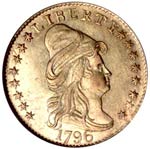
Reprinted with permission from A Buyer's Guide to United States Gold Coins.
Quarter eagles were first made in 1796. Production was intermittent from that time through the last year of the series, 1929.
Early quarter eagles of the 1796-1834 style are rarities in each instance, although none is impossibly rare. Over the years a number of specialists have put together one of each date and major variety. As a perusal of the Guide Book listings will indicate, the series is punctuated by a number of key issues. Collecting the early series can be accomplished in one of several ways. The most popular is by design types, a procedure which necessitates obtaining the following issues: 1796 Capped Bust to Right, no obverse stars; 1796-1807 Capped Bust to Right, with obverse stars; 1808 Capped Bust to Left, large size; and 1821-1834 Capped Head to Left. Of these types the 1796 without stars and the 1808 are the most elusive and expensive.
By 1834, the price of gold metal on the bullion market had risen to the point at which quarter eagles and other gold denominations could be melted down at a profit. As a result, most earlier mintages were destroyed. Although production figures of early quarter eagles were sufficiently low that the pieces would be scarce in any event, today the mintage figures tell only part of the story. The coins are even rarer than the low mintage figures suggest.
In 1834 the so-called Classic Head quarter eagle, of reduced weight, designed by William Kneass, appeared. The Classic Head style was produced from 1834 through 1839.
In 1840 the Coronet or Braided Hair quarter eagle appeared. This design, by Christian Gobrecht, was continued without interruption through the year 1907, the longest span in any American coinage series in which a major design was employed without substantial modification.
In 1908 a new design made its appearance: the innovative Indian Head motif by Bela Lyon Pratt. For the first time on an American coin, the designs were incuse on the coin, and the field or background of the coin, traditionally the lowest part of the design, was on this issue the highest. The Indian motif was produced from 1908 through 1915, then intermittently until 1929.
In terms of availability today, all pre-Classic Head quarters eagles, those minted from 1796 through 1834, are rare in any grade and are extremely rare in Uncirculated preservation.
Classic Head quarter eagles are scarce in higher grades and are rarities in Mint State. Particularly elusive are branch mint pieces.
Among Coronet or Braided Hair quarter eagles of the 1840-1907 type, a good rule of thumb is that issues from 1840 through the mid-1870s are available in worn grades in approximate proportion to their mintages. In Uncirculated grade nearly all are scarce, and many are extremely rare. The assembling of a complete set from 1840 onward, in MS-60 or better condition, is a practical impossibility.
For the astute buyer who takes time to study the series, there are many fantastic sleepers among earlier dates. Take, for example, the 1840 quarter eagle. The Guide Book suggests a price of $1,300 in MS-60 grade. One might think that, based upon this price, the coin would be more or less available. However, if you were to run advertisements in leading numismatic publications and offer to pay ten times that price, or $13,000, for each and every MS-60 or better 1840 quarter eagle offered to you, I would be surprised if you could buy even a single piece! Skeptical? There is no need to be. A glance at David Akers's study shows that over a long span of years studied, just two Uncirculated 1840 quarter eagles came on the market, one in the Bell Collection in 1944 and one in the Kern Collection in 1950! To that survey can be added a piece we handled at auction a few years ago. It is quite possible that no more than five or six Uncirculated 1840 quarter eagles exist, and I am not even sure that there are that many, for the pieces sold years ago might not grade MS-60 by today's standards.
Quarter eagles after the mid-1870s underwent a different distribution pattern. Shortly after the time of minting, many were exported in payment for international transactions, with the result that European and South American banks, among others, accumulated quantities of them. In addition, quarter eagles became popular holiday gifts. Thus, American citizens set pieces aside. Although the assembly of a set of Uncirculated Coronet type quarter eagles from, say, 1880 onward, through 1907, would be a challenge, the coins are available, and over a period of a year or two such a collection could be completed.
Let me turn your attention to the 1904 quarter eagle. The Guide Book suggests a price of $1,100 for an MS-60 example. This price is not much different from the $1,300 suggested for the 1840 quarter eagle. However, several thousand MS-60 or better 1904 quarter eagles exist. While an Uncirculated 1904 quarter eagle is highly desirable, in view of the widespread demand for such pieces in date and type collections, it can hardly be called a rarity. My point is that, by comparison, the 1840 quarter eagle has to be one of the great sleepers of the century.
Lest you think that I studied hard to pick out the single example of a sleeper, I hasten to add that many other examples could be cited as well. In MS-60 or finer grade, probably fewer than a dozen examples exist of such otherwise "common" quarter eagle varieties as 1847-0, 1848, 1849, etc. In his study, David Akers was able to locate just two Uncirculated 1860-S quarter eagles ever appearing on the market, and just a single 1861-S. The only 1861-S he was able to find came on the market in 1944, over 40 years ago! And yet the Guide Book lists the value of an 1861-S at just $1,200. One of my favorite sayings is and always has been, "Buy the book before the coin." By studying auction appearances of such coins as the 1861-S quarter eagle, and by reading specialized references on the series, you will learn what casual readers of the Guide Book don't know: that the 1861-S quarter eagle is so rare that if you could indeed buy one for $1,300 you could probably make a profit of $5,000 to $10,000 the next day!
Indian Head quarter eagles of the 1908-1929 type are mostly so-called common dates, except for the 1911-D issue, the lowest in the series, which is elusive in all grades. Modern grading interpretations, which are much stricter than those used a few years ago, are such that when Indian Head quarter eagles are re-evaluated using these new interpretations, a number of rarities emerge, even among the issues that are common in lower grades. For example, in MS-63 or finer grade, all issues from 1908 to 1915, the early range of the series, can be called rare, and in MS-65 condition they are extremely rare.
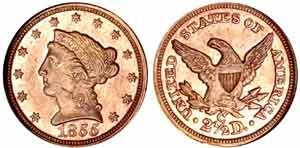
Coronet, or Braided Hair, Quarter Eagles were introduced in 1840.
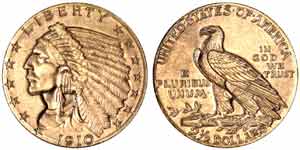
Coronet, or Braided Hair, Quarter Eagles were introduced in 1840.


 Copper & Nickel
 Silver Coins
 Gold Coins
 Commemoratives
 Others
 Bullion
 World
World
 Coin Market
 Auctions
 Coin Collecting
 PCGS News