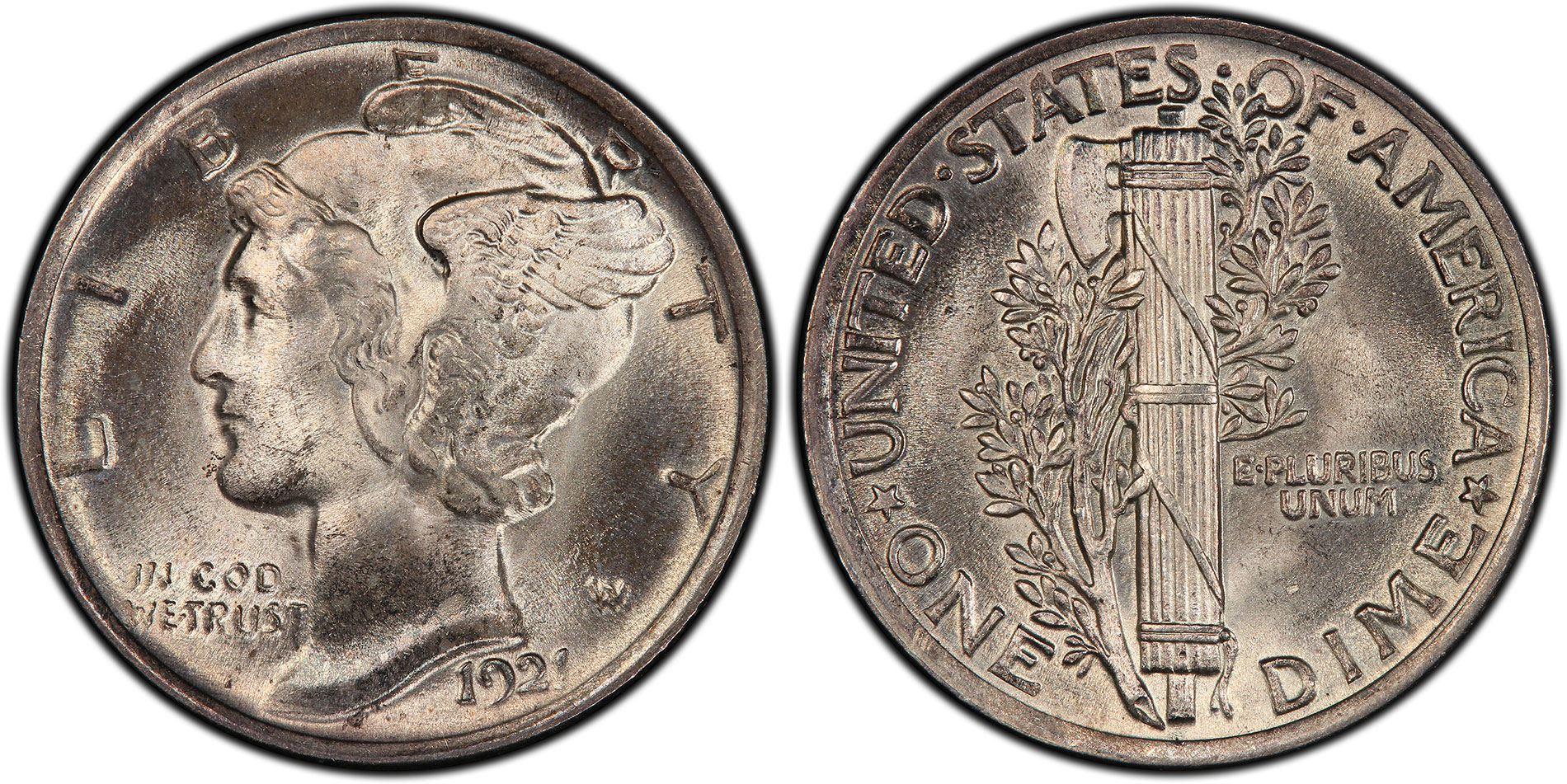
Mercury Dime, 1921 10C, PCGS MS64. Click image to enlarge.
Mercury Dime enthusiasts regard the famous 1916-D as the grail of the series, a key date coin on par with 20th-century rarities such as the iconic 1909-S VDB Lincoln Cent and 1916 Standing Liberty Quarter. And while the 1916-D Mercury Dime often steals the proverbial show, the ten-cent coin series that ran from 1916 through 1945 and was designed by Adolph A. Weinman also boasts several other collectible highlights, including the scarce issues struck in 1921.
Across the board, the coins of 1921 feature relatively low mintages; the exception to that is the Morgan Dollar, which was then in its final year of production and, due to a mandate requiring strong output for that coin, siphoned the mintages of the smaller silver coins. Another reason most 1921 United States coins are categorically scarce has much to do with a post-World War I recession that took hold of the country, greatly reducing the need for new coinage in commerce.
The U.S. Mint restricted the striking of Mercury Dimes to just the Philadelphia and Denver Mints in 1921, omitting Mercury Dimes from the production lineup at the San Francisco Mint and interrupting the usual “P-D-S” trio of coinage that was so common for the various coin series of the 1920s. All told, the United States Mint managed to produce fewer than 2.5 million dimes combined between the Philadelphia and Denver Mints that year, with just 1,230,000 struck at the former and 1,080,000 coming from the latter.
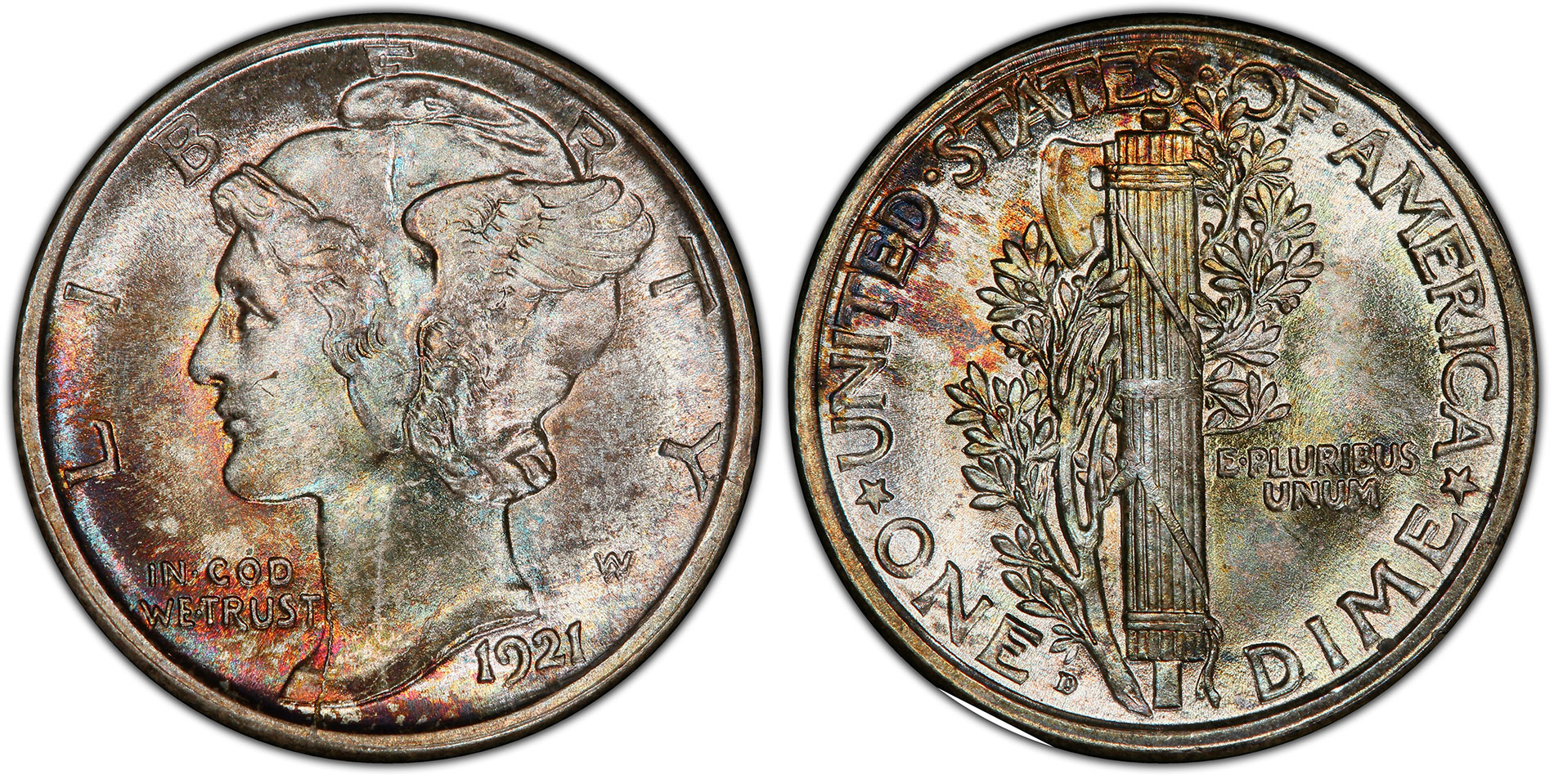
Mercury Dime, 1921-D 10C, PCGS MS67+. Click image to enlarge.
Those mintage figures represent a mere trickle as compared to the tens of millions of dimes that flowed out of the mints just prior to and after the recessive streak of the early 1920s. Making matters more difficult for collectors today is the overall availability factor for these two Mercury Dime issues. PCGS CoinFacts estimates there are roughly 2,500 survivors of the 1921 and only 4,000 or so for the 1921-D. Not many examples of either issue were saved, as these pieces entered circulation and prompted little notice from collectors of the time; these coins served as workhorse laborers on the economic scene to be sure.
In some respects, the 1921 and 1921-D Mercury Dimes can be somewhat tougher for collectors than the 1916-D, which saw by far the lowest circulation-strike mintage in the series but was also saved in much larger numbers early on due to it being both a first-year coin and a particularly low-mintage issue. The 1921 Mercury Dimes certainly serve as conditional rarities, with only about 550 extent examples in MS60 or above and just 125 or so estimated in MS65 or better; at least half offer Full Bands (FB) details, indicated by the complete horizontal lines across the banding of the fasces on the reverse of the coin. The 1921-D Mercury Dimes are also scarce in uncirculated grades, with about 800 in MS60 or better and 130 or so in MS65 or higher, more than half of these represented by FB examples.
Overall, the 1921 Mercury Dimes are much more affordable in circulated grades than their 1916-D key-date counterpart. While even well-circulated specimens of the 1916-D easily command around $1,000 and up, a collector can obtain the 1921 for around $50 in G4 and $450 in XF40. The 1921-D will set one back slightly more in those same grades, with prices of $75 and $550, respectively. Predictably, the uncirculated specimens cost way more, with a 1921 PCGS MS63 priced at $1,850 and the 1921-D at that same grade level taking $2,200.
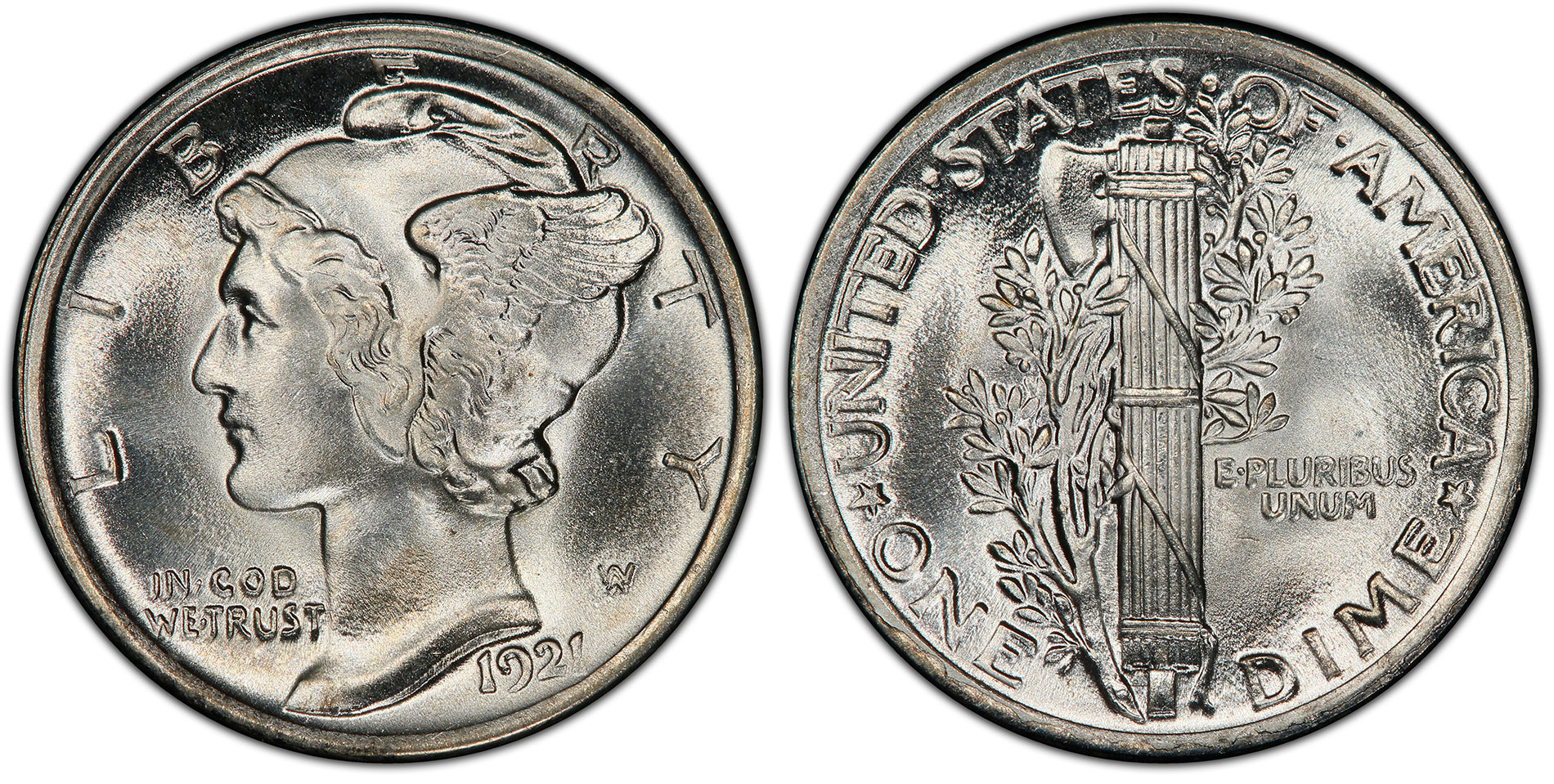
Mercury Dime, 1921 10C, FB, PCGS MS67FB. Click image to enlarge.
The coveted Full Bands specimens lure many a PCGS Set Registry member, and these pieces trade for a good bit more, too. A 1921 PCGS MS63FB retails for around $2,800 while a similar 1921-D can fetch $3,250, and PCGS-graded MS65FB Gems top those prices at $4,750 and $5,500. Above MS65FB, population numbers for these two coins go from thin to thinner. For the 1921, there are just about 50 PCGS pieces graded MS66FB and only four in the highest grade of PCGS MS67FB. The 1921-D offers only two dozen in PCGS MS66FB and but two in the top grade of PCGS MS67FB. It should be noted that the absolute top grade for the 1921-D is PCGS MS67+, while the best grade for a 1921 from the Philadelphia Mint without the FB designation is MS65.
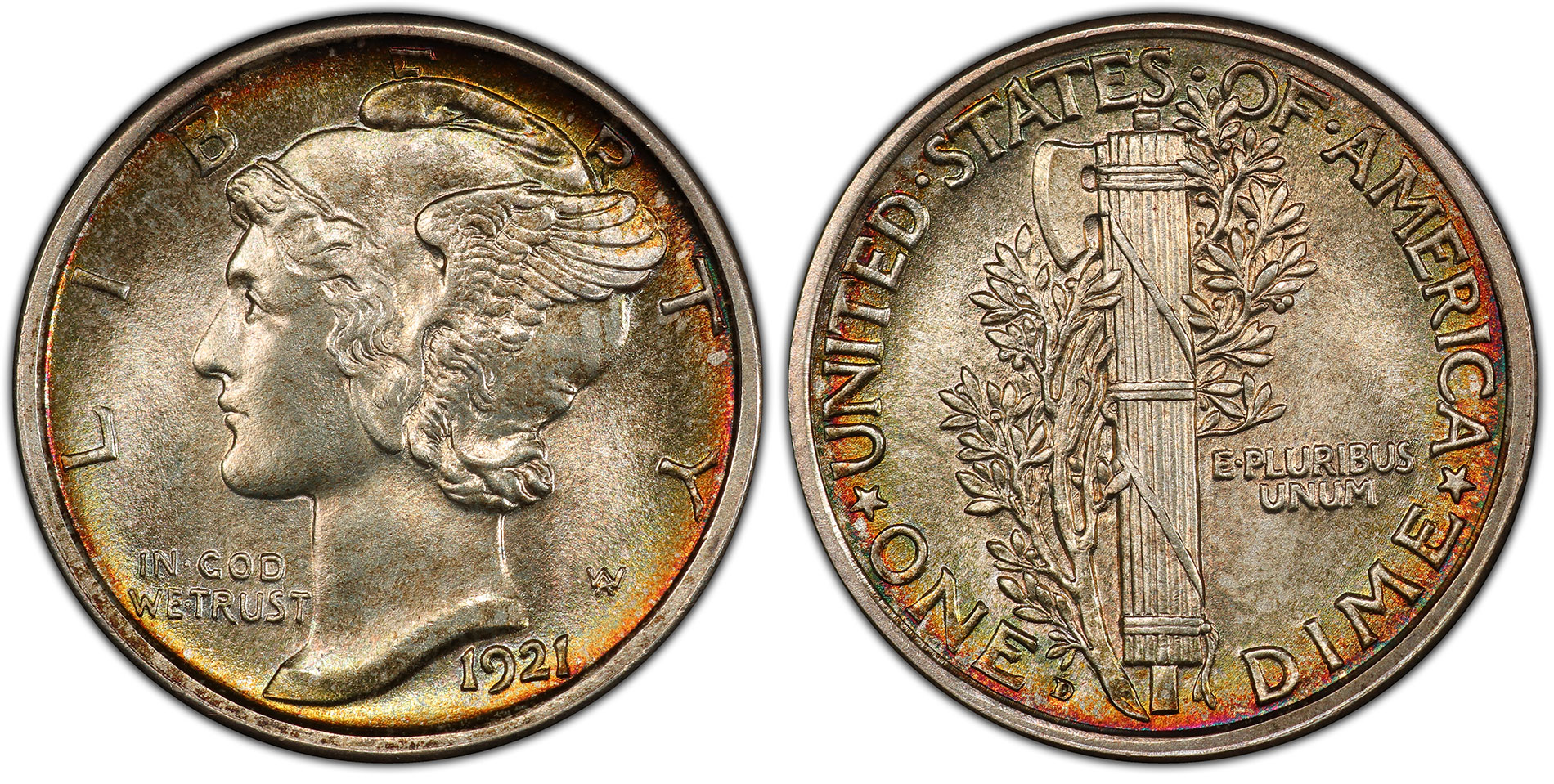
Mercury Dime, 1921-D 10C, FB, PCGS MS67FB. Click image to enlarge.
Not surprisingly, Mercury Dime collectors will often rather go for an FB example over one numerically equivalent (or even higher) in grade but lacking those critical reverse details. This preference for Full Bands specimens is reflected in the record prices achieved for 1921 Mercury Dimes. A 1921 PCGS MS67FB holds that issue’s record price of $32,200, the amount realized at a 2010 Heritage Auctions event. Meanwhile, a 1921-D graded PCGS MS66+FB commanded a stunning $50,400 in a 2019 Heritage Auctions offering.


 Copper & Nickel
 Silver Coins
 Gold Coins
 Commemoratives
 Others
 Bullion
 World
World
 Coin Market
 Auctions
 Coin Collecting
 PCGS News