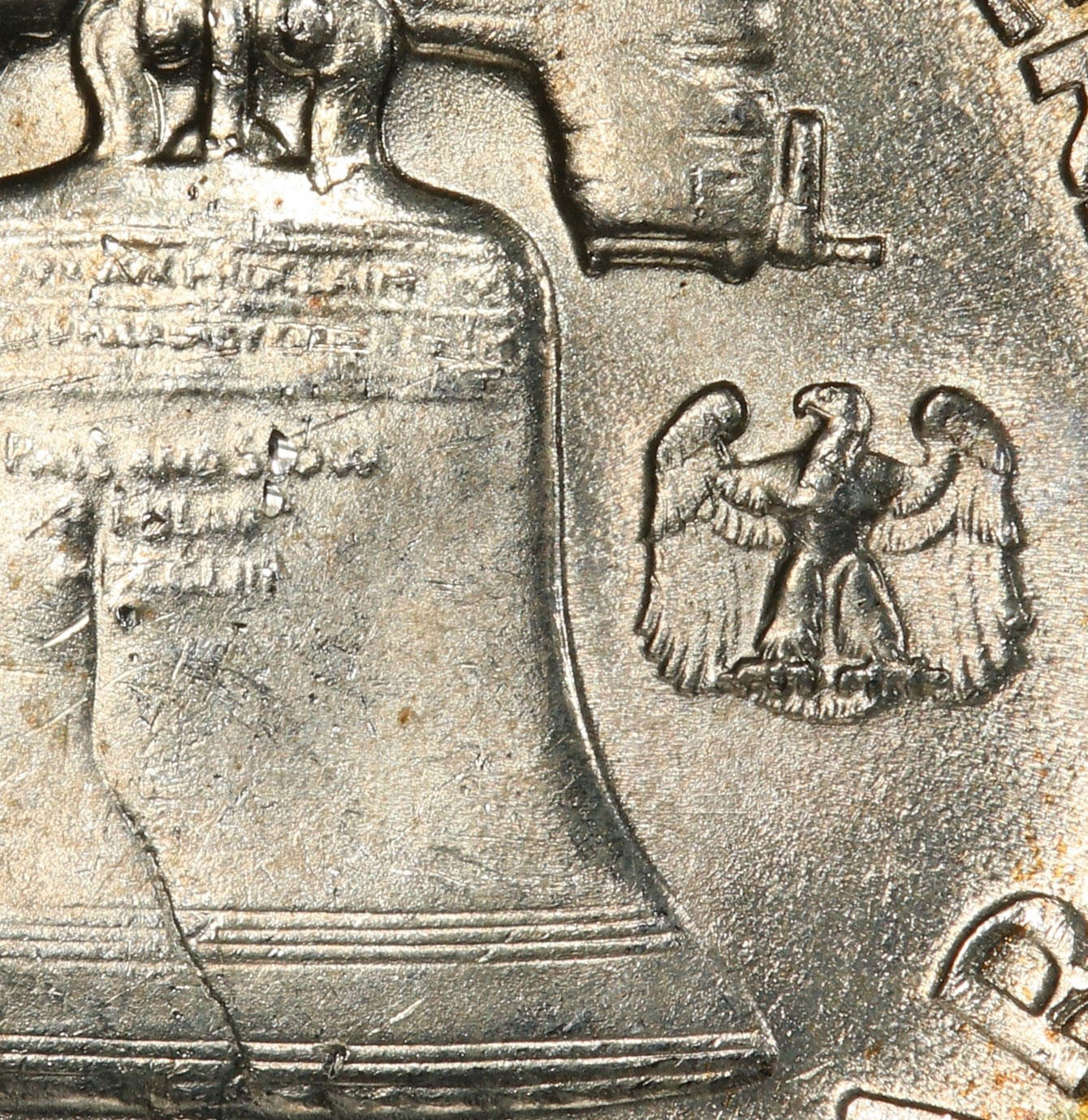
What’s up with the little eagle on the reverse of the Franklin Half Dollar? Click images to enlarge.
The Franklin Half Dollar, which was in production from 1948 through 1963, was the last series of circulating 90% silver United States coins to both debut and finish without transitioning to a copper-nickel clad format. As such, it remains highly popular with collectors today. Yet, at least one detail on the coin stands out as rather incongruous with the remainder of the design – a tiny, squarish eagle placed just to the right of a large rendition of the Liberty Bell.
Why is the eagle there? Why is it so small? And why does it share the coin with Franklin, a Founding Father who had a well-publicized dislike of eagles?
Philadelphia Story
The Franklin Half Dollar was the last coin designed by John R. Sinnock, a talented artist who served as the United States Mint’s chief engraver from 1925 until his death in 1947. Taking over the role from elder statesman George T. Morgan (of 19th-century Morgan Dollar fame) and succeeded by mid-century Engraver in Chief Gilroy Roberts (who worked on the Kennedy Half Dollar), it can be said that Sinnock served as a bridge between two very distinct and chronologically distant eras in United States Mint history.
By the time he had begun work on the Franklin Half Dollar, Sinnock had already worked on the 1926 Sesquicentennial Commemorative Half Dollar and, 20 years later, the Roosevelt Dime. Interestingly, the 1926 Sesquicentennial Half Dollar portrays a reverse depiction of the Liberty Bell, which cracked soon after it was cast in the 1750s and has long resided in Philadelphia as a landmark of freedom. Sinnock would resurrect his 1926 design of the Liberty Bell on the reverse of the Franklin Half Dollar, anchored by an obverse depiction of Benjamin Franklin – a Boston-born Founding Father who became inextricably linked to his adopted home of Philadelphia.
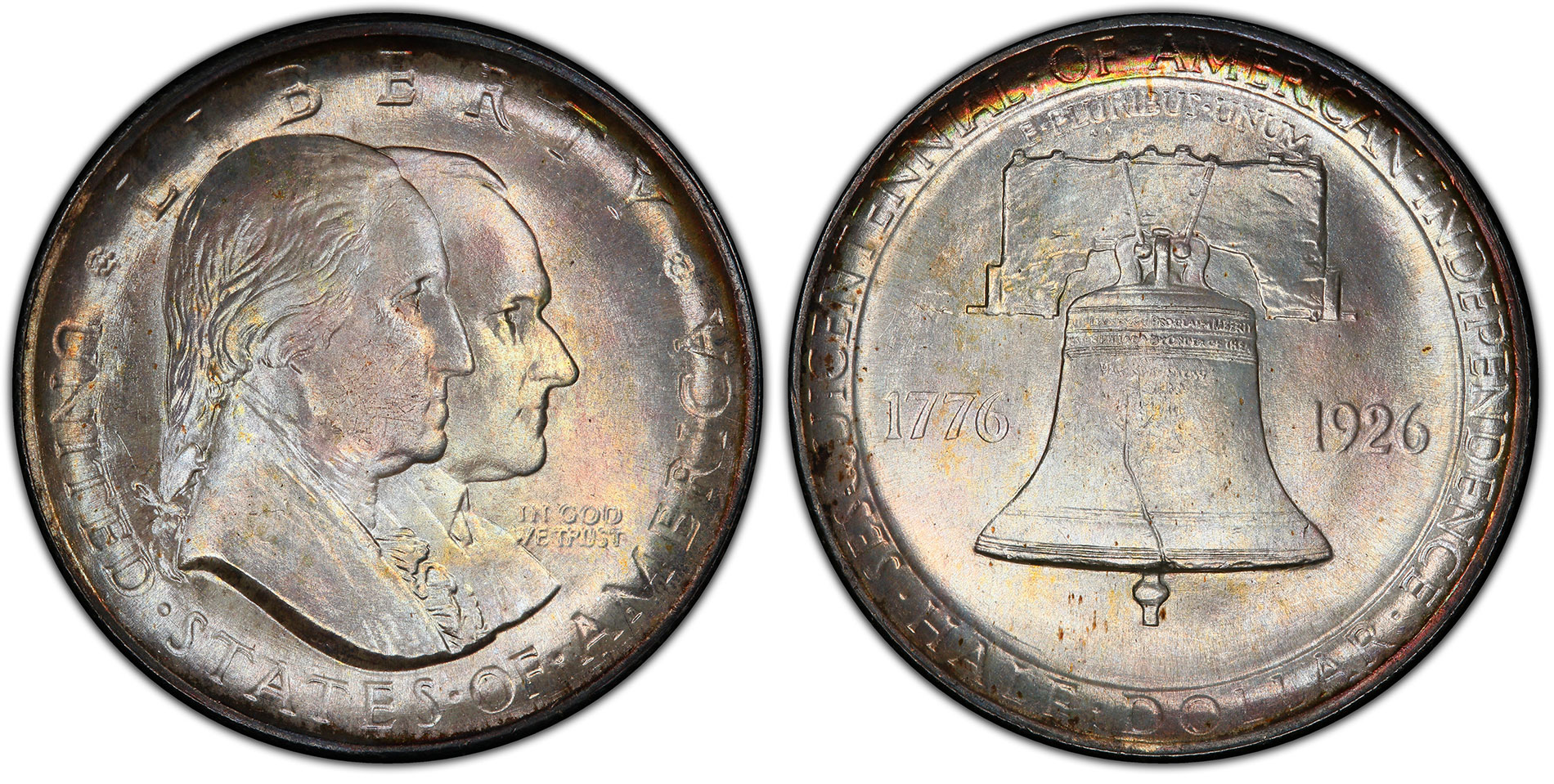
Silver Commemorative, 1926 50C Sesquicentennial, PCGS MS66+. Click images to enlarge.
Franklin was the quintessential renaissance man – he was a diplomat, postmaster, humorist, political philosopher, writer, and Freemason. However, he had a fervent distrust of bald eagles and advocated instead for the turkey to become the United States national bird. “For my own part, I wish the bald eagle had not been chosen as the representative of our country,” Franklin decried, suggesting that the eagle was “a bird of bad moral character” and “does not get his living honestly” because the bird is known to steal food from other animals.
So, perhaps Franklin would be rolling over in his Philadelphia grave – just steps from the Philadelphia Mint – if he knew the coin carrying his likeness was accompanied on a half dollar by the appearance of an eagle. It’s hard to say if Franklin’s opinion on the matter would have mellowed had he aged into his 200s, but even then he would have had little influence on whether or not the he’d share a numismatic canvas with the eagle beginning in the 1940s. Why? The law…
…The Law!
United States coinage law dictates that “United States coins shall have the inscription ‘IN GOD WE TRUST.’ The obverse side of each coin shall have the inscription ‘LIBERTY.’ The reverse side of each coin shall have the inscriptions ‘UNITED STATES OF AMERICA’ and ‘E PLURIBUS UNUM’ and a designation of the value of the coin. The design on the reverse side of the dollar, half dollar, and quarter dollar is an eagle.”
The Commish Gets Dissed
Along with his adaption of the 1926 Liberty Bell design from the Sesquicentennial Commemorative Half Dollar, Sinnock incorporated the little eagle on the reverse essentially as an afterthought to ensure the coin would meet legal requirements. Sadly, he never did get to see his Franklin Half Dollar go into production in 1948, as he passed away on May 14, 1947, at the age of 58. As preparations for the Franklin Half Dollar continued into the latter half of 1947, the Commission of Fine Arts provided their feedback on the new coin, and it wasn’t all rosy.
“The Commissioned recognized good workmanship in the head of Benjamin Franklin, as portrayed on the medal by the late Mr. Sinnock,” wrote Chairman of the Commission of Fine Arts Gilmore Clarke to United States Mint Director Nellie Tayloe Ross in a December 1, 1947 letter. “However, the Commission are not satisfied with the model of the reverse. The eagle shown on the model is so small as to be insignificant and hardly discernable when the model is reduced to the size of a coin.”
A little further reading of the Commission’s letter suggests the Liberty Bell’s cracks also weren’t very flattering. “The Commission hesitate to approve the Liberty Bell as shown with the crack in the bell visible; to show this might lead to puns and to statements derogatory to United States coinage.” While the United States Mint has long typically shown deference to the opinions of the Fine Art Commission, their approval wasn’t necessary for turning a numismatic design concept into a circulating coin. Ross and the United States Mint proceeded with Sinnock’s design anyway and the Franklin Half Dollar was initially released to the public in April 1948.
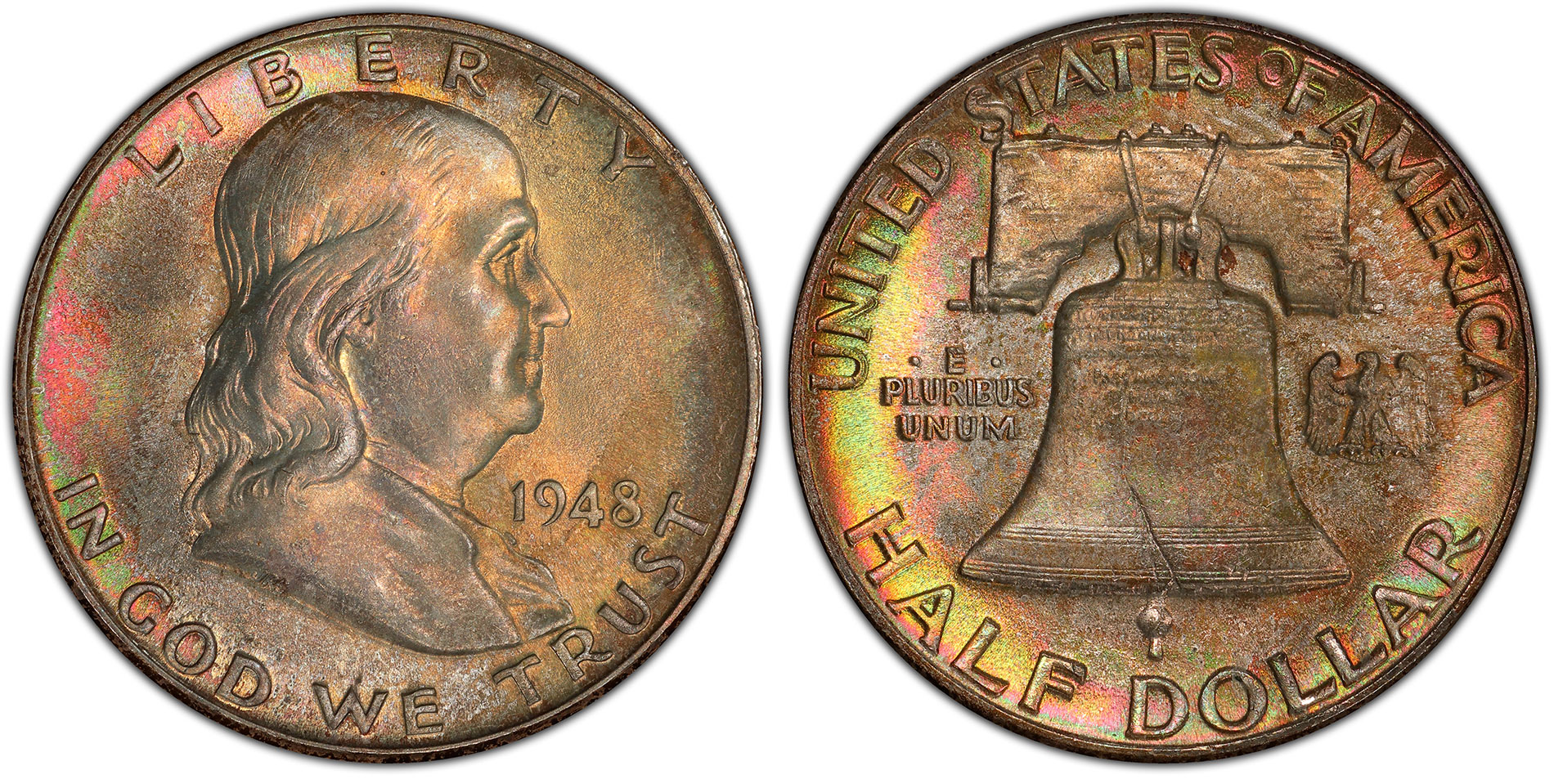
Franklin Half Dollar, 1948 50C, PCGS MS66. Click images to enlarge.
Production of the Franklin Half Dollar might have continued until the 1970s or even well beyond, given another coinage law stipulating designs can only be replaced without congressional approval 25 years after a coin design goes into use. But in a most tragic twist of fate for the world, that wasn’t to be. President John F. Kennedy was assassinated in Dallas, Texas, on November 22, 1963.
Within hours of his murder by a lone shooter at the age of 46, calls came far and wide for the young, slain president to be honored on a coin. By the end of 1963, Congress approved a redesign of the half dollar to include Kennedy on the obverse. The little eagle on the back of the Franklin Half Dollar was replaced by a much larger one in the form of the Presidential Seal, and the last Franklin halves rolled off the presses in 1963.
Sources
- Breen, Walter. Walter Breen’s Complete Encyclopedia of US and Colonial Coins. Doubleday, 1988.
- Klein, Christopher. “Did Benjamin Franklin Propose the Turkey as the National Symbol?” History. August 31, 2018. Accessed December 9, 2020.
- Taxay, Don. The U.S. Mint and Coinage. Arco, 1966.
- “31 U.S. Code S 5112 – Denominations, Specifications, and Design of Coins.” Legal Information Institute. Cornell University. Accessed December 10, 2020.


 Copper & Nickel
 Silver Coins
 Gold Coins
 Commemoratives
 Others
 Bullion
 World
World
 Coin Market
 Auctions
 Coin Collecting
 PCGS News